Rejoignez-nous pour un voyage dans le monde des livres!
Ajouter ce livre à l'électronique
Grey
Ecrivez un nouveau commentaire Default profile 50px
Grey
Abonnez-vous pour lire le livre complet ou lisez les premières pages gratuitement!
All characters reduced
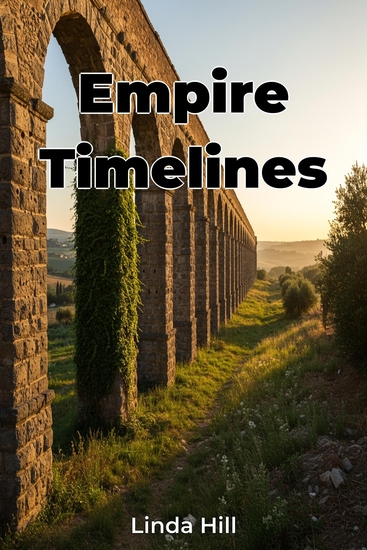
Empire Timelines - cover

Empire Timelines

Linda Hill

Traducteur A Ai

Maison d'édition: Publifye

  • 0
  • 0
  • 0

Synopsis

Empire Timelines explores the cyclical nature of empires, examining the political, economic, and military factors influencing their rise and fall throughout world history. The book argues that an empire's ability to adapt in these key areas is crucial for long-term survival. It highlights how political legitimacy, whether through popular support or other means, is vital for maintaining power, and how economic sustainability, driven by innovation and resource management, ensures an empire can support its ambitions. 

 
The book uses case studies of prominent empires like the Roman Empire, the Mongol Empire, and the British Empire to illustrate these dynamics. For example, the Mongol Empire's vast trade networks contributed significantly to its economic strength.

 
By focusing on adaptability, Empire Timelines offers a fresh perspective on imperial history, moving beyond simple narratives of rise and fall. Each chapter builds upon the previous one, culminating in a comparative analysis and insights applicable to contemporary global power structures.
Disponible depuis: 29/03/2025.
Longueur d'impression: 59 pages.

D'autres livres qui pourraient vous intéresser

  • Golden Horde The: A Captivating Guide to the European Appanage of the Mongol Empire That Was Ruled by the Descendants of Genghis Khan - cover

    Golden Horde The: A Captivating...

    Captivating History

    • 0
    • 0
    • 0
    Unveil the Epic History of the Golden Horde! 
    Journey back to the times of Genghis Khan and discover how he divided his empire into four parts, shaping the course of history. For over two centuries, the Golden Horde ruled a vast region, influencing lands from the Urals to Poland, from the taiga to the Caspian Sea. 
    Explore the Mysteries of the Eurasian Steppe 
    Learn why the Eurasian Steppe, stretching from the Danube to Manchuria, produced nomadic armies that threatened empires in Europe and China for three thousand years. 
    Unravel the Rise of Moscow 
    Understand how Kievan Rus’ dominated Russian lands while Moscow was just an outpost and how Moscow rose to power by aligning with the Mongols. 
    Discover Shocking Historical Events 
    See how a fight in Caffa led to the Black Death devastating Europe. Be surprised by Venice’s and Genoa’s involvement in the slave trade and its connection to the Golden Horde and Mamluk Egypt. 
    Here are just some of the things you will learn about in this audiobook:Why the Mongols executed the last Abbasid caliph by trampling him to death.The terror tactics of the Mongols, including the massacre of entire cities.Why European horses starved on the steppe while Mongol ponies thrived.The diverse trade items that traveled the Silk RoadHow medieval merchants navigated bureaucracy by bribing customs officials in Crimea. 
    To delve into these captivating stories and the profound impact of the Golden Horde, scroll up and click the “add to cart” button now!
    Voir livre
  • Broken - How Our Social Systems are Failing Us and How We Can Fix Them - cover

    Broken - How Our Social Systems...

    Paul LeBlanc

    • 0
    • 0
    • 0
    Many of the systems built to serve people instead do more harm than good. 


    In Broken, Dr. Paul LeBlanc, president of Southern New Hampshire University, draws on his experience working in one such system—education—to reconnect us to the human facets of serving people. In doing so, he charts a course for rebuilding and reinhabiting better systems across education, healthcare, criminal justice, government, and more. 


    The United States spends enormous sums on helping people—$3.8 trillion on healthcare, $182 billion on prisons, and $604 billion on higher education—and yet these systems routinely fail us. 


    When we seek to improve how they function, our efforts focus on policy debates, technical solutions, funding, and data. But if these systems are to truly improve, we have to start with the human values that fuel decision making. 


    Broken explores the deeply human dimensions we must consider—aspiring, discovering, mattering—if we want to rebuild the policies, technologies, processes, and, most importantly, the heart we use to serve people.
    Voir livre
  • The Qing Dynasty - The Last Imperial Dynasty - cover

    The Qing Dynasty - The Last...

    Jun Liu

    • 0
    • 0
    • 0
    The Qing Dynasty, the last imperial dynasty of China, was established in 1644 by the Manchu people, an ethnic group from the northeast of China. The rise of the Qing Dynasty was a result of a combination of military conquest, strategic alliances, and a deep understanding of Chinese traditions. The Manchus, initially a small tribe in what is today known as Manchuria, were able to capitalize on the weakening Ming Dynasty and internal strife within China. This chapter will explore how the Manchu rulers successfully expanded their power and established one of the longest and most influential dynasties in Chinese history. 
    The Manchu people, led by the ambitious and skilled leader Nurhaci, had been unified under his banner in the early 17th century. Nurhaci’s military campaigns in Manchuria helped create a strong foundation for what would later become the Qing Dynasty. After his death in 1626, his son, Hong Taiji, continued to build on his father’s legacy, consolidating power and forming alliances with various Chinese factions. Hong Taiji's strategic foresight helped prepare the Manchus for a successful invasion of China. In 1636, he formally declared the establishment of the Qing Dynasty, marking the official beginning of their imperial rule. 
    By the early 1640s, the Ming Dynasty was in a state of disarray. The empire was plagued by corruption, peasant uprisings, and economic instability. The most notable rebellion was the Li Zicheng-led peasant revolt, which culminated in the fall of the Ming capital, Beijing, in 1644. In this moment of vulnerability, the Manchus, under the leadership of Emperor Shunzhi, seized the opportunity to invade China. The Qing forces entered Beijing and effectively replaced the fallen Ming dynasty, marking the beginning of the Qing rule over China.
    Voir livre
  • The Viking Age - Raiders and Traders - cover

    The Viking Age - Raiders and...

    Harris Ropes

    • 0
    • 0
    • 0
    The story of the Vikings begins in the rugged, coastal lands of Scandinavia, where modern-day Norway, Sweden, and Denmark now stand. These northern regions, characterized by their cold climate, deep fjords, and dense forests, shaped a resilient and resourceful people. Isolated by geography and challenged by limited arable land, the early Norse communities developed a strong connection to nature, the sea, and their close-knit societies. Life in Scandinavia during the early Middle Ages was not easy, but it fostered a culture of survival, adaptability, and innovation. 
    At the heart of Viking society was a deep belief in their mythology and gods. Norse mythology offered a complex system of deities, heroes, and mythical creatures that guided the moral and spiritual lives of the people. Central figures like Odin, the wise All-Father; Thor, the thunder god and protector; and Freyja, the goddess of love and fertility, were not just worshipped but also deeply integrated into the everyday lives of the Norse. These myths were passed down through oral storytelling, poetic sagas, and ritual practices, helping to create a shared identity among the diverse Scandinavian tribes. 
    Viking society was organized into a hierarchical structure that valued strength, honor, and loyalty. At the top were the jarls, or chieftains, who held power over clans and led warriors into battle or on raids. Below them were the karls, the free farmers, craftsmen, and traders who formed the backbone of Viking communities. At the bottom were the thralls, or slaves, who were usually captured during raids or born into servitude. Despite this stratification, Viking culture emphasized personal achievement and reputation, allowing individuals to rise in status through bravery, skill, and loyalty.
    Voir livre
  • Literary Theory for Robots - How Computers Learned to Write - cover

    Literary Theory for Robots - How...

    Dennis Yi Tenen

    • 0
    • 0
    • 0
    Literary Theory for Robots reveals the hidden history of modern machine intelligence, taking listeners on a spellbinding journey from medieval Arabic philosophy to visions of a universal language, past Hollywood fiction factories, and missile defense systems trained on Russian folktales. In this provocative reflection on the shared pasts of literature and computer science, former Microsoft engineer and professor of comparative literature Dennis Yi Tenen provides crucial context for recent developments in AI, which holds important lessons for the future of humans living with smart technology. 


    Intelligence expressed through technology should not be mistaken for a magical genie, capable of self-directed thought or action. Rather, in highly original and effervescent prose with a generous dose of wit, Yi Tenen asks us to read past the artifice—to better perceive the mechanics of collaborative work. Something as simple as a spell-checker or a grammar-correction tool, embedded in every word-processor, represents the culmination of a shared human effort, spanning centuries. 


    With its masterful blend of history, technology, and philosophy, Yi Tenen's work ultimately urges us to view AI as a matter of labor history, celebrating the long-standing cooperation between authors and engineers.
    Voir livre
  • Civics Test The - 100 Questions & Answers for the Naturalization Test & US Citizenship - Study Guide with all 100 Official New Questions & Answers (Approved For 2024 2025 2026) - cover

    Civics Test The - 100 Questions...

    RTB Education

    • 0
    • 0
    • 0
    Did you know that you only get two chances to pass your naturalization test? 
    If you fail both attempts, you’ll have to start the whole process all over again – and you may not attain the U.S. Citizenship and life you’ve been dreaming of. 
    That’s why it’s so important that you pass the civics test, first time round. 
    In this audiobook, we’ve narrated the most recent 100 questions & answers to the civics test. You can be sure that these are up to date, so you can go into the oral test feeling confident about scoring more than 6 out of 10. 
    Examples of some of the 100 questions you’ll be asked include: 
    ·     How many amendments does the Constitution have? 
    ·     What are two rights in the Declaration of Independence? 
    ·     What is the economic system in the United States? 
    ·     How many U.S. Senators are there? 
    ·     Who vetoes bills? 
    ·     Name one of the two longest rivers in the United States. 
    ·     Name one U.S. territory. 
    ·     Why does the flag have 50 stars?  
    If you didn’t instantly know the right answer to each of these questions – it’s crucial that you improve your knowledge by purchasing our audiobook today and then listening to it as many times as you like. 
    The narration in our audiobook is of the highest quality, with a calm, clear, American voice. We’ve also left a 10 second gap after each question, to give you time to think about your answer – for the most efficient learning experience. 
    So, buy this audiobook now - and get one step closer to your U.S. Citizenship!
    Voir livre