Rejoignez-nous pour un voyage dans le monde des livres!
Ajouter ce livre à l'électronique
Grey
Ecrivez un nouveau commentaire Default profile 50px
Grey
Abonnez-vous pour lire le livre complet ou lisez les premières pages gratuitement!
All characters reduced
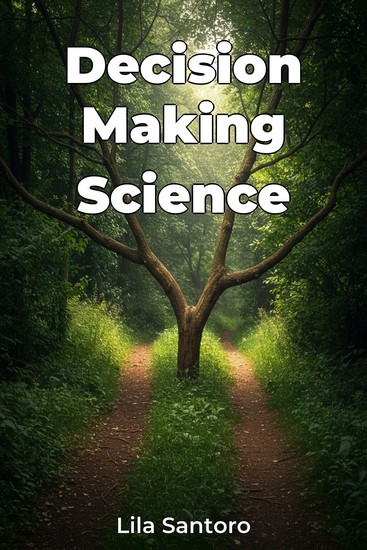
Decision Making Science - cover

Decision Making Science

Lila Santoro

Traducteur A AI

Maison d'édition: Publifye

  • 0
  • 0
  • 0

Synopsis

"Decision Making Science" explores the fascinating science behind our everyday choices, delving into the psychological factors and cognitive biases that subtly influence our judgments. This self-help psychology book helps readers understand the neuroscience of decision making and provides techniques to enhance decision-making skills for improved outcomes. For example, the book reveals how our brains are wired to make quick decisions, often relying on mental shortcuts that can lead to predictable errors.

 
The book uniquely combines rigorous scientific research from behavioral economics with practical, actionable advice, moving beyond anecdotal self-help to ground its recommendations in solid empirical evidence. It progresses systematically, starting with fundamental concepts of decision theory and neural pathways, then moves into cognitive biases like confirmation bias and loss aversion, and culminates in effective decision-making frameworks such as decision trees.

 
By understanding these principles, readers can strategically mitigate psychological factors and make better choices in personal finance, strategic business planning, and beyond.
Disponible depuis: 15/03/2025.
Longueur d'impression: 95 pages.

D'autres livres qui pourraient vous intéresser

  • My Blue Book of Grammar for Class 4 - cover

    My Blue Book of Grammar for Class 4

    Meigha Rawat

    • 0
    • 0
    • 0
    A Grammar Series That Uses the Functional Approach
    
    KEY FEATURES 
    - Functional approach to grammar teaching, using exemplars to illustrate the usage before defining the structure and rules
    - Vocabulary taught through language-in-use to build the learners’ vocabulary through use rather than memorisation of rules
    - Contemporary topics to inculcate 21-century skills amongst learners
    - Use of literature to help learners understand how grammar is used in text
    - A comprehension section comprising texts from different genres so that learners may relate grammar to different types of works produced in English
    - Phonics in Grades 1 and 2 to teach the very basis of language
    - Uniquely stylised illustrations
    - Activities such as puzzles, crosswords, word grids and games to aid the facilitator in using the concept of ‘flipped classroom’
    - Periodic tests to help the learners self-assess the acquisition of concepts
    - Digital component to cater to a technology-driven classroom
    
    DESCRIPTION: 
    My Blue Book of Grammar is a course that has been conceptualized and designed keeping in mind the increasingly dynamic role of the English language in today’s world. Especially in our country, where English serves as the lingua franca, a grammar course has to offer not only an exposition of the pedagogy but also the exhibition of the utility of that pedagogy. The aim of a grammar series should be to encourage the development of competency amongst learners, even though their proficiency levels may vary. While the level of exposure to English of all learners may be different, a grammar series should aid in the development of a certain level of confidence amongst the learners, with the end result being that they are able to converse without hesitation in English. 
    
    WHAT WILL YOU LEARN
    - Understand grammar concepts
    - Learn how to use different vocabulary concepts taught through language-in-use 
    - Learn 21-century skills 
    - Develop deeper understanding of and appreciation for literature
    - Have clearer pronunciation through a better understanding of phonics
    
    WHO THIS BOOK IS FOR: 
    School students of Grades 4
    
    TABLE OF CONTENTS
    GRAMMAR
    1. Subject and Predicate 
    2. Gerunds 
    3. Subject–Verb Agreement 
    4. Pronouns
    5. Past Continuous Form
    6. Prepositions 
    7. Future Continuous Form 
    8. Adjectives
    9. Conjunctions 
    10. Adverbs of Frequency 
    11. Punctuations and Use of Capitals 
    Test Paper 1 
    VOCABULARY
    12. Alphabetising Using the Third Letter of the Word 
    13. Suffix: -able 
    14. Suffixes: Using -able and -ible
    15. Prefixes: pre- and mis- 
    16. The Difference between will and be going to 
    17. The Difference between must and have got to
    18. Noun–Verb Collocations 
    19. Onomatopoeia 
    Test Paper 2 
    WRITING
    20. Writing a Paragraph 
    21. Writing a Biography 
    22. Formal Letter Writing 
    23. Writing an Email 
    24. Writing a Personal Email 
    25. Writing a Thank-You Letter 
    Test Paper 3 
    COMPREHENSION
    26. Meeting Mr Holmes – It’s Elementary! 
    27. Playing Pilgrims 
    28. The Ink and the Art 
    29. The Velveteen Rabbit 
    Orange Global Olympiad – English Sample Paper
    Voir livre
  • Carlist Wars The: The History and Legacy of the Spanish Civil Wars in the 19th Century - cover

    Carlist Wars The: The History...

    Editors Charles River

    • 0
    • 0
    • 0
    Thinking of Spain as a modern nation state today distorts the complicated reality that the Iberian Peninsula faced in the past. Spain was a nation in progress, consisting of regions united under the Spanish crown, but with strong regional identities based on different historical and cultural experiences. The largest entities were the kingdoms of León and Castile, but Spain also included the kingdoms of Navarre, Andalusia, Granada, Jaén, Aragon, and Valencia. There were also the principalities of Asturias and Catalonia, the lordship of Vizcaya, and both Guipúzcoa and Alava were “exempted provinces.” Navarre, Aragon, and Catalonia had separate Cortes, which were versions of parliaments (Parker 18-19). This complex system of entities granted privilege to local power structures over the concept of a unified nation and made administration difficult, because there were few standards that applied to all of Spain. Many of the regions had special laws that respected and allowed traditional institutions, administrative patterns, and cultural patterns. These local and regional rights were called fueros and were fiercely defended against centralization. The fueros originated as rights agreed to when the regions joined the Spanish crown. Before becoming king, the king-designate had to swear to maintain and respect the fueros. This meant that the rights of the king were to a considerable extent limited. 
    Inevitably, liberals and centralizing monarchs alike tried to change the situation over the years, which produced political tensions. The Carlists promised to maintain the older system, which is why they were so firmly backed in the Basque regions by most of the peasants and nobility. The Carlist claimants were strong Catholics and were strongly supported by the Church, and thus by the more fervently Catholic portions of the population. 
    Voir livre
  • Broken to Brave - Your Courageous Act of Healing After Intimate Betrayal - cover

    Broken to Brave - Your...

    Tammy Gustafson

    • 0
    • 0
    • 0
    How Do You Pick Up the Pieces After Intimate Betrayal? 
    · Learn how to heal your heart, reclaim your self-worth, and move forward with strength 
    · Addresses healing from all forms of infidelity, from adultery to emotional affairs to pornography 
    · Empowers you to embrace beauty, joy, and adventure again 
     
     
    Intimate betrayal shatters you. Everything you thought was true suddenly seems like a lie. It feels like you are falling through a black hole, unsure if it's possible to get to the other side. But there is a way through. It is possible to heal, grow stronger, and reclaim yourself. 
     
    With deep compassion and expert advice, this book helps you 
    · identify where you are in the healing journey 
    · avoid getting stuck in the process 
    · move forward with strength, courage, and deeper self-worth 
    · navigate decisions about your relationship 
     
    Broken to Brave offers the guidance, encouragement, and empowerment you need to pick up the pieces of your life and create a brave, beautiful future--whether the relationship makes it or not.
    Voir livre
  • The Great Refusal - A New Vision of Resistance - cover

    The Great Refusal - A New Vision...

    Casey Gerald

    • 0
    • 0
    • 0
    In the tradition of Ta-Nehisi Coates’ Between the World and Me, bell hook’s All About Love, and even James Baldwin’s The Fire Next Time, comes a groundbreaking blend of personal and political commentary from acclaimed memoirist Casey Gerald, offering an iconoclastic reframe of resistance and rebellion to meet the current moment and remake the world on our terms. In 2019, 400 years after the first Africans were stolen and brought to American shores for enslavement, Casey Gerald made a bold and controversial proclamation on national television: “We’ve been given strategies to make it in this country, to endure this land… but there’s another very important tradition that each person has the right and opportunity and perhaps, at this very urgent moment, the responsibility to reclaim, and that is the strategy of flight, of escape.” His interviewer, Michel Martin, asked, “Where are we going?”The Great Refusal is the answer to Martin’s apt question. In a short yet powerful volume, Gerald maps the path forward, calling on the works of Black luminaries, writers, and activists, as well as his own experience stepping back from the limelight and reassessing our current strategies of resistance and endurance. He implores us to tend to our inner resources and restrengthen our own worlds. Much resistance, he argues, is an inherent dialogue with the oppressor, playing on their battlefield, a defense to their offensive. (He is a former football star, after all.) Now, again, we find ourselves on the shorelines of destruction. The strategies we’ve been taught – assimilation, respectability politics, meritocracy – are stalling out or degrading us further. What would rebellion look like if we stepped out of this cycle and imagined a different world, one on our terms? Marginalized Americans are in a gridlock fight for dignity in a system that is hellbent on never granting it. It’s time we understood our power, our peace, and our needs, and built them on our own instead of begging for scraps. Gerald offer’s a way — one that saved him, just as it once saved his forebears: the great refusal.
    Voir livre
  • Viracocha: The History and Legacy of the Inca’s Creator God - cover

    Viracocha: The History and...

    Editors Charles River

    • 0
    • 0
    • 0
    Although the Inca’s oral traditions suggested that the history of the region began with their empire, the various gods and the religious ceremonies of the peoples that inhabited the Inca’s lands before their arrival were assimilated into the Inca Empire and were incorporated into Inca religion. However, under Inca rule, all those gods were to be subordinate to those gods of the Incas themselves, so as to ensure that imperial authority was clear and without dispute among all quarters of the empire.  
    	Viracocha was the primary god in the Inca pantheon as the origin and creator of all things. His son, the god Inti, or the Sun, was married to Mama Quilla, the Moon, who was also created by Viracocha. According to one myth, Inti was the father of Manco Cápac, the founder of the Inca ruling dynasty, but it was believed by some that Viracocha himself fathered Manco Cápac. In practice, the Inca centered their religious worship on Inti, and this god's High Priest was the second most important person in Inca society. The god Inti was honored at an annual celebration held each June, and the Inti Raymi festival included sacrifices, feasts and sexual abstinence. This cosmology was imposed throughout the empire, and temples to the Sun were constructed and staffed by religious officials who were allotted farmland called “lands of the Sun.” Other local cults were provided with produce from these lands as well.  
    	The main temple of Inca religion was the Coricancha or Sun Temple in Cuzco, in which was kept the great golden disk of the Sun. The disk was appropriated by the Spanish in 1571 and sent off to the Pope. While it has disappeared, perhaps lost somewhere during the tortuous route to Spain, it remains alive in the fabulous world of adventure story writers, New Age mystics and manufacturers of souvenirs. It became a major element in the iconography of the 19th century independence movement in South America.
    Voir livre
  • Mississippian Culture The: The History and Legacy of the Ancient Indigenous Culture in North America - cover

    Mississippian Culture The: The...

    Editors Charles River

    • 0
    • 0
    • 0
    When most people think of “ancient American civilizations,” the Aztec, Maya, or Inca cultures probably come to mind immediately, because the societies in Mesoamerica have left behind permanent structures for millions of visitors from around the world to see each year. At the same time, however, from about 1000-1500 CE, an equally complex culture formed along the banks of the Mississippi, Missouri, and Ohio Rivers. From Red Wing, Minnesota to Greenhouse, Louisiana, and from Spiro, Oklahoma to Macon, Georgia, societies built impressive mound structures that served as ritual platforms, burial sites, and residences for the elites. These mounds also served as the focal points of urban areas of varying sizes that were connected to each other through trade and ideology, forming a culture that modern historians have since designated the “Mississippian culture.”  
    	It has only been recently that modern archaeological, anthropological, and historical methods were utilized to create a somewhat accurate image of the Mississippian culture’s reach and importance in the wider contexts of American and world history. Today, historians have a much better understanding of many aspects of Mississippian culture, including its chronology, the religion of the people, urbanization, and how the people lived, and the fact that there were fully functioning complex societies that had sophisticated forms of government and long-distance trade networks. 	The mounds they made, which continue to serve as standing testaments to their extraordinary accomplishments, continue to be studied by experts who still have plenty of questions about the societies that produced them. But one thing’s for sure: with no evidence of a written language and a high probability that the groups spoke different languages (based on the earliest lingual patterns encountered from each region), what the Mississippian culture accomplished in the span of a few centuries is nothing short of phenomenal. 
    Voir livre