Rejoignez-nous pour un voyage dans le monde des livres!
Ajouter ce livre à l'électronique
Grey
Ecrivez un nouveau commentaire Default profile 50px
Grey
Abonnez-vous pour lire le livre complet ou lisez les premières pages gratuitement!
All characters reduced
Mental Health Rise - cover

Mental Health Rise

Liam Brown

Traducteur A AI

Maison d'édition: Publifye

  • 0
  • 0
  • 0

Synopsis

Mental Health Rise explores the concerning surge in anxiety and depression among young people globally. It examines contributing factors like academic pressures and the pervasive influence of social media. For example, the book presents data revealing how constant social comparison online impacts self-esteem, a key aspect of adolescent mental health. Readers will gain insights into the evolving landscape of mental health disorders and effective intervention strategies.

 
The book uniquely integrates research with real-world examples and personal accounts. It delves into societal pressures, technological advancements, and biological factors, offering a comprehensive analysis.

 
The book progresses from defining the scope of the problem to exploring the impact of academic stress, social media, and lifestyle habits, culminating in practical strategies for individuals and policymakers.

 
This book is a valuable resource for parents, educators, and young people seeking to understand and address the mental health rise. It highlights the need for a holistic approach, emphasizing prevention, early intervention, and accessible treatment options for mental health disorders. The content is presented accessibly, avoiding jargon and providing a balanced perspective on the challenges and opportunities in today's society.
Disponible depuis: 22/02/2025.
Longueur d'impression: 103 pages.
D'autres livres qui pourraient vous intéresser

  • Job Interview Preparation - A Practical Strategies Guide with Questions and Answers Interviewing Tips and Techniques for Success How to Be More Confident Overcome Anxiety Get Any Job You Want - cover

    Job Interview Preparation - A...

    Ted Barton

    • 0
    • 0
    • 0
    Are you a desperate job seeker who’s being invited to interviews but never getting the job? 
    Do you wish to get your dream job? 
    Would you like to have a book that tells you exactly what to do? 
    If you want to know all the secrets to the perfect interview, and know what to do and how to behave during the interview in order to get any job you desire then keep reading! 
    What you need is a solid strategy for your job interview, and this book is perfect to help anyone gain an advantage during the toughest part of the process, the dreaded job interview: you'll find everything you need to successfully interview for the jobs you want. 
    If you follow all the steps and advice in this book you will not only be the best candidate in the room but you will also be able to finally choose a job you like and not just settle for the only one available. 
    In this book you will learn:The most important mistake that job candidates make in the interview – and how to avoid it!The most frequent questions selected from thousands of interviewsThe exact process of the interview and how it worksHow to prepare before an interview and make a first good impressionAll the different types of interview questions How to overcome stress and anxietyNegotiation Strategies to get your dream job101 Valuable Tips from HR Experts…and much, much more! 
    Even if you have never experienced a job interview, even if you have tried hundreds of times and failed, even if you think you will never be able to get the job you love, this audiobook will take you to the next level and you will find that getting a job couldn't be easier. 
    Are you ready to become the best candidate for your dream job? 
    Scroll up, click on the "Buy Now" Button, and Get Your Copy Now!
    Voir livre
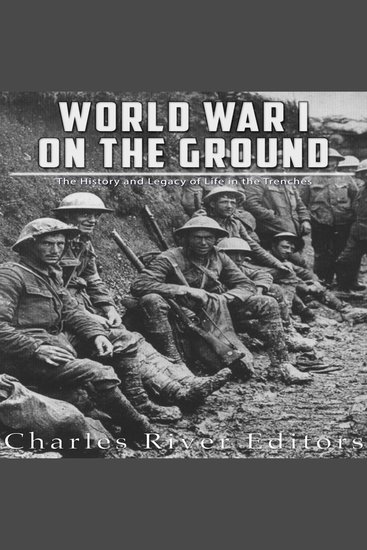
  • World War I on the Ground: The History and Legacy of Life in the Trenches - cover

    World War I on the Ground: The...

    Editors Charles River

    • 0
    • 0
    • 0
    World War I, also known in its time as the “Great War” or the “War to End all Wars”, was an unprecedented holocaust in terms of its sheer scale. Fought by men who hailed from all corners of the globe, it saw millions of soldiers do battle in brutal assaults of attrition which dragged on for months with little to no respite. Tens of millions of artillery shells and untold hundreds of millions of rifle and machine gun bullets were fired in a conflict that demonstrated man’s capacity to kill each other on a heretofore unprecedented scale, and as always, such a war brought about technological innovation at a rate that made the boom of the Industrial Revolution seem stagnant. 
    The enduring image of World War I is of men stuck in muddy trenches, and of vast armies deadlocked in a fight neither could win. It was a war of barbed wire, poison gas, and horrific losses as officers led their troops on mass charges across No Man’s Land and into a hail of bullets. While these impressions are all too true, they hide the fact that trench warfare was dynamic and constantly evolving throughout the war as all armies struggled to find a way to break through the opposing lines. 
    There was another war going on beneath the trenches, a war of tunnels and mines fought by men who didn’t see sunlight for days at a time and who lived in constant fear of cave-ins and enemy detection. These men, who had mostly been miners in civilian life, lived a twilight existence, working long hours in silence and near darkness while great battles raged overhead. They suffered from fatigue, stress, and the knowledge that they could be killed at any time by an unseen enemy. Despite this, they persevered, and the mines they laid under enemy trench systems turned the tide of at least one major battle.
    Voir livre
  • Anatolia and the Bronze Age: The History of the Earliest Kingdoms and Cities that Dominated the Region - cover

    Anatolia and the Bronze Age: The...

    Editors Charles River

    • 0
    • 0
    • 0
    While the Bronze Age is recognized as one of history’s most important phases, it’s been hard for historians to precisely date. The idea of the Bronze Age comes from a three-age system developed in the 19th century through which archaeologists and historians believe cultures evolve. These three ages are the Stone Age, the Bronze Age, and the Iron Age, and the concept of the system stems from the simultaneous development of museums in Europe during that time. In the Royal Museum of Nordic Antiquities in Denmark, Christian Jürgensen Thomsen, the director of the museum, began classifying objects of stone, bronze, or iron to better categorize and exhibit them. Each archaeological artifact was thus sorted according to their materials and further organized by shape and style. Through such methodology, working alongside archaeological reports, he was able to show how certain objects changed over time. 
    	During the Late Bronze Age, from about 1500-1200 BCE, the Near East was a time and place where great kingdoms and empires vied for land and influence, playing high stakes diplomatic games, trading, and occasionally going to war with each other in the process. The Egyptians, Hittites, Babylonians, Assyrians, and several smaller Canaanite kingdoms were all part of this system, which was one of the first true “global” systems in world history and also one of the most materially prosperous eras in antiquity. The major kingdoms are well-known to most people, but among them were powerful neighbors, many of whom have been mostly overlooked.  
    The transition from the Bronze to the Iron Age during the late 13th and early 12th centuries BCE arguably changed the structure and course of world history more fundamentally than any period before or since, and at the center of this period of turmoil was a group of people known today as the Sea Peoples, the English translation of the name given to them by the Egyptians.
    Voir livre
  • Unwanted Advances - Sexual Paranoia Comes to Campus - cover

    Unwanted Advances - Sexual...

    Anonyme

    • 0
    • 0
    • 0
    From a highly regarded feminist cultural critic and professor comes a polemic arguing that the stifling sense of sexual danger sweeping American campuses doesn’t empower women, it impedes the fight for gender equality. 
    Feminism is broken, argues Laura Kipnis, if anyone thinks the sexual hysteria overtaking American campuses is a sign of gender progress.  
    A committed feminist, Kipnis was surprised to find herself the object of a protest march by student activists at her university for writing an essay about sexual paranoia on campus. Next she was brought up on Title IX complaints for creating a ""hostile environment."" Defying confidentiality strictures, she wrote a whistleblowing essay about the ensuing seventy-two-day investigation, which propelled her to the center of national debates over free speech, ""safe spaces,"" and the vast federal overreach of Title IX. 
    In the process she uncovered an astonishing netherworld of accused professors and students, campus witch hunts, rigged investigations, and Title IX officers run amuck. Drawing on interviews and internal documents, Unwanted Advances demonstrates the chilling effect of this new sexual McCarthyism on intellectual freedom. Without minimizing the seriousness of campus assault, Kipnis argues for more honesty about the sexual realities and ambivalences hidden behind the notion of ""rape culture."" Instead, regulation is replacing education, and women’s hard-won right to be treated as consenting adults is being repealed by well-meaning bureaucrats. 
    Unwanted Advances is a risk-taking, often darkly funny interrogation of feminist paternalism, the covert sexual conservatism of hook-up culture, and the institutionalized backlash of holding men alone responsible for mutually drunken sex. It’s not just compulsively readable, it will change the national conversation.
    Voir livre
  • A Rare Recording of President John F Kennedy’s "We Choose To Go To The Moon" Speech - cover

    A Rare Recording of President...

    President John F. Kennedy

    • 0
    • 0
    • 0
    "We choose to go to the Moon", officially titled the Address at Rice University on the Nation's Space Effort, is a September 12, 1962, speech by United States President John F. Kennedy to bolster public support for his proposal to land a man on the Moon before 1970. Kennedy gave the speech, largely written by presidential advisor and speechwriter Ted Sorensen, to a large crowd at Rice University Stadium in Houston, Texas. 
     
    President John Fitzgerald Kennedy (May 29, 1917 - November 22, 1963), often referred to by his initials JFK, was an American politician who served as the 35th president of the United States from 1961 until his assassination in 1963. He was the youngest person to assume the presidency by election and the youngest president at the end of his tenure. Kennedy served at the climax of the Cold War, and the majority of his foreign policy concerned relations with the Soviet Union and Cuba. A Democrat, Kennedy represented Massachusetts in both houses of the U.S. Congress prior to his presidency.
    Voir livre
  • Traditions of the North American Indians - cover

    Traditions of the North American...

    James Athearn Jones

    • 0
    • 0
    • 0
    The first of three volumes of collected Native American folktales or oral traditions.Born in Massachusetts in 1790, James Athearn Jones grew up with Native American culture all around him. His childhood nursemaid was from the Gay Head tribe, and his household was frequented by other local Indigenous people of all ages. He enjoyed hearing their folktales. As an adult, he traveled the continent and sought to preserve and collect these stories in a book. In this first of three volumes, Jones shares eighteen captivating folktales from the North American Indians he encountered in his life. Discover such stories as “The Man of Ashes,” “Pomatare, the Flying Beaver,” and “The Resurrection of the Bison.” This enriching and enlightening collection serves as a fascinating means to explore some of the history and culture of Native Americans.
    Voir livre