Begleiten Sie uns auf eine literarische Weltreise!
Buch zum Bücherregal hinzufügen
Grey
Einen neuen Kommentar schreiben Default profile 50px
Grey
Jetzt das ganze Buch im Abo oder die ersten Seiten gratis lesen!
All characters reduced
Vanishing Landmarks: The Trend Toward Bolshevism - Exploring the Impact of Social Change and Ideology in History - cover

Vanishing Landmarks: The Trend Toward Bolshevism - Exploring the Impact of Social Change and Ideology in History

Leslie M. Shaw

Verlag: Good Press

  • 0
  • 0
  • 0

Beschreibung

In "Vanishing Landmarks: The Trend Toward Bolshevism," Leslie M. Shaw meticulously examines the socio-political landscape leading to the rise of Bolshevism, drawing parallels between historical events and contemporary socio-political movements. Shaw's literary style merges rigorous historical analysis with poignant narrative techniques, rendering complex ideological debates accessible to a broad readership. Through a critical lens, this book situates Bolshevism within a wider context of upheaval, exploring its implications on identity, governance, and societal structure in an increasingly globalized world. Leslie M. Shaw, a prominent scholar in political theory and history, draws on a wealth of experience from both academia and activism. Her journey through various socio-political environments has afforded her a unique perspective on the persistent allure of radical ideologies. Shaw's previous works have established her as a thought leader, and her deep-seated interest in the intersection of history and ideology shines through in this compelling analysis, reflecting her commitment to demystifying complex socio-political phenomena. I highly recommend "Vanishing Landmarks" to readers interested in the evolution of political thought and its lingering impact on modern society. Shaw's insights are not only timely but also crucial for understanding how historical trajectories influence current ideological trends. This book is an indispensable resource for students, academics, and anyone keen to grapple with the forces shaping our world.
Verfügbar seit: 12.10.2023.
Drucklänge: 121 Seiten.

Weitere Bücher, die Sie mögen werden

  • How to Abolish Prisons - Lessons from the Movement against Imprisonment - cover

    How to Abolish Prisons - Lessons...

    Rachel Herzing, Justin Piché,...

    • 0
    • 0
    • 0
    Critics of abolition sometimes castigate the movement for its utopianism, but in How to Abolish Prisons, long-time organizers Rachel Herzing and Justin Piché reveal a movement that has made the struggle for abolition as real as the institutions they are fighting against. 


    Drawing on extensive interviews with abolitionist crews all over North America, Herzing and Piché provide a collective reconstruction of what the grassroots movement to abolish prisons actually is, what initiatives it has launched, how it organizes itself, and how its protagonists build the day-to-day practice of politics. Listeners sit in on the Winnipeg rideshares of Bar None and the meetings of the Chicago Community Bail Fund as they assess the utility of politicized mutual aid. They follow the campaigns and coalitions of Critical Resistance in Oakland and San Francisco and Survived and Punished in New York City, and learn about the prisoner correspondence projects that keep activists behind bars and outside them in constant coordination. 


    Abolitionist campaigns are constructing on-the-ground initiatives across North America to deconstruct carceral society and build resistant communities. Through the words, deeds, and personalities of this beautifully peopled movement, How to Abolish Prisons emerges as a stunning snapshot of a movement's thinking in motion.
    Zum Buch
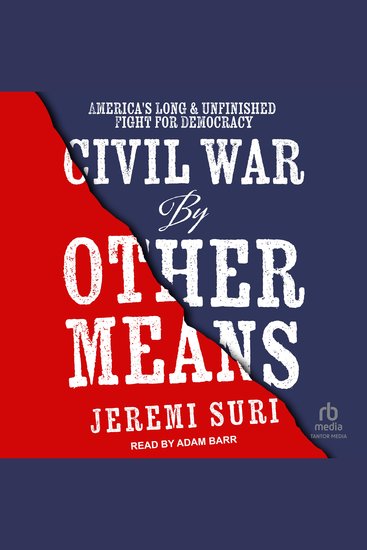
  • Civil War by Other Means - America's Long and Unfinished Fight for Democracy - cover

    Civil War by Other Means -...

    Jeremi Suri

    • 0
    • 0
    • 0
    In 1865, the Confederacy was comprehensively defeated, its economy shattered, its leaders in exile or in jail. Yet in the years that followed, Lincoln's vision of a genuinely united country never took root. Apart from a few brief months, when the presence of the Union army in the South proved liberating for newly freed Black Americans, the military victory was squandered. Old white supremacist efforts returned, more ferocious than before. 


    In Civil War by Other Means, Jeremi Suri shows how resistance to a more equal Union began immediately. From the first postwar riots to the return of Confederate exiles, to the impeachment of Andrew Johnson, to the highly contested and consequential election of 1876, Suri explores the conflicts and questions Americans wrestled with as competing visions of democracy, race, and freedom came to a vicious breaking point. 


    What emerges is a vivid and at times unsettling portrait of a country striving to rebuild itself, but unable to compromise on or adhere to the most basic democratic tenets. What should have been a moment of national renewal was ultimately wasted, with reverberations still felt today. The recent shocks to American democracy are rooted in this forgotten, urgent history.
    Zum Buch
  • A Better Nation - The Challenges of Scottish Independence - cover

    A Better Nation - The Challenges...

    Simon Barrow, Gerry Hassan

    • 0
    • 0
    • 0
    ­­­As the battle of words over the future of Scotland as a democracy, nation and society continues, A Better Nation: The Challenges of Scottish Independence aims to go beyond the superficial divisions and media noise in order to address matters of real substance. Drawing on a range of original thinkers from a wide range of backgrounds, it tackles key issues about money, culture, equality, energy, borders, jobs, Europe and other 'big questions' head on.
    
    A Better Nation illustrates the high stakes in this debate, as well as the opportunities it affords. Outlining political approaches which are respectful of different views, doubts and ambiguities, it asks what kind of society we want to create and how we want to govern ourselves. The nature of the British state and Scottish democracy, the need to tackle inequalities, the challenges of centre-left politics, the climate emergency and the pressing need for a wellbeing economy are put at the heart of the discussion about independence.
    
    Contributors include:
    Ciaran Martin, Roz Foyer, Paul Mason, Gavin Esler, Joyce McMillan, John Curtice, Dani Garavelli, David Clark, Tanja Bueltmann, Malcolm Chalmers, Kirsty Hughes, John Kay, Lisa Clark, Colin Kidd, Hannah Graham, Paul Sweeney and many others.
    Zum Buch
  • Civil Resistance - What Everyone Needs to Know - cover

    Civil Resistance - What Everyone...

    Erica Chenoweth

    • 0
    • 0
    • 0
    Civil resistance is a method of conflict through which unarmed civilians use a variety of coordinated methods (strikes, protests, demonstrations, boycotts, and many other tactics) to prosecute a conflict without directly harming or threatening to harm an opponent. Sometimes called nonviolent resistance, unarmed struggle, or nonviolent action, this form of political action is now a mainstay across the globe. It was been a central form of resistance in the 1989 revolutions and in the Arab Spring, and it is now being practiced widely in Trump's America. If we are going to understand the manifold protest movements emerging around the globe, we need a thorough understanding of civil resistance and its many dynamics and manifestations. 


    In Civil Resistance: What Everyone Needs to Know®, Erica Chenoweth—one of the world's leading scholars on the topic—explains what civil resistance is, how it works, why it sometimes fails, how violence and repression affect it, and the long-term impacts of such resistance. Featuring both historical cases of civil resistance and more contemporary examples such as the Arab Awakenings and various ongoing movements in the United States, this book provides a comprehensive yet pithy overview of this enormously important subject.
    Zum Buch
  • Soviet Union Spy Operations - Learn About the Soviet Union's Most Notorious Spy Organization and Its Lasting Impact on World History (2022 Guide for Beginners) - cover

    Soviet Union Spy Operations -...

    Roger Holt

    • 0
    • 0
    • 0
    The KGB is one of the most well-known abbreviations of the twentieth century, and it has come to represent the shadowy and often violent activities of the Soviet Union's secret police and internal security agencies. 
      
     Indeed, it has frequently been used to refer to the Soviet state security agencies throughout its history, from the formation of the Cheka (Extraordinary Commission) in 1917 to the official demise of the KGB in 1992. The KGB has long been viewed as the West's biggest bogeyman during the second half of the twentieth century, whether it's associated with the excesses of the Russian Civil War, Stalin's purges, or even Vladimir Putin. 
      
    The KGB: The History and Legacy of the Soviet Union's Notorious Spy Agency delve into the history of one of history's most notorious agencies. You will learn about the KGB like never before, thanks to images depicting important people, places, and events. 
      
    ...And Much More! 
      
    What are you waiting for? 
      
    Don't let that chance pass you by... 
      
    Get Your Copy Today by Clicking the "BUY NOW" Button! 
     
    Zum Buch
  • Competing for the Global South - Asia and the Quest for Leadership in a Multipolar World - cover

    Competing for the Global South -...

    Filippo Fasulo, Nicola Missaglia

    • 0
    • 0
    • 0
    As the world transitions into a multipolar era, an increasing number of nations are challenging Western dominance and reshaping the global order. Central to this shift is the rise of the Global South, led by Asia's powerhouses – India and China. These two nations, each offering distinct governance, development, and security models, are in a growing competition for influence. Countries across the Global South are advocating for a more equitable international system, demanding debt restructuring, climate action, and solutions to emerging security challenges. What strategies will India and China propose to address these demands? And how will their rivalry shape the future of the Global South as a unified force on the world stage?
    Zum Buch