Rejoignez-nous pour un voyage dans le monde des livres!
Ajouter ce livre à l'électronique
Grey
Ecrivez un nouveau commentaire Default profile 50px
Grey
Abonnez-vous pour lire le livre complet ou lisez les premières pages gratuitement!
All characters reduced
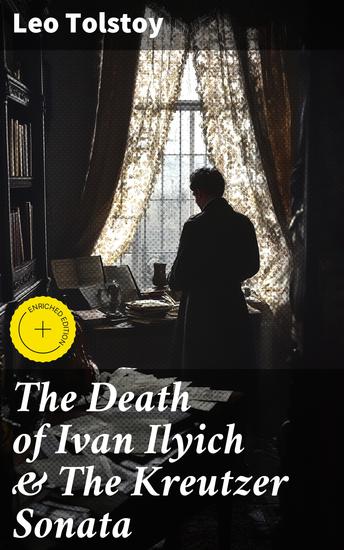
The Death of Ivan Ilyich & The Kreutzer Sonata - Enriched edition Two Psychological Novellas - cover

The Death of Ivan Ilyich & The Kreutzer Sonata - Enriched edition Two Psychological Novellas

Leo Tolstoy

Traducteur Aylmer Maude, Benjamin Tucker

Maison d'édition: Good Press

  • 0
  • 0
  • 0

Synopsis

In "The Death of Ivan Ilyich & The Kreutzer Sonata," Leo Tolstoy intricately weaves existential themes with incisive social critique, exploring the human condition and the complexities of love, death, and morality. The novella "The Death of Ivan Ilyich" presents a poignant examination of a bureaucrat's anguished realization of his superficial existence as he confronts terminal illness, while "The Kreutzer Sonata" delves into the darker recesses of passion, jealousy, and the nature of marital relations, illustrating the conflict between societal expectations and genuine human connection. Tolstoy's stark realism, characterized by profound psychological insight and disarming sincerity, paints a vivid portrayal of the struggles faced by individuals in a rapidly industrializing world, positioned against the backdrop of late 19th-century Russian society. Leo Tolstoy, an eminent figure in world literature, draws upon his own life experiences, particularly his grappling with faith, morality, and the purpose of life, to craft these compelling narratives. His deep introspection and fervent quest for truth played an integral role in shaping his literary output. Recognized as a moral philosopher, Tolstoy's works reflect his activism and advocacy for social reform, providing a rich and fertile ground for these philosophical explorations. This compelling duality of Tolstoy's work invites readers to confront the profound questions that govern human existence. "The Death of Ivan Ilyich & The Kreutzer Sonata" is highly recommended for those seeking to engage with thought-provoking literature that challenges societal norms and prompts introspection, making it an essential read for anyone interested in the intricacies of life, love, and the human experience.

In this enriched edition, we have carefully created added value for your reading experience:
- A comprehensive Introduction outlines these selected works' unifying features, themes, or stylistic evolutions.
- The Author Biography highlights personal milestones and literary influences that shape the entire body of writing.
- A Historical Context section situates the works in their broader era—social currents, cultural trends, and key events that underpin their creation.
- A concise Synopsis (Selection) offers an accessible overview of the included texts, helping readers navigate plotlines and main ideas without revealing critical twists.
- A unified Analysis examines recurring motifs and stylistic hallmarks across the collection, tying the stories together while spotlighting the different work's strengths.
- Reflection questions inspire deeper contemplation of the author's overarching message, inviting readers to draw connections among different texts and relate them to modern contexts.
- Lastly, our hand‐picked Memorable Quotes distill pivotal lines and turning points, serving as touchstones for the collection's central themes.
Disponible depuis: 10/12/2023.
Longueur d'impression: 177 pages.
D'autres livres qui pourraient vous intéresser

  • History of the Philippines A (Unabridged) - cover

    History of the Philippines A...

    David P. Barrows

    • 0
    • 0
    • 0
    A History of the Philippines is a short, dense and temporally expansive book. It starts with the Evolution of the Land 100 million years ago. The writing is predominantly dry, dispassionate and academic. It's full of details, and often presumes an existing familiarity with Philippine history and culture, introducing terms with no definition provided.
    Voir livre
  • Les Misérables: Volume 2: Cosette - Book 5: For a Black Hunt a Mute Pack (Unabridged) - cover

    Les Misérables: Volume 2:...

    Victor Hugo

    • 0
    • 0
    • 0
    Victor-Marie Hugo (26 February 1802 - 22 May 1885) was a French poet, novelist, essayist, playwright, and dramatist of the Romantic movement. During a literary career that spanned more than sixty years, he wrote abundantly in an exceptional variety of genres: lyrics, satires, epics, philosophical poems, epigrams, novels, history, critical essays, political speeches, funeral orations, diaries, and letters public and private, as well as dramas in verse and prose.
    BOOK 5: FOR A BLACK HUNT, A MUTE PACK: An observation here becomes necessary, in view of the pages which the reader is about to peruse, and of others which will be met with further on. The author of this book, who regrets the necessity of mentioning himself, has been absent from Paris for many years. Paris has been transformed since he quitted it.
    Voir livre
  • Inspiration An - From their pens to your ears genius in every story - cover

    Inspiration An - From their pens...

    George Gissing

    • 0
    • 0
    • 0
    George Robert Gissing was born on November 22nd, 1857 in Wakefield, Yorkshire.  
    He was educated at Back Lane School in Wakefield. Gissing loved school. He was enthusiastic with a thirst for learning and always diligent.  By the age of ten he was reading Dickens, a lifelong hero. 
    In 1872 Gissing won a scholarship to Owens College. Whilst there Gissing worked hard but remained solitary. Unfortunately, he had run short of funds and stole from his fellow students. He was arrested, prosecuted, found guilty, expelled and sentenced to a month's hard labour in 1876. 
    On release he decided to start over.  In September 1876 he travelled to the United States. Here he wrote short stories for the Chicago Tribune and other newspapers. On his return home he was ready for novels. 
    Gissing self-published his first novel but it failed to sell.  His second was acquired but never published. His writing career was static.  Something had to change.  And it did. 
    By 1884 The Unclassed was published.  Now everything he wrote was published. Both Isabel Claren-don and Demos appeared in 1886. He mined the lives of the working class as diligently as any capitalist. 
    In 1889 Gissing used the proceeds from the sale of The Nether World to go to Italy. This trip formed the basis for his 1890 work The Emancipated. 
    Gissing's works began to command higher payments. New Grub Street (1891) brought a fee of £250.  
    Short stories followed and in 1895, three novellas were published; Eve's Ransom, The Paying Guest and Sleeping Fires. Gissing was careful to keep up with the changing attitudes of his audience.  
    Unfortunately, he was also diagnosed as suffering from emphysema. The last years of his life were spent as a semi-invalid in France but he continued to write. 1899; The Crown of Life. Our Friend the Charlatan appeared in 1901, followed two years later by The Private Papers of Henry Ryecroft. 
    George Robert Gissing died aged 46 on December 28th, 1903 after catching a chill on a winter walk.
    Voir livre
  • The House at Pooh Corner - cover

    The House at Pooh Corner

    Alan Alexander Milne

    • 0
    • 0
    • 0
    Enjoy the sequel to A A Milne's "Winnie-the-Pooh", where we are introduced to Tigger! Join the Pooh, Piglet, Eeyore, and the rest for delightful mishaps and adventures filled with Warmth, Whimsy, and Honey. Rediscover the charming tales that have captured hearts for generations.
    Voir livre
  • Signal-Man The (Unabridged) - cover

    Signal-Man The (Unabridged)

    Charles Dickens

    • 0
    • 0
    • 0
    "The Signal-Man" is a first-person horror/mystery story by Charles Dickens, first published as part of the Mugby Junction collection in the 1866 Christmas edition of All the Year Round.
    The railway signal-man of the title tells the narrator of an apparition that has been haunting him. Each spectral appearance precedes a tragic event on the railway on which the signalman works. The signalman's work is at a signal-box in a deep cutting near a tunnel entrance on a lonely stretch of the railway line, and he controls the movements of passing trains. When there is danger, his fellow signalmen alert him by telegraph and alarms. Three times, he receives phantom warnings of danger when his bell rings in a fashion that only he can hear. Each warning is followed by the appearance of the spectre, and then by a terrible accident.
    Voir livre
  • Anna Karenina (Part 7) - cover

    Anna Karenina (Part 7)

    Leo Tolstoy

    • 0
    • 0
    • 0
    Part 7: While visiting Moscow for Kitty's confinement, Kostya quickly gets used to the city's fast-paced, expensive and frivolous society life. He accompanies Stiva to a gentleman's club, where the two meet Vronsky. Kostya and Stiva pay a visit to Anna, who is occupying her empty days by being a patroness to an orphaned English girl. Kostya is initially uneasy about the visit, but Anna easily puts him under her spell. When he admits to Kitty that he has visited Anna, she accuses him of falling in love with her. The couple are later reconciled, realizing that Moscow society life has had a negative, corrupting effect on Kostya.
    Anna Karenina is a novel by the Russian author Leo Tolstoy, first published in book form in 1878. Many writers consider Anna Karenina the greatest work of literature ever, and Tolstoy himself called it his first true novel. It was initially released in serial installments from 1873 to 1877 in the periodical The Russian Messenger.
    Voir livre