Begleiten Sie uns auf eine literarische Weltreise!
Buch zum Bücherregal hinzufügen
Grey
Einen neuen Kommentar schreiben Default profile 50px
Grey
Jetzt das ganze Buch im Abo oder die ersten Seiten gratis lesen!
All characters reduced
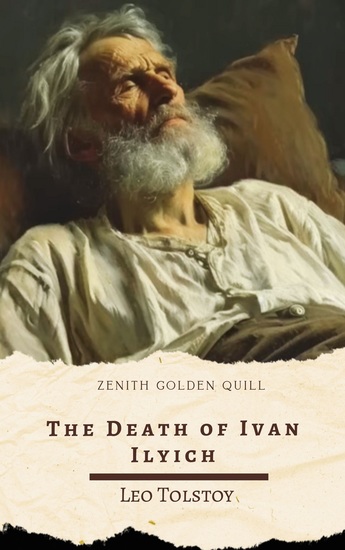
The Death of Ivan Ilyich - A Timeless Novella of Inner Crisis Spiritual Clarity and the Search for Truth - cover

The Death of Ivan Ilyich - A Timeless Novella of Inner Crisis Spiritual Clarity and the Search for Truth

Leo Tolstoy, Zenith Golden Quill

Verlag: Zenith Golden Quill

  • 0
  • 0
  • 0

Beschreibung

He lived by convention—but only in dying did he truly live.

In The Death of Ivan Ilyich, Leo Tolstoy delivers one of the most emotionally powerful and philosophically rich novellas in world literature. As Ivan Ilyich, a respected judge, confronts a terminal illness, he also confronts a terrifying question: has his entire life been a lie?

Through psychological realism and piercing moral insight, Tolstoy explores themes of alienation, materialism, the inevitability of death, and the possibility of spiritual awakening. The novella is a landmark in existential literature—spare, searing, and deeply human.

This edition includes historical annotations and period illustrations, ideal for students, scholars, and readers seeking to reflect on life's ultimate questions.

"One of the most powerful stories ever written about death—and life." — The New York Times
"A quiet, devastating masterpiece of truth and compassion." — The Guardian

Click Buy Now to experience a novella that will change how you see life—and death.
Verfügbar seit: 15.05.2025.
Drucklänge: 78 Seiten.

Weitere Bücher, die Sie mögen werden

  • Her Lover - From their pens to your ears genius in every story - cover

    Her Lover - From their pens to...

    Maxim Gorky

    • 0
    • 0
    • 0
    Alexei Maximovich Peshkov was born on 28th March 1868, in Nizhny Novgorod, Russia. 
    Better known as Maxim Gorky he was orphaned at 11 and ran away from home at 12.  At 19 he had already attempted suicide and thereafter travelled, by foot, across the Russian Empire for 5 years. 
    His first book ‘Essays & Stories’ in 1898 was a sensation and so began a long career as an author of short stories, novels and plays.  Gorky saw writing as a moral and political act that would help to change the unjust world around him.  He was an ardent early advocate of the emerging Marxist movement and publicly opposed the Tsarist regime leading several times to his arrest.  
    In 1904 he began his own theatre but the censor banned every play and Gorky was forced to abandon the project. 
    But Gorky was a financially successful author, editor, and playwright and gave monies to political parties as well as for civil rights and social reform.  The brutal shooting of workers, which set in motion the Revolution of 1905, pushed Gorky more decisively toward radical solutions.  
    In 1906 he went to the United States to raise funds for the Bolsheviks. Those experiences including a scandal over travelling with his lover and not his wife deepened his contempt for the ‘bourgeois soul.’ 
    Gorky now moved to Capri in Italy, both for health reasons and to escape the increasingly repressive times in Russia.  
    An amnesty for the 300th anniversary of the Romanov dynasty saw him return to Russia in 1914. His politics remained close to the Bolshevik cause.  But soon, after the 1918 revolution, his essays referred to Lenin as a tyrant for his senseless arrests and repression.  He was soon appealing to the outside world for food aid after the catastrophic crop failure. 
    In October 1921 Gorky returned to Italy, now in Fascist hands, and settled in Sorrento until 1932.  His health worsened with the onset of tuberculosis. 
    He wrote several successful books there but now decided to find an understanding with the communist regime. Stalin invited him home and his return was hailed as a major propaganda victory.  He was decorated with the Order of Lenin, and a province, a park, and various streets re-named in his honour. 
    But he had his faults too.  In 1933, Gorky co-edited a book on the White Sea-Baltic Canal and denied even a single prisoner died during its construction, but thousands had. As well, knowing that some Nazis were homosexual, a phrase was attributed to him that said ‘exterminate all homosexuals and fascism will vanish’.  Although he was himself was quoting another he was decidedly homophobic. 
    With the increase of Stalinist repression in 1935 Gorky was placed under unannounced house arrest. 
    Maxim Gorky died on the 18th June 1936 from pneumonia.  He was 68. 
    Stalin and Molotov were among those who carried Gorky's urn of ashes at his funeral.
    Zum Buch
  • The Three Imposters - or the Transmutations - cover

    The Three Imposters - or the...

    Arthur Machen

    • 0
    • 0
    • 0
    The complete lost classic of psychological horror from the master himself, Arthur Machen!   It is a coincidence…   But what happens when one coincidence turns into two? Or three? Or more?   Dyson knows something is strange after a man in spectacles casts aside an ancient coin that has been missing for centuries. But when Dyson meets mysterious stranger after mysterious stranger looking for the man in spectacles, he realizes someone is not telling the truth.   But who can he trust?   An early influence over H. P. Lovecraft’s “The Call of the Cthulu,” The Three Imposters is sure to please any fan of psychological horror. Now with a brand new foreword by game designer of the acclaimed role-playing game Call of the Cthulu, Sandy Petersen!
    Zum Buch
  • Compendium Of Revolutionary Notions A - Politics And The English Language A Nice Cup Of Tee - Notes On Nationlism - cover

    Compendium Of Revolutionary...

    George Orwell

    • 0
    • 0
    • 0
    George Orwell, was an English novelist, essayist, journalist and critic. His work is characterized by lucid prose, biting social criticism, total opposition to totalitarianism, and outspoken support of democratic socialism. 
     
    Orwell produced literary criticism and poetry, fiction and polemical journalism. He is known for the allegorical novella Animal Farm (1945) and the dystopian novel Nineteen Eighty-Four (1949). His non-fiction works, including The Road to Wigan Pier (1937), documenting his experience of working-class life in the north of England, and Homage to Catalonia (1938), an account of his experiences soldiering for the Republican faction of the Spanish Civil War (1936–1939), are as critically respected as his essays on politics and literature, language and culture. In 2008, The Times ranked George Orwell second among "The 50 greatest British writers since 1945". 
     
    Orwell's work remains influential in popular culture and in political culture, and the adjective "Orwellian"—describing totalitarian and authoritarian social practices—is part of the English language, like many of his neologisms, such as "Big Brother", "Thought Police", "Two Minutes Hate", "Room 101", "memory hole", "Newspeak", "doublethink", "unperson", and "thoughtcrime", as well as providing direct inspiration for the neologism "groupthink".
    Zum Buch
  • Disease of Parliaments The (Unabridged) - cover

    Disease of Parliaments The...

    H. G. Wells

    • 0
    • 0
    • 0
    Herbert George Wells (21 September 1866 - 13 August 1946) was an English writer. Prolific in many genres, he wrote dozens of novels, short stories, and works of social commentary, history, satire, biography and autobiography. His work also included two books on recreational war games. Wells is now best remembered for his science fiction novels and is often called the "father of science fiction", along with Jules Verne and the publisher Hugo Gernsback.
    THE DISEASE OF PARLIAMENTS: There is a growing discord between governments and governed in the world. There has always been discord between governments and governed since States began; government has always been to some extent imposed, and obedience to some extent reluctant.
    Zum Buch
  • Character Building (Unabridged) - cover

    Character Building (Unabridged)

    Booker T. Washington

    • 0
    • 0
    • 0
    Booker T. Washington has been regarded as the leading figure in African American life, and as the man who brought his people from slavery to unfettered economic, political, and social involvement in the American mainstream. He has also been strongly criticized for advancing the cause of racial accommodation when the political agenda dictated the development of an independent black standpoint in all areas of the industrial structure. This agenda went far beyond educational reform and agrarian participation.
    Character Building first appeared in 1902. While enormous changes have occurred in all phases of African American rights and responsibilities, Booker T. Washington's broad outlines on building moral character have remained intact. Washington's book can be viewed as a Dale Carnegie volume on How to Win Friends and Influence People_black and white_as noted by the very title of the chapters: "Helping Others," "Influencing by Example," "Education that Educates," "The Gospel of Service," etc.
    For those in search of the ideological roots of black life in post-slavery times, this text will be a reminder of where the American nation has come from and, arguably, where it is going.
    Zum Buch
  • Cranford - cover

    Cranford

    Elizabeth Gaskell

    • 0
    • 0
    • 0
    Step into the quaint village of "Cranford" by Elizabeth Gaskell, where tradition and charm rule the day. This delightful novel chronicles the lives of the village's predominantly female inhabitants, led by the endearing and resilient Miss Matty. Through a series of vignettes, Gaskell captures their small triumphs, cherished routines, and subtle resistances to change. With gentle humor and deep empathy, "Cranford" offers a nostalgic and touching portrait of community, friendship, and the enduring strength of women in a rapidly evolving world.
    Zum Buch