Rejoignez-nous pour un voyage dans le monde des livres!
Ajouter ce livre à l'électronique
Grey
Ecrivez un nouveau commentaire Default profile 50px
Grey
Abonnez-vous pour lire le livre complet ou lisez les premières pages gratuitement!
All characters reduced
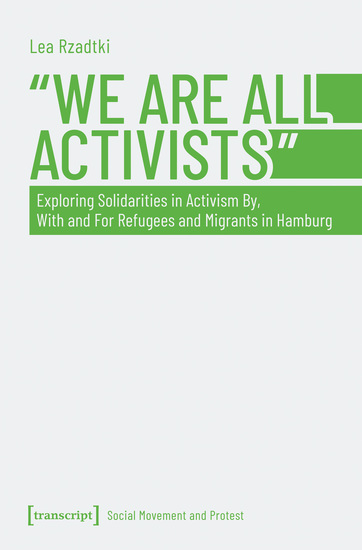
»We Are All Activists« - Exploring Solidarities in Activism By With and For Refugees and Migrants in Hamburg - cover

»We Are All Activists« - Exploring Solidarities in Activism By With and For Refugees and Migrants in Hamburg

Lea Rzadtki

Maison d'édition: transcript Verlag

  • 0
  • 0
  • 0

Synopsis

Who is meant when people talk about the citizens or the activists? Often, they are implied to mean the most privileged positionalities. Simultaneously, refugees and migrants tend to be seen through their (supposed) legal status. Thus, they are neither practically nor conceptually regarded as activists. The variety of intersecting positionings in migrant rights activism results in complex inequalities and power dynamics within activist groups. Solidarities are continually challenged, negotiated, and built. Lea Rzadtki develops a conceptual view on claims, challenges, and processes that activists experience and deal with. She moves beyond dichotomies and engages in transversal dialogue.
Disponible depuis: 30/09/2022.
D'autres livres qui pourraient vous intéresser

  • The Perils of Prosperity 1914-1932 - Second Edition - cover

    The Perils of Prosperity...

    William E. Leuchtenburg

    • 0
    • 0
    • 0
    Beginning with Woodrow Wilson and U.S. entry into World War I and closing with the Great Depression, The Perils of Prosperity traces the transformation of America from an agrarian, moralistic, isolationist nation into a liberal, industrialized power involved in foreign affairs in spite of itself.
     
    William E. Leuchtenburg’s lively yet balanced account of this hotly debated era in American history has been a standard text for many years. This substantial revision gives greater weight to the roles of women and minorities in the great changes of the era and adds new insights into literature, the arts, and technology in daily life. He has also updated the lists of important dates and resources for further reading.
     
    “This book gives us a rare opportunity to enjoy the matured interpretation of an American Historian who has returned to the story and seen how recent decades have added meaning and vividness to this epoch of our history.”—Daniel J. Boorstin, from the Preface
    Voir livre
  • Enemy of the People - How Jacob Zuma stole South Africa and how the people fought back - cover

    Enemy of the People - How Jacob...

    Adriaan Basson, Pieter Du Toit

    • 0
    • 0
    • 0
    He swore to serve the people, but Jacob Zuma robbed us blind. 
    This is the first definitive account of Zuma’s catastrophic misrule, offering eyewitness descriptions and cogent analysis of how South Africa was brought to its knees – and how the people fought back.  
    When Jacob Zuma took power of the ANC in December 2007, he inherited a country whose economy was growing and a party that had the support of two-thirds of the electorate. Today, South Africa is caught in the grip of state capture, the economy is moribund and a divided ANC is staring down the barrel of defeat at the 2019 elections. How did we get here? 
    Zuma ruthlessly brought his party to heel, subduing and isolating his political opponents. Then he built a patronage network of family, friends and business associates – powerful, corruptible political tenderpreneurs – who stopped at nothing to take control of state institutions and enterprises. State capture became Zuma’s brand – a maze of corruption so far-reaching that it has replaced many parts of government, causing irreparable damage to institutions, state enterprises, and the ANC itself.  
    But it hasn’t all gone Zuma’s way. In a new era of activism, former political allies, public-minded civil servants, the media and the people have stepped forward to join the anti-Zuma groundswell. In the courts, too, the pressure has mounted against a bad president, who has become an enemy of the people. 
    As a deeply divided ANC squares off for the party’s conference in December, journalists Adriaan Basson and Pieter du Toit offer an insightful, up-to-the-minute account of the Zuma era.
    Voir livre
  • Our Voices From The Heart - A behind-the-scenes book about the Uluru Statement From The Heart from the co-chairs of the Uluru Dialogue Professor Megan Davis and Patricia Anderson AO - cover

    Our Voices From The Heart - A...

    Patricia Anderson AO, Professor...

    • 0
    • 0
    • 0
    A behind-the-scenes book about the Uluru Statement From The Heart, from the co-chairs of the Uluru Dialogue, Professor Megan Davis and Patricia Anderson, AO. 
     
      
    The Australian story began long before the arrival of the First Fleet. 
    We Australians all know this.  
    We have always known this. 
    Australia finds itself standing on the edge of a 60,000-year-old precipice. The Uluru Statement From The Heart respectfully asks for First Nations people to finally be given a Voice - but what path led us here? 
    The story of the twelve Regional Dialogues and the Uluru National Constitutional Convention has never been told. It is a yarn borne from centuries of struggle, full of vision, determination and courage. These community gatherings, led and attended by fifteen hundred everyday First Peoples, represent the largest ever consultation of Aboriginal and Torres Strait Islanders in history. The unanimous result was the Uluru Statement From The Heart, and its call for Voice and Makarrata. 
    Our Voices From The Heart is the official celebration of the grassroots campaign that guided us to this inspiring moment in Australia's history. It is a profound call to action for the nation, but is also an offering of peace and unity that recognises the past and reconciles it with the truth. 
    Filled with powerful never-before-seen photography and helpful information to share with friends and family alike, this book charts the world's oldest living civilisation's ongoing fight for constitutional recognition and is destined to become a treasured keepsake for years to come. 
    It's time, Australia. History is calling.  
    HarperCollins Australia 2023
    Voir livre
  • History of India - The Kashmir Region and the Maurya Empire - cover

    History of India - The Kashmir...

    Kelly Mass

    • 0
    • 0
    • 0
    This is a compilation of 2 different titles, which are about the following topics: 
    1: The Maurya Empire was a South Asian Iron Age historic empire centered in Magadha, created by Chandragupta Maurya in the year 322 before Christ and lasting till 185 before Christ in a loose-knit way. The conquest of the Indo-Gangetic Plain focused the Maurya Empire, and Pataliputra functioned as its capital city (modern-day Patna). Beyond this royal core, the empire's geographical reach was limited by the dedication of army leaders who ruled the armed cities that dot the landscape. 
    Other than for the far south, the empire briefly controlled the significant city centers and arteries of the Indian subcontinent throughout Ashoka's rule (which was from around 268 to 232 before Christ). 
    After Ashoka's reign, it sank for practically 50 years before liquifying in 185 before Christ with the murder of Brihadratha by Pushyamitra Shunga and the facility of the Shunga dynasty in Magadha. 
    2: Kashmir is the Indian subcontinent's northern most geographical area. It is quite different from the rest of India. And till the mid-nineteenth century, "Kashmir" only described the Kashmir Valley, which lies between the Great Mountain Ranges and the Pir Panjal Variety. Today, the word describes the Indian-controlled parts of Jammu and Kashmir and Ladakh, and also the Pakistani-controlled terrain of Azad Kashmir and Gilgit-Baltistan, and the Chinese-controlled areas of Aksai Chin and the Trans-Karakoram System. 
    The Kashmir area ended up being a crucial center of Hinduism and later Buddhism in the first centuries, while Kashmir Shaivism developed later, in the ninth century. This is why so many people attribute significant spiritual meaning to the area. It is no wonder, therefore, that some travelers go to this specific area for spiritual purposes.
    Voir livre
  • Indus Valley Civilization and Maurya Empire The: The History and Legacy of Ancient India’s Most Influential Powers - cover

    Indus Valley Civilization and...

    Editors Charles River

    • 0
    • 0
    • 0
    India’s oldest civilization, known as the Indus Valley Civilization or the Harappan Civilization, was contemporary with ancient Mesopotamia and ancient Egypt and had extensive contacts with the former, making it one of the most important early civilizations in the world. Spread out along the rivers of the Indus River Valley, hundreds of settlements began forming around 3300 BCE, eventually coalescing into a society that had all of the hallmarks of a true civilization, including writing, well-developed cities, a complex social structure, and long-distance trade. 
    During the last centuries of the first millennium BCE, most of the Mediterranean basin and the Near East were either directly or indirectly under the influence of Hellenism. The Greeks spread their ideas to Egypt, Mesopotamia, and Persia and attempted to unify all of the peoples of those regions under one government. Although some of the Hellenistic kingdoms proved to be powerful in their own rights – especially Ptolemaic Egypt and the Seleucid Empire, which encompassed all of Mesopotamia, most of the Levant, and much of Persia during its height – no single kingdom ever proved to be dominant. The Hellenic kingdoms battled each other for supremacy and even attempted to claim new lands, especially to the east, past the Indus River in lands that the Greeks referred to generally as India. But as the Hellenistic Greeks turned their eyes to the riches of India, a dynasty came to power that put most of the Indian subcontinent under the rule of one king. The dynasty that came to power in the late 4th century BCE is known today as the Mauryan Dynasty, and although the ruling family was short-lived and their power was ephemeral, its influence resonated for several subsequent centuries and spread as far east as China and into the Hellenistic west.
    Voir livre
  • A Rare Recording of Neville Goddard - cover

    A Rare Recording of Neville Goddard

    Neville Goddard

    • 0
    • 1
    • 0
    Neville Goddard (1905 - 1972) was a teacher, author and lecturer. He was born in St. Michael, Barbados, and came to the US in 1922 to study drama and dance. While touring with his dance company in England he developed an interest in metaphysics. After his return to New York he gave up the entertainment industry to devote his full attention to the study of spiritual and mystical matters. While living in Los Angeles in the 1950s, he gave a series of talks on television and radio. In his lectures and books Neville dealt with what he called "The Law" and "The Promise." These relate to the method of creating one's physical reality through imagining, and is similar to the teachings of the New Thought movement. This public lecture is about beliefs, knowing, and other mystical topics.
    Voir livre