Rejoignez-nous pour un voyage dans le monde des livres!
Ajouter ce livre à l'électronique
Grey
Ecrivez un nouveau commentaire Default profile 50px
Grey
Abonnez-vous pour lire le livre complet ou lisez les premières pages gratuitement!
All characters reduced
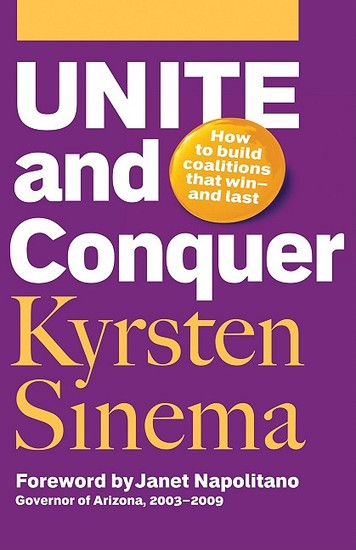
Unite and Conquer - How to Build Coalitions That Win—and Last - cover

Unite and Conquer - How to Build Coalitions That Win—and Last

Kyrsten Sinema

Maison d'édition: Berrett-Koehler Publishers

  • 0
  • 0
  • 0

Synopsis

Old-school divide-and-conquer tactics—demonizing opponents, frightening voters, refusing to compromise—may make us feel good about the purity of our ideals, but it's no way to get anything done. Worse, this approach betrays some of the most cherished ideals of the progressive movement: inclusion, reason, justice, and hope. Illuminated by examples from her own work and a host of campaigns across the country, Kyrsten Sinema shows how to forge connections—both personal and political—with seemingly unlikely allies and define our values, interests, and objectives in ways that broaden our range of potential partners and expand our tactical options. With irreverent humor, enthralling campaign stories, and solid, practical advice, Sinema enables us to move past “politics as war” and build support for progressive causes on the foundation of our common humanity.
Disponible depuis: 13/07/2009.
Longueur d'impression: 217 pages.

D'autres livres qui pourraient vous intéresser

  • The US Supreme Court - A Very Short Introduction - cover

    The US Supreme Court - A Very...

    Linda Greenhouse

    • 0
    • 0
    • 0
    For thirty years, Pulitzer Prize-winning journalist Linda Greenhouse chronicled the activities of the U.S. Supreme Court and its justices as a correspondent for the New York Times. In this Very Short Introduction, she draws on her deep knowledge of the court's history and of its written and unwritten rules to show listeners how the Supreme Court really works. 


    Greenhouse offers a fascinating institutional biography of a place and its people—men and women who exercise great power but whose names and faces are unrecognized by many Americans and whose work often appears cloaked in mystery. How do cases get to the Supreme Court? How do the justices go about deciding them? What special role does the chief justice play? What do the law clerks do? How does the court relate to the other branches of government? Greenhouse answers these questions by depicting the justices as they confront deep constitutional issues or wrestle with the meaning of confusing federal statutes. Throughout, the author examines many individual Supreme Court cases to illustrate points under discussion. 


    The third edition of Greenhouse's Very Short Introduction tracks the changes in the Court's makeup over the past decade, including the landmark decisions of the Obama and Trump eras and the emergence of a conservative supermajority.
    Voir livre
  • Who Will Defend Europe? - An Awakened Russia and a Sleeping Continent - cover

    Who Will Defend Europe? - An...

    Keir Giles

    • 0
    • 0
    • 0
    Who will defend Europe? The answer should be obvious: Europe should be able to defend itself. Yet, for decades, most of the continent enjoyed a defense holiday, outsourcing protection to the United States while banking an increasingly illusory 'peace dividend'. Now, after three decades of reducing armed forces and drawing down defense industries, Europe finds itself close to unprotected—while Russia is intent on continuing its war of expansion, and the United States is distracted and divided. 


    In this urgent, vital book, Keir Giles lays out the stark choices facing leaders and societies as they confront the return of war in Europe. He explains how the West's unwillingness to confront Russia has nurtured the threat, and that Putin's ambition puts the whole continent at risk. He assesses the role and deficiencies of NATO as a guarantor of hard security, and whether the European Union or coalitions of the willing can fill the gap. Above all, Giles emphasizes the need for new leadership in defense of the free world after the United States has stepped aside—and warns that the United Kingdom's brief moment of setting the pace for Europe has already been squandered.
    Voir livre
  • Twilight's Last Gleaming - Can America Be Saved? - cover

    Twilight's Last Gleaming - Can...

    Todd Starnes

    • 0
    • 0
    • 0
    "Todd Starnes is a fierce defender of freedom and a great patriot. He has seen, and understands, what is happening to our country like few others—his book is absolutely terrific, a must read!" —President Trump 


    President Biden ushered in a dark winter of malaise across our great nation. He snuffed out Lady Liberty's bright beacon of hope and brought despair to the land. And now we stand at a time of great choosing. Do we choose the path that leads to freedom or the path that leads to tyranny? 


    We face difficult days, but not hopeless days. Together, we can restore the Republic and reclaim our standing in the world. But first, we must remember our roots and return to the values that made our nation great. A deep and abiding desire for freedom and liberty, girded by faith in God, is the essence of who we are. Those are the precepts that must be reaffirmed if America is to be saved.
    Voir livre
  • On This Day in Politics - Britain's Political History in 365 Days - cover

    On This Day in Politics -...

    Iain Dale

    • 0
    • 0
    • 0
    Who became Britain's first Prime Minister on 3 April 1721? 
    When was Karl Marx born? 
    Where and when was the first battle of the Wars of the Roses? 
    When did Big Ben first bong? 
    When did the first British woman cast her vote? (Clue: It wasn't 1918.) 
     
    Find the answers to these questions and many more in this landmark political history. 
     
    From the first meeting of an elected English parliament on 20 January 1265 to the tabling of the Bill of Rights on 13 February 1689; from the Peterloo massacre of 16 August 1819 to Britain voting to leave the EU on 23 June 2016, there is a growing thirst for knowledge about the history of our constitutional settlement, our party system and how our parliamentary democracy has developed. 
     
    Writing as an observer of political history, but also as someone with an opinion, acclaimed political broadcaster Iain Dale charts the main events of the last few hundred years, with one event per page, per day. 
     
    'The indefatigable Iain Dale always cuts to the nub of politics.' Adam Boulton
    Voir livre
  • Pakistan's ISI - A Concise History of the Inter-Services Intelligence Directorate - cover

    Pakistan's ISI - A Concise...

    Julian Richards

    • 0
    • 0
    • 0
    Forged during the tumultuous aftermath of Partition in 1947, the Inter-Services Intelligence Directorate (ISI) has grown to become the preeminent intelligence service in Pakistan. Its capabilities are comprehensive, its remit covers both foreign and domestic intelligence, and it is one of the most feared and respected agencies of the Global South. 


    Pakistan's ISI provides an up-to-date and detailed introduction to the ISI and its historical evolution. The narrative is rooted in a deep and wide-ranging contextualization of the state of Pakistan and its security environment. The story is one of an agency that grew from humble beginnings into an extremely capable and robust force at the heart of power in the state. The ISI utilizes broad human intelligence networks and employs covert action and support for militants, particularly in its rivalry with India. As a crucial intelligence partner for the West during the Cold War and into the contemporary era, the ISI has been both an essential ally and problematic partner. The shadow of this agency continues to loom over Pakistan's democratic institutions. 


    This book will appeal to students, scholars, and general listeners interested in intelligence and the politics and history of South Asia.
    Voir livre
  • Ukraine and the Art of Strategy - cover

    Ukraine and the Art of Strategy

    Lawrence Freedman

    • 0
    • 0
    • 0
    The Russian invasion of Crimea in 2014, subsequent war in Eastern Ukraine, and economic sanctions imposed by the West transformed European politics. The conflict did not escalate to the levels originally feared but nor was either side able to bring it to a definitive conclusion. Ukraine suffered a loss of territory but was not forced into changing its policies away from the Westward course adopted as a result of the EuroMaidan uprising of February 2014. President Putin was left supporting a separatist enclave as Russia's economy suffered significant damage. 


    Ukraine and the Art of Strategy provides an account of the origins and course of the Russia-Ukraine conflict through the lens of strategy. Lawrence Freedman describes the development of President Putin's anxieties that former Soviet countries were being drawn towards the European Union, the effective pressure he put on President Yanokvych of Ukraine to turn away from the EU, and the resulting "EuroMaidan Revolution" which led to Yanukovych fleeing. He explores the reluctance of Putin to use Russian forces to do more that consolidate the insurgency in Eastern Ukraine, the failure of the Minsk peace process, and the limits of the international response. Putin's strategic-making is kept in view at all times, including his use of "information warfare" and attempts to influence the American election.
    Voir livre