Rejoignez-nous pour un voyage dans le monde des livres!
Ajouter ce livre à l'électronique
Grey
Ecrivez un nouveau commentaire Default profile 50px
Grey
Abonnez-vous pour lire le livre complet ou lisez les premières pages gratuitement!
All characters reduced
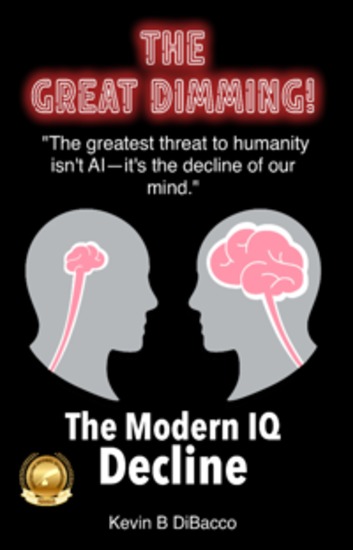
The Great Dimming - “The Modern IQ Decline” - cover

The Great Dimming - “The Modern IQ Decline”

Kevin B DiBacco

Maison d'édition: Urgesta AS

  • 0
  • 0
  • 0

Synopsis

"The Great Dimming: The Modern IQ Decline" investigates a paradox that would have seemed unthinkable just decades ago: even as technology advances at breakneck speed, our collective cognitive capabilities appear to be deteriorating.Through compelling research and analysis, the book reveals how IQ scores that rose steadily throughout the 20th century (the Flynn Effect) have now reversed in developed nations. Core cognitive capabilities like abstract reasoning, working memory, and critical thinking are declining at measurable rates, with profound implications for society's future.Unlike simplistic explanations blaming technology alone, "The Great Dimming" presents a multifaceted analysis of interlocking factors driving this trend. From environmental toxins altering neural development to the attention-fragmenting effects of digital media, from educational systems failing to develop deep thinking to lifestyle changes disrupting sleep and physical activity—each contributes to a perfect storm of cognitive challenges.Beyond identifying problems, the book presents evidence-based solutions at every level. For individuals, it offers a practical toolkit of interventions ranked by effectiveness, from cardiovascular exercise that boosts cognitive function by 15-20% to digital wellness practices that enhance focus by 40%. For communities and policymakers, it showcases successful case studies like Singapore's "Smart Environment" program and Vermont's comprehensive cognitive health initiative, demonstrating real-world models for intervention.What sets "The Great Dimming" apart is its balance of rigorous science, accessible explanations, and practical optimism. While unflinching in its assessment of alarming trends, it also reveals our remarkable neuroplasticity and potential for recovery.The book makes a compelling case that addressing the Great Dimming represents our most crucial challenge—not just for intellectual progress, but for solving existential threats like climate change and social polarization. By protecting and enhancing our cognitive capabilities, we don't just preserve human intelligence; we create the conditions for a new flowering of human potential.
Disponible depuis: 06/05/2025.
Longueur d'impression: 200 pages.

D'autres livres qui pourraient vous intéresser

  • 15+ Political Science Classics Collection - The Art of War Tao Te Ching The Republic Meditations The Prince Utopia Utilitarianism Anarchism and others - cover

    15+ Political Science Classics...

    Sun Tzu, Lao Tzu, Plato, Marcus...

    • 0
    • 0
    • 0
    What is Political Science?
    Within human society, it is customary to distinguish between the following spheres: economic, political, social, and spiritual.
    The political sphere is important in that it involves and determines the interactions of different political powers.  This understanding lies at the foundation of any political analysis of public life.
    Politics as a specific sector within human society is as old as it is modern. Many famous statesmen and scientists are credited as the authors of laws and political systems. 
    In today's global community, facing growing pressures of political extremism and radicalism, knowledge of basic political science principles should help students develop a democratic ethos and foster qualities, such as political tolerance, compromise, and cooperation, while learning to express and defend their interests in a civilized manner.
    The foundation of political science lies in the accumulated knowledge of mankind.
    Each included piece o this collection is required reading at some of the best universities on the planet including: Harvard, Princeton, Yale, and Columbia Universities, the Massachusetts Institute of Technology (MIT), and the Universities of Oxford and Cambridge, among others.
     
    Sun Tzu: The Art of War
    Lao Tzu: Tao Te Ching
    Plato: The Republic
    Marcus Aurelius: Meditations
    Niccolo Machiavelli: The Prince
    Thomas More: Utopia
    Tommaso Campanella: The City of the Sun
    Francis Bacon: The New Atlantis
    Thomas Paine: Common Sense
    John Stuart Mill: Utilitarianism
    Karl Marx and Friedrich Engels: The Communist Manifesto
    Vladimir Lenin: The State and Revolution
    Rosa Luxemburg: Reform or Revolution
    Peter Kropotkin: The Conquest of Bread
    Emma Goldman: Anarchism: What It Really Stands For
    Leon Trotsky: Fascism: What It Is and How to Fight It
    Voir livre
  • The Myth That Made Us - How False Beliefs about Racism and Meritocracy Broke Our Economy (and How to Fix It) - cover

    The Myth That Made Us - How...

    Jeff Fuhrer

    • 0
    • 0
    • 0
    The Myth That Made Us exposes how false narratives—of a supposedly post-racist nation, of the self-made man, of the primacy of profit- and shareholder value-maximizing for businesses, and of minimal government interference—have been used to excuse gross inequities and to shape and sustain the US economic system that delivers them. Jeff Fuhrer argues that systemic racism continues to produce vastly disparate outcomes and that our brand of capitalism favors doing little to reduce disparities. 


    Rather than merely laying blame at the feet of both conservatives and liberals for aiding and abetting an unjust system, Fuhrer charts a way forward. He supplements evidence from data with insights from community voices and outlines a system that provides more equal opportunity to accumulate both human and financial capital. His key areas of focus include universal access to high-quality early childhood education; more effective use of our community college system as a pathway to stable employment; restructuring key aspects of the low-wage workplace; providing affordable housing and transit links; supporting people of color by serving as mentors, coaches, and allies; and implementing Baby Bonds and Reparations programs. Fuhrer emphasizes embracing humility, research-based approaches, and community involvement as ways to improve economic opportunity.
    Voir livre
  • Story Behind Kaashi Wellness - cover

    Story Behind Kaashi Wellness

    Tenzim Norzom

    • 0
    • 0
    • 0
    This woman entrepreneur tapped into India's growing e-commerce market for her holistic wellness brand amid COVID-19
    Voir livre
  • Filthy Rich Politicians - The Swamp Creatures Latte Liberals and Ruling-Class Elites Cashing in on America - cover

    Filthy Rich Politicians - The...

    Matt K. Lewis

    • 0
    • 0
    • 0
    From one of America's sharpest conservative journalists is this searing, thought-provoking and hilarious takedown of the ruling class running amok in Washington. These are your elected officials. Some are slyly taking advantage of the system. They are hoping no one is savvy enough to notice. But Matt Lewis has. And this is what he’s learned.  Today’s politicians are an unsavory lot—a hybrid of plutocrats and hypocrites. And it’s worse (and more laughable) than you can imagine. Lewis will introduce you to a crop of latte liberals, ivy league populists, insider traders, trust-fund babies, and swamp creatures as he exposes how truly ludicrous money in politics has gotten.  In Filthy Rich Politicians, Lewis embarks on an investigative deep dive into the ridiculous state of modern American democracy—a system where the rich get elected and the elected get rich. One of the brightest conservative writers of his generation, Lewis doesn’t just complain: he articulates how Americans can achieve accountability from their elected leaders through radically commonsense reforms. But many of these ruling-class elites have a vested financial interest in rejecting the reforms so desperately needed to rebuild Americans’ trust in the institutions that once made our nation great.  This is not an “eat the rich” kind of book, and it is not for those who want to stoke class warfare, topple the whole regime, and burn it all to the ground. This is a must-read book for thoughtful readers who yearn for transparency and will commit to holding their elected leaders accountable to those they are supposed to represent—we the people.  The reforms spelled out in this book would incentivize good behavior in our leaders, stymie corruption, and prevent politicians from using the system (and our taxpayer dollars) to feather their filthy rich nests.  It is only by taking these steps to reform the system that we can rebuild trust in our institutions and preserve American democracy for future generations. There really is no richer inheritance we could leave them.
    Voir livre
  • The Dhammapada Vol 7 - The Way of the Buddha - cover

    The Dhammapada Vol 7 - The Way...

    Osho

    • 0
    • 0
    • 0
    Osho explains that these sutras are concerned with aspects of man's unawareness and that Buddha's whole message is concerned with the raising of our consciousness. These sutras were compiled by Buddha's disciples to contain the essence of all his teachings. This was the last turning of the Wheel of Dharma, 2,500 years ago. At the beginning of his commentaries on these sutras, Osho says he is setting the Wheel of Dharma in motion again.
    "Buddha transformed the word  meditation . Meditation had always been something of the mind, and Buddha brought a new quality, so totally new, diametrically opposite to the old meaning: He said, meditation means a state of no mind. It is not concentration; it is not contemplation. It is not thinking; it is not thinking about God. It is not even prayer - because thinking is of the head, intellectual; prayer is emotional. That is another side of the head, not very far away from it; a different language used by another part of the head." (Osho)
    Talks are "meditating talks", allowing the listener an experience of meditation. "These words of Buddha come from eternal silence. They can reach you only if you receive them in silence."
    Chatpers:
    
    - Man Is Only a Possibility
    - The Greatest Rebellion Ever Tried
    - Life Is Easy
    - Man Is Not Predictable
    - Truth Is That Which Is
    - Don't Take Enlightenment Seriously
    - The Silence of a Song
    - Be the Center of the Cyclone
    - The Endless Journey into Truth
    - The Art of Surrendering
    © & ℗ 1979 OSHO International Foundation
    Voir livre
  • The Lie of the Land - cover

    The Lie of the Land

    Guy Shrubsole

    • 0
    • 0
    • 0
    WINNER OF THE WAINWRIGHT PRIZE FOR CONSERVATION 2025 
    A WATERSTONES AND GUARDIAN BEST BOOK OF 2024 
    'Both dynamite and medicine' AMY-JANE BEER 
    'Timely and rousing' THE TIMES 
    ________________________________ 
    The lie of the land: that Britain’s landowners care for the countryside. 
    Our landowning elite are paid billions of taxpayer pounds to be good stewards. But these same landowners have carelessly trampled over our best-loved landscapes, leaving the rivers polluted, fenlands drained, and moorlands burned. 
    Guy Shrubsole has travelled across Britain to expose the lie and meet the communities fighting back to restore our lost landscapes. This is a bold, shared vision for our nation’s wild places, and how we can treat them with the awe and care they deserve. 
    *Guy Shrubsole's The Lost Rainforests of Britain was a Sunday Times bestseller w/c 2023-04-30* 
    *SHORTLISTED FOR THE WESTMINSTER BOOK AWARDS* 
    *SHORTLISTED FOR THE UNWIN AWARD* 
    This Sunday Times bestseller is a must-read for anyone interested in environmental conservation and the protection of habitats. Shrubsole's non-fiction work is a deep dive into the science of ecosystems, the politics of agriculture, and the social implications of rural land management. 
    For fans of Robin Wall Kimmerer (The Democracy of Species), Derek Gow (Birds, Beasts and Bedlam), Christopher Hart (Hedgelands [US Edition]), Yanis Varoufakis (Technofeudalism), and Isabella Tree (Wilding). 
    HarperCollins 2024
    Voir livre