Begleiten Sie uns auf eine literarische Weltreise!
Buch zum Bücherregal hinzufügen
Grey
Einen neuen Kommentar schreiben Default profile 50px
Grey
Jetzt das ganze Buch im Abo oder die ersten Seiten gratis lesen!
All characters reduced
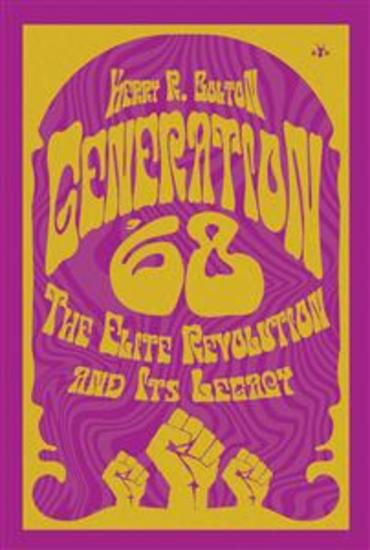
Generation '68 - The Elite Revolution and Its Legacy - cover

Generation '68 - The Elite Revolution and Its Legacy

Kerry Bolton

Verlag: Antelope Hill Publishing LLC

  • 0
  • 0
  • 0

Beschreibung

Marked by cultural revolution and bold, new ways of thinking and living, including revolutions in philosophical thought, economic practices, and cultural touchstones such as music and dress, the 1960s ushered in a new era. However, in Generation '68: The Elite Revolution and Its Legacy, prolific author Kerry R. Bolton argues that the supposed “grassroots” youth revolt of the 1960s was anything but; instead of a bottom-up revolt of the youth, it was in fact a top-down revolt of the elites. 
 
Bolton echoes the assessment that both the left and its supposed antithesis, capitalism, share in their roots a rebellious spirit against authenticity, and he goes on to stress how the manipulation of the “youth revolt” played a primary role in what has brought us to the modern predicament, a world completely lacking in objectivity and authenticity. Generation '68 exposes the phoniness of the 1960s youth revolt for what it is and delves into its various aspects and effects, including: the Cold War CIA origins of certain youth movements; the “hip capitalism” of Woodstock, Hair, and Hollywood co-optations; federal agency and foundation funding for “radical” groups, including Students for a Democratic Society (SDS); the ’68 “revolts” in Paris, the United States, and Prague; and employment of New Leftists in the Peace Corps, VISTA, etc. 
 
Taking advantage of the fact that these events were thoroughly documented, Bolton uses an extensive trail of evidence to make his case. Antelope Hill Publishing is proud to publish this latest masterpiece from Kerry R. Bolton: Generation '68: The Elite Revolution and Its Legacy.
Verfügbar seit: 22.02.2024.

Weitere Bücher, die Sie mögen werden

  • Who Cleans the Park? - Public Work and Urban Governance in New York City - cover

    Who Cleans the Park? - Public...

    John Krinsky, Maud Simonet

    • 0
    • 0
    • 0
    America’s public parks are in a golden age. Hundreds of millions of dollars—both public and private—fund urban jewels like Manhattan’s Central Park. Keeping the polish on landmark parks and in neighborhood playgrounds alike means that the trash must be picked up, benches painted, equipment tested, and leaves raked. Bringing this often-invisible work into view, however, raises profound questions for citizens of cities. In Who Cleans the Park? John Krinsky and Maud Simonet explain that the work of maintaining parks has intersected with broader trends in welfare reform, civic engagement, criminal justice, and the rise of public-private partnerships. Welfare-to-work trainees, volunteers, unionized city workers (sometimes working outside their official job descriptions), staff of nonprofit park “conservancies,” and people sentenced to community service are just a few of the groups who routinely maintain parks. With public services no longer being provided primarily by public workers, Krinsky and Simonet argue, the nature of public work must be reevaluated. Based on four years of fieldwork in New York City, Who Cleans the Park? looks at the transformation of public parks from the ground up. Beginning with studying changes in the workplace, progressing through the public-private partnerships that help maintain the parks, and culminating in an investigation of a park’s contribution to urban real-estate values, the book unearths a new urban order based on nonprofit partnerships and a rhetoric of responsible citizenship, which at the same time promotes unpaid work, reinforces workers’ domination at the workplace, and increases the value of park-side property. Who Cleans the Park? asks difficult questions about who benefits from public work, ultimately forcing us to think anew about the way we govern ourselves, with implications well beyond the five boroughs.
    Zum Buch
  • Spirit of the Laws The: Book Summary & Analysis - cover

    Spirit of the Laws The: Book...

    Briefly Summaries

    • 0
    • 0
    • 0
    This is a concise summary and analysis of The Spirit of the Laws, by Montesquieu.
     
    It is not the original book and is not affiliated with or endorsed by 
    Montesquieu.
     
    Ideal those seeking a quick and insightful overview.
     
    The Spirit of the Laws is a groundbreaking exploration of political theory, law, and governance. It examines the principles that shape governments, emphasizing the balance of power, the importance of justice, and the role of social and cultural factors in shaping legal systems. From dissecting the separation of powers to analyzing the influence of climate and geography on societies, this work remains a cornerstone of modern political thought and a vital resource for understanding the foundations of democracy and human rights.
    Zum Buch
  • Pardon Power - How The Pardon System Works And Why - cover

    Pardon Power - How The Pardon...

    Kim Wehle

    • 0
    • 0
    • 0
    If you've ever wondered about the constitutional basis for presidential pardons, this book explains it, offering examples from the recent and distant past. Follow constitutional law professor and popular newsroom commentator Kim Wehle through a fascinating rundown of how this executive power has been—and might be—used by American presidents.
    Zum Buch
  • Princess Countess Socialite Spy - True Stories of High-Society Ladies Turned WWII Spies - cover

    Princess Countess Socialite Spy...

    Elise Baker

    • 0
    • 0
    • 0
    The Second World War changed the course of modern history. It is filled with incredible stories of daring risks and exceptional struggles, but these stories are more often than not the stories of men. 
    There is, however, a hidden treasure trove of untold stories of heroic women who have risked their lives in the monumental battle against fascism. 
    We’ve heard of women who became nurses treating soldiers with battlefield injuries, partisans who fought occupying armies, and skilled laborers who worked in wartime industries. 
    But in the shadows, as part of a secret war against the Nazis, women served as intelligence agents who risked their lives to collect and relay information vital to the war effort. Danger lurked at every turn. 
    These courageous women spies worked in secret, but their stories, which are finally coming to light today, offer a significant and unique perspective on the history of World War II. 
    You'll learn the thrilling stories of five high-society ladies (Virginia Hall, Christine Granville, Noor Inayat Khan, Nancy Wake and Aline Griffith) who went behind enemy lines to aid the war effort, what motivated them to take such risks, and how these women heroes of WWII helped shape the course and outcome of the most significant war in modern history. 
    You’ll gain insights into why some high-society ladies chose to give up a life of comfort to fight against global tyranny and live under constant threat of exposure and imprisonment or death. 
    If you’re looking for a unique and enlightening view of the Second World War and are interested in women’s historically overshadowed roles in international espionage, then look no further than Princess, Countess, Socialite, Spy.
    Zum Buch
  • State of the Union 1986 - cover

    State of the Union 1986

    Ronald Reagan

    • 0
    • 0
    • 0
    The 1986 State of the Union Address delivered February 4, 1986, was delayed following the Space Shuttle Challenger disaster which killed its seven crew members. Reagan reports the U.S. is the economic miracle to which the world once again turns, with record economic growth and inflation cut from over 12 to under 4 percent.  
    But the federal budget system is broken. “We do not face large deficits because American families are undertaxed; we face those deficits because the Federal Government overspends.” “We must proceed with Grace commission reforms against waste.” Tax cuts have done more to “help America's economy break free than any program since John Kennedy's tax cut almost a quarter century ago.” 
    We “must redouble our efforts for freer and fairer trade.” We oppose legislation touted as providing protection that raises prices for us all.  
    We see a renaissance in education and support “vouchers that give parents freedom of choice”. Hundreds of billions of dollars in poverty programs have led to a breakdown of the family and deteriorating schools. As Franklin Roosevelt said, “Welfare is a narcotic, a subtle destroyer of the human spirit.” Welfare “should be judged by how many of its recipients become independent of welfare.” 
    Reagan sees technology as the solution to “the greatest problem of the 20th century. A security shield can one day render nuclear weapons obsolete and free mankind from the prison of nuclear terror.”  
    “The American dream is a song of hope… to discover a new universe inside a tiny silicon chip or a single human cell.” “So, let us go forward to create our world of tomorrow in faith, in unity, and in love. God bless you, and God bless America.” 
    Audio recording courtesy of the Ronald Reagan Presidential Library. 
    AspenLeafMedia.com
    Zum Buch
  • No Island of Sanity - Paula Jones v Bill Clinton - The Supreme Court on Trial - cover

    No Island of Sanity - Paula...

    Vincent Bugliosi

    • 0
    • 0
    • 0
    In a series called "The Library of Contemporary Thought," top opinion-makers explore the most provocative, fascinating, and momentous issues that have occurred in the United States. In this first volume, famed Los Angeles prosecutor Vincent Bugliosi takes on the Supreme Court. Considered by some to be an island of sanity surrounded by a sea of insanity that is our society, the Supreme Court has increasingly come under scrutiny for some dubious decisions.
    In this compelling work, Bugliosi puts the Supreme Court on trial for its handling of Paula Jones vs. Bill Clinton. The author argues that the right of a president to be free of a private lawsuit while in office outweighs a plaintiff's interest in having his or her case brought expediently to trial—regardless of a case's supposed merit.
    Zum Buch