Begleiten Sie uns auf eine literarische Weltreise!
Buch zum Bücherregal hinzufügen
Grey
Einen neuen Kommentar schreiben Default profile 50px
Grey
Jetzt das ganze Buch im Abo oder die ersten Seiten gratis lesen!
All characters reduced
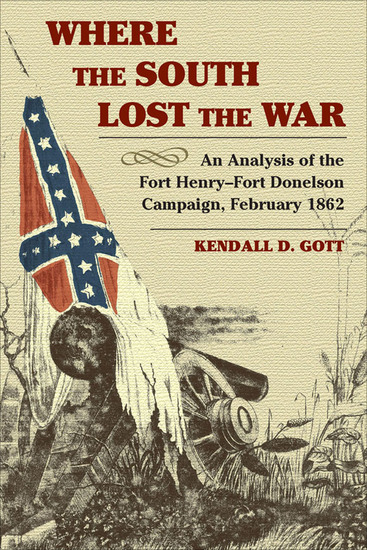
Where the South Lost the War - An Analysis of the Fort Henry-Fort Donelson Campaign February 1862 - cover

Where the South Lost the War - An Analysis of the Fort Henry-Fort Donelson Campaign February 1862

Kendall D Gott

Verlag: Stackpole Books

  • 0
  • 0
  • 0

Beschreibung

This in-depth Civil War study examines two early Union victories that were instrumental in deciding the conflict’s ultimate outcome. Some historians argue that the Civil War was decided in February 1862 with the collapse of the Confederate defenses of Forts Henry and Donelson on the Tennessee and Cumberland Rivers. This ambitious offensive opened the whole Tennessee Valley to Union invasion and control, effectively cutting the Confederacy in two.  In domino fashion, the Confederates lost Nashville and central and western Tennessee. Memphis eventually fell, and the upper stretch of the Mississippi itself was brought under Union control. During this period, General Ulysses S. Grant came to prominence, putting him in place to lead the Union to victory. Where the South Lost the War is a major contribution to Civil war literature. Shedding light on an overlooked campaign and revising conventional judgments on key players and events, author Kendall D. Gott provides a detailed, incisive, and even controversial study of the operation’s events.
Verfügbar seit: 14.06.2023.
Drucklänge: 387 Seiten.

Weitere Bücher, die Sie mögen werden

  • The Yalta Conference - The Political Decisions That Shaped the Post-War World - cover

    The Yalta Conference - The...

    Sage Winters

    • 0
    • 0
    • 0
    The Yalta Conference, held in February 1945, was a pivotal moment in the history of the 20th century, marking the intersection of military triumph and political strategy. As World War II neared its end, the leaders of the three major Allied powers—President Franklin D. Roosevelt of the United States, Prime Minister Winston Churchill of the United Kingdom, and Premier Joseph Stalin of the Soviet Union—gathered in the Crimean resort town of Yalta to discuss the future of Europe and the post-war world. This summit was not only a negotiation of territory but a critical turning point that set the stage for the global dynamics that would shape the Cold War and the decades that followed. 
    The atmosphere at Yalta was charged with the urgency of closing the chapter on a devastating war while simultaneously navigating the fractured relations between the Allies. The conversations were less about compromise and more about power, as each leader sought to secure the best possible outcome for their respective nations. Roosevelt, with his idealistic vision of a world order based on cooperation and peace, worked to establish the groundwork for the United Nations, believing that international cooperation would prevent future wars. Churchill, wary of Soviet expansion, focused on ensuring the preservation of British influence in Europe and curbing the rise of Soviet power. Stalin, on the other hand, aimed to secure the Soviet Union's strategic interests, particularly in Eastern Europe, and to strengthen the USSR's position as a superpower. 
    The decisions made at Yalta were far-reaching, with agreements on the division of Germany, the establishment of post-war borders, and the promise of Soviet participation in the Pacific War against Japan. These discussions laid the foundation for the division of Europe into spheres of influence, with the Soviet Union asserting control over Eastern Europe, while the Western Allies sought to maintain democratic governance in the West.
    Zum Buch
  • Boobs - cover

    Boobs

    Dr. Lisa Portolan, Amanda Goff

    • 0
    • 0
    • 0
    Breasts are celebrated and scrutinised, fetishised and censored, worshipped and weaponised. As the saying goes: ‘Behind every great woman is a pair of boobs trying desperately to stay out of the conversation.’ 
     
    For most of her life, unconcernedly flat-chested author and academic Dr Lisa Portolan had never really thought about her breasts, or boobs in general. But then she met Amanda Goff - aka former escort Samantha X - fellow author, journalist and owner of a huge pair of breasts. A friendship formed, then a working relationship ... and as the two women embarked on business dealings together, the monolithic power of mammary glands became glaringly apparent.  
     
    All too often, men would ogle Amanda's chest in meetings, text her romantic/perverse messages, and try to get into her pants. The same men would focus their attention on Lisa's face, send her professional emails, and otherwise ignore her. Lisa was left pondering whether she should have her breasts augmented in order to become more visible, while Amanda wondered whether she should have hers reduced.  
     
    But they both found themselves asking the same question: why all the fuss about boobs? 
     
    Lisa and Amanda don't pretend to have all the answers - they're not even sure how they feel about them most of the time. But that's precisely the point. Boobs is a smart, irreverent, wide-ranging and often hilarious conversation about the human and social-historical journey of breasts, richly illustrated with personal anecdotes and perspectives from coauthors at opposite ends of the bust spectrum.  
     
    With its eclectic mix of chest-related topics - from our fixation with symmetry to the judgy debates about breastfeeding - Boobs celebrates our messy, often ridiculous and always complex relationship with these culturally charged appendages.
    Zum Buch
  • Disembedded - Regulation Crisis and Democracy in the Age of Finance - cover

    Disembedded - Regulation Crisis...

    Basak Kus

    • 0
    • 0
    • 0
    During the last two decades, there has been much scholarly and popular interest in the financialization of the American economy—why the turn to finance has taken place, what constituted it, and what has come out of it. In Disembedded, Basak Kus draws from the theories of Karl Polanyi—one of the greatest and most influential political economists of the twentieth century—to answer these questions. Focused primarily on the state's regulatory role in a dominantly financialized economy, Kus examines how neoliberal principles influenced the evolution of American regulatory policies, shaping the financial sector's operations and practices. Her narrative traces the trajectory of these interactions, highlighting critical junctures, policy decisions, and market outcomes that culminated in the financial crisis. Offering historical insights into the financial crisis spanning 2007-2010 and its ensuing influence on American politics and democracy, Disembedded provides a broad-ranging and systemic explanation of the American political economy, especially the regulatory landscape that shaped the patterns of financialization.
    Zum Buch
  • Stop Being Toxic - How to Quit Narcissistic and Manipulative Behaviors Overcome Negativity and Build Healthy Relationships - cover

    Stop Being Toxic - How to Quit...

    Chase Hill

    • 0
    • 0
    • 0
    Are your relationships stuck in a cycle of negativity and misunderstandings? Ready for a change? Admitting your part is tough, but now comes the fun. Discover 7 easy steps to a brand new you! 
    It's easy to say, “My boss is too demanding.”, “My friends just don't get me.” or, “My partner is always on my case.” 
    But what if, just what if, the problem isn't “out there?”... What if the real problem is actually... you? 
    Recognizing you’re the “toxic one” isn't a moment of shame – it's a moment of power. Because if you're the problem, guess what? You're also the solution. 
    This book is for anyone who’s ready to take responsibility for their own happiness. 
    It's for people like you who are ready to break free and become the best versions of themselves. 
    Here’s a fraction of what you’ll discover inside: 
    ✓ A life-changing 7-step guide to escaping the toxic trap 
    ✓ How to own up to the traits and patterns in your behavior 
    ✓ The invisible strings fueling your toxic behavior and how to cut them loose 
    ✓ A counterintuitive method that allows you to walk a mile in another’s shoes, even if empathy doesn’t come naturally to you 
    ✓ How to voice your disagreements and resolve conflicts without resorting to manipulation or confrontation 
    ✓ The freedom that comes from shedding toxic habits 
    You are simply someone who's fallen into some unhelpful patterns that, believe it or not, CAN be changed. You’ve got so much potential just waiting to be tapped into. 
    Change is tough. It takes grit and commitment. But it's totally achievable. And it’s never too late to start.
    Zum Buch
  • Who Gets Ahead: Unlocking Secrets of College Admissions - "Transform your college admissions prep! Access compelling audio lessons packed with insider tips for success" - cover

    Who Gets Ahead: Unlocking...

    Cyrus Eldridge

    • 0
    • 0
    • 0
    Who Gets Ahead: Unlocking Secrets of College Admissions  
    ⭐⭐ Simplified Guide & Explanations Included ⭐⭐ 
    Are you eager to advance your career and enhance your knowledge for a successful future? 
    Searching for an all-inclusive manual that covers everything you need to know for unlocking the secrets that shape future opportunities and success?  
    Your quest ends here! 
    This guide serves as your ultimate resource for enriching your understanding, honing your skills, and engaging in practical exercises. With it, you're prepared for success. 
    Updated to reflect current trends in admissions strategies. 
    Key features of this comprehensive guide: 
    - In-depth insights into the college admissions process 
    - Clear explanations of what you need to know for success 
    - Effective strategies for preparation and approach 
    Our guide stands out with extensive coverage, which is critical for your advantageous positioning. Concepts are explored in detail, ensuring you’re fully equipped. 
    Please note that this guide is independent and not affiliated with any official admissions body—it is created solely for your benefit. 
    Crafted with a logical structure and straightforward language, our College Admissions Guide offers smooth transitions between topics. Say farewell to complicated jargon and embrace clear, accurate, and comprehensible information. 
    So, why delay? Click the BUY NOW button, secure your guide, and embark on your journey toward understanding the secrets that lead to future success! 
    Take the step now and unlock your potential!
    Zum Buch
  • Cracking the China Conundrum - Why Conventional Economic Wisdom Is Wrong - cover

    Cracking the China Conundrum -...

    Yukon Huang

    • 0
    • 0
    • 0
    China's rise is altering global power relations, reshaping economic debates, and commanding tremendous public attention. Despite extensive media and academic scrutiny, the conventional wisdom about China's economy is often wrong. Cracking the China Conundrum provides a holistic and contrarian view of China's major economic, political, and foreign policy issues. 


    Yukon Huang trenchantly addresses widely accepted yet misguided views in the analysis of China's economy. Huang explains that misconceptions arise in part because China's economic system is unprecedented in many ways—namely because it's driven by both the market and state—which complicates the task of designing accurate and adaptable analysis and research. Further, China's size, regional diversity, and uniquely decentralized administrative system poses difficulties for making generalizations and comparisons from micro to macro levels when trying to interpret China's economic state accurately. 


    This book not only interprets the ideologies that experts continue building misguided theories upon, but also examines the contributing factors to this puzzle. Cracking the China Conundrum provides an enlightening and corrective viewpoint on several major economic and political foreign policy concerns currently shaping China's economic environment.
    Zum Buch