Rejoignez-nous pour un voyage dans le monde des livres!
Ajouter ce livre à l'électronique
Grey
Ecrivez un nouveau commentaire Default profile 50px
Grey
Abonnez-vous pour lire le livre complet ou lisez les premières pages gratuitement!
All characters reduced
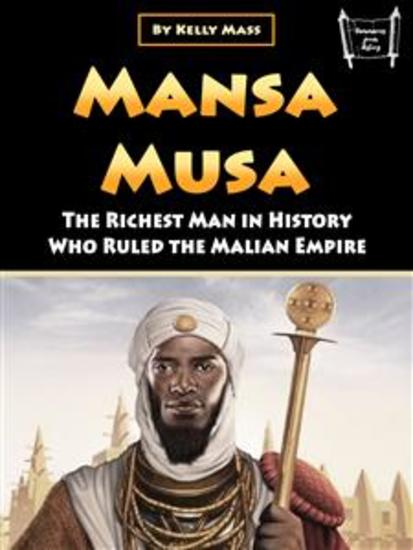
Mansa Musa - The Richest Man in History Who Ruled the Malian Empire - cover

Mansa Musa - The Richest Man in History Who Ruled the Malian Empire

Kelly Mass

Maison d'édition: Efalon Acies

  • 0
  • 0
  • 0

Synopsis

Mansa Musa, also known as Musa I, assumed the role of the ninth Mansa of the Mali Empire, a prominent West African realm, reigning from approximately 1280 to 1337. While the precise assessment of his wealth remains elusive, Musa has earned the title of "the wealthiest person in history."

At the zenith of his rule, Musa expanded the Mali Empire's boundaries, incorporating territories like Gao and Timbuktu. To strengthen ties with the broader Muslim world, he embarked on a pilgrimage to Mecca in 1324, accompanied by a sizable entourage and a considerable amount of gold. His generosity in Cairo during this journey triggered a decade-long decline in gold prices and garnered widespread attention across the Muslim world.
Musa actively promoted Islamic scholarship, drawing scholars from various Muslim regions to Mali. Under his patronage, Timbuktu emerged as a center of learning, exemplified by the construction of the Djinguereber Mosque. His reign marked Mali's pinnacle of power and magnificence.

Our understanding of Musa primarily relies on Arabic texts, particularly works by Al-Umari and Ibn Khaldun, composed after his pilgrimage. The Tarikh as-Sudan and the Tarikh al-fattash, written in Timbuktu in the 17th century, offer additional insights.
Disponible depuis: 08/12/2023.

D'autres livres qui pourraient vous intéresser

  • Ownership - The Evangelical Legacy of Slavery in Edwards Wesley and Whitefield - cover

    Ownership - The Evangelical...

    Sean McGever, Vincent E. Bacote

    • 0
    • 0
    • 0
    The latest book from the author of Evangelism: For the Care of Souls.
    Voir livre
  • The First Anzacs - cover

    The First Anzacs

    Jimmy Thomson, George Hulse

    • 0
    • 0
    • 0
    This is the unknown story of the combat engineers who kept World War I running. Although it has been repeatedly denied by the army, they were the first Australians to land at Anzac Cove: in any combat, even today, sappers are always the first in and last out. 
     
     
    They were airbrushed out of history. Official historian Charles Bean claimed the first Australian ashore at the Gallipoli landing on 25 April 1915 was an infantry officer. But Bean wasn't there, and a bunch of Australian and New Zealand army engineers were. Even today, the army is reluctant to accept that sappers were among the very first Australian soldiers ashore. 
     
    This is the untold story of the Australian and New Zealand sappers - combat engineers - who fought in World War I. They were always in the vanguard, clearing defences, and building bridges, roads and walkways for the troops who followed, usually under fire. At Gallipoli, strafed by machine guns and targeted by snipers, they dug trenches and tunnels to advance on the Turkish defences. On the Western Front, they burrowed under the German lines to plant massive explosives, whose eruption could be heard in England. In Egypt they demolished a Turkish railway in a day. 
     
    From Gallipoli to the sands of the Middle East, to the blood-soaked battlefields of France and Belgium, engineers put down their tools to also fight as combat soldiers at every major battle and campaign, often with heroic feats of astonishing courage. Three sappers stole a giant field gun from under German noses at Amiens. Sappers were classic Aussie larrikins, indefatigably practical men who don't take kindly to bureaucracy. Typically under-appreciated, two were cheated of their well-earned VCs by a British general after they, working alone, tricked a German platoon into surrendering. 
     
     
    'Sappers are the unsung heroes of the First World War and this book helps bring them back into the limelight where they belong.' WILL DAVIES, Beneath Hill 60 
     
     
    'It has taken 111 years for true stories to appear in a book adequately honouring Australian sappers in WW1 - you will remember these heroes forever'. COLONEL SANDY MACGREGOR MC (rtd) 
     
     
    'An excellent insight into the role of the Field Engineers as part of the combined arms team in World War One' BRIGADIER MICK SAY DSC, Head of Corps, Royal Australian Engineers
    Voir livre
  • Future Morality - cover

    Future Morality

    David Edmonds

    • 0
    • 0
    • 0
    The world is changing so fast that it's hard to know how to think about what we ought to do. We barely have time to reflect on how scientific advances will affect our lives before they're upon us. New kinds of dilemma are springing up. Can robots be held responsible for their actions? Will artificial intelligence be able to predict criminal activity? Is the future gender-fluid? Should we strive to become post-human? Should we use drugs to improve our intimate relationships—or to reduce crime? Our intuitions about questions like these are often both weak and confused. 


    David Edmonds has put together a philosophical task force to get to grips with these challenges. Twenty-nine philosophers present provocative and engaging pieces about aspects of life today, and life tomorrow—birth and death, health and medicine, brain and body, personal relationships, wrongdoing and justice, the internet, animals, and the environment. The future won't look the same when you've finished this book.
    Voir livre
  • The Civil Rights Act - America Changes Course - cover

    The Civil Rights Act - America...

    Nova Ashford

    • 0
    • 0
    • 0
    The history of civil rights in America is deeply intertwined with the nation’s founding principles, yet it is also defined by contradictions that stem from its treatment of African Americans. Slavery, which was institutionalized from the country’s early days, placed millions of African people in bondage and marked the beginning of a long struggle for racial equality. Enslaved individuals were considered property rather than people, denied basic human rights, and subjected to a life of forced labor and brutality. This practice was vital to the economic growth of the southern states, where plantations relied on enslaved labor to produce cash crops like cotton, tobacco, and sugar. The dehumanizing nature of slavery created an enduring racial hierarchy that persisted even after its formal abolition. 
    The end of the Civil War in 1865, with the passage of the 13th Amendment, theoretically liberated enslaved people. However, the promise of freedom was not immediately realized, as the southern states passed a series of laws known as Black Codes. These laws sought to maintain white dominance by severely limiting the rights and freedoms of African Americans. The Black Codes restricted mobility, employment opportunities, and legal protections, pushing many freedmen and women back into forced labor through sharecropping arrangements that mirrored slavery in many ways. Despite these setbacks, African Americans began to organize, laying the groundwork for future civil rights movements.
    Voir livre
  • Polish for Beginners: Learn Polish in 30 Days the Easy Way - cover

    Polish for Beginners: Learn...

    Lingo Publishing

    • 0
    • 0
    • 0
    Have you ever wanted to learn Polish but haven't found a comprehensive course that is also easy to understand?  
    Perhaps you have a family member from Poland or Polish friends you'd like to converse with. Maybe you've tried online apps and found them burdensome, one-size-fits-all, or just too fast or slow to enjoy. 
    Are you ready to learn this fascinating language, its roots, its evolution, and how it is spoken today? Poised to learn many everyday phrases, greetings, questions, and travel help? Then, you've come to the right place! 
    This book starts at the beginning with the exciting history behind this lovely language. It takes you to its present-day use without boring or overwhelming you on the way! This book provides a step-by-step way to learn beginning Polish – enough to get around and converse, and an excellent start to an intermediate or more graduated course. 
    Are you ready to:Learn one of the few languages only spoken in its own nation?Find out how to get around in Polish cities/towns with ease?Discover Polish literature and other cultural aspects of Poland?Become comfortable around Poles and handle everyday situations with ease?Build an excellent base for progressing to intermediate lessons?Gain confidence in online situations as well as one-on-one personal encounters? 
    With the help of skill-building exercises and plenty of samples of everyday situations, you'll become comfortable with the spoken language and quickly learn this wonderful country's verbal cues and social norms. You'll be taken on a journey that allows you to easily review and assess your progress, only moving on when you are comfortable with what you've learned.   
    Scroll up and click the “add to cart” button, and start your journey to comfortably interacting online and in person in Polish! 
    Voir livre
  • Sex After Grief - Navigating Your Sexuality After Losing Your Beloved - cover

    Sex After Grief - Navigating...

    Joan Price

    • 0
    • 0
    • 0
    Sex after Grief is the first book to address sex and grief together and treat sex as a normal, positive, life-affirming part of emerging from such a difficult time. Joan Price, the top expert on senior sex, draws on her own experiences as a widow since 2008, when she lost the love of her life to cancer. She shares her raw grief journey, sexual reawakening (and the many stumbles along the way), and attempts to dip back into dating, along with advice on handling each step. 


    Sex After Grief includes a variety of people's personal stories from folks of all genders and orientations. Some jumped into sex quickly. Some took years. Some withdrew from sexual possibility. No one was wrong, and no choice is defective or shameful. Sex After Grief includes: 


    ● Inspiring tales of how different people brought sex back into their lives after the loss of their spouse or partner 


    ● Guidelines for dating again and getting sexual with a new person 


    ● Reasons that solo sex is healthy and can be the path to feeling sexual again 


    ● Advice from therapists, grief counselors, and sex coaches 


    ● Self-help takeaways for creating an action plan
    Voir livre