Rejoignez-nous pour un voyage dans le monde des livres!
Ajouter ce livre à l'électronique
Grey
Ecrivez un nouveau commentaire Default profile 50px
Grey
Abonnez-vous pour lire le livre complet ou lisez les premières pages gratuitement!
All characters reduced
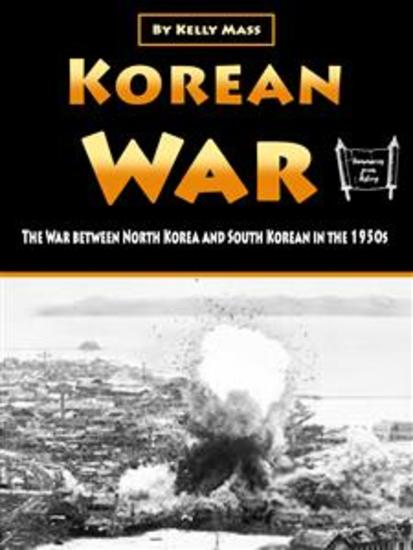
Korean War - The War between North Korea and South Korean in the 1950s - cover

Korean War - The War between North Korea and South Korean in the 1950s

Kelly Mass

Maison d'édition: Efalon Acies

  • 0
  • 0
  • 0

Synopsis

The Korean War, which lasted from June 25, 1950, to July 27, 1953, was a conflict between North and South Korea. It began when North Korea invaded South Korea after a series of border battles and uprisings in the South. The United Nations supported South Korea, with the United States as its primary backer, while North Korea received support from China and the Soviet Union. On July 27, 1953, the war ended with an armistice.

After Japan's surrender to the Allies on August 15, 1945, at the end of World War II, Korea, which had been under Japanese rule for 35 years, was divided along the 38th parallel by the United States and the Soviet Union. This division led to the establishment of two sovereign entities in 1948: the Democratic People's Republic of Korea in the north, led by the communist ruler Kim Il-sung, and the Republic of Korea in the south, led by the authoritarian Syngman Rhee. Both claimed to be the legitimate authority for all of Korea and rejected the border as a long-term solution.

The Korean War began when troops from the North Korean People's Army crossed the border into South Korea. In response, the UN Security Council declared it an invasion and authorized the formation of a UN Command to repel the North Korean forces. The UN forces, primarily composed of US troops, launched a daring counteroffensive from Incheon in September 1950, cutting off the North Korean troops and forcing them to retreat. However, Chinese forces from the People's Volunteer Army joined the war effort in October 1950, leading to a UN withdrawal from North Korea. Chinese troops remained stationed in North Korea, and the conflict continued with various offensives until an armistice was reached in July 1953.
Disponible depuis: 16/01/2024.
D'autres livres qui pourraient vous intéresser

  • Kaiser Wilhelm II - Biography of the Last German Emperor and King of Prussia - cover

    Kaiser Wilhelm II - Biography of...

    Kelly Mass

    • 0
    • 0
    • 0
    Wilhelm II, the last German Emperor (Kaiser) and King of Prussia, ruled from June 15, 1888, until his abdication on November 9, 1918, marking the end of the German Empire. His reign was tumultuous, characterized by grand ambitions and disastrous decisions that not only reshaped Germany but also contributed to the broader context of global conflict. Although Wilhelm's creation of a powerful navy and his drive to position Germany as a dominant world power earned him recognition, his erratic public statements and volatile foreign policy alienated many, making him a central figure in the lead-up to World War I. 
    Born in 1859 to Prince Frederick William of Prussia and Victoria, Princess Royal of the United Kingdom, Wilhelm II was part of a deeply interconnected European royal family. His mother, Queen Victoria’s eldest daughter, brought him into a web of political alliances that spanned several major European nations. Wilhelm’s father, Frederick III, briefly held the throne for only 99 days in 1888 before his untimely death, making it a year of remarkable transitions. Just months after his father’s passing, Wilhelm succeeded to the throne during what historians refer to as the "Year of the Three Emperors," as Wilhelm’s grandfather, Wilhelm I, had also died earlier that year.
    Voir livre
  • Rare Earth Elements & Critical Minerals: Science Supply Chains & Statecraft - What They Do Why They Matter & What The Future Holds… - cover

    Rare Earth Elements & Critical...

    Dr. Nick Coman, I. A.I.

    • 0
    • 0
    • 0
    A 36‑lecture audio course on the materials that run the modern world—from ore bodies and brines to magnets, batteries, chips, and reactors. Each lecture focuses on one element or mineral, tracing its journey from deposit geology through beneficiation and refining to the devices it powers. 
    We make the flowsheet legible: comminution and flotation; roasting, high‑pressure acid leaching, solvent extraction, and ion exchange; separation to oxides and metals; alloying and specialty powders. See how neodymium‑iron‑boron magnets are born, why lithium hexafluorophosphate matters in electrolytes, where gallium nitride wins in power, how graphite anodes evolve with silicon, and how the uranium fuel cycle and vanadium flow batteries actually work. 
    Markets and politics are treated as engineering constraints. Learn to spot yield killers, read offtake agreements, and separate strategic scarcity from narrative. Test real substitutions—ferrites in small motors, sodium‑ion for short‑range storage, gallium nitride versus silicon carbide—and where performance cliffs block redesign. We map chokepoints beyond the mine: separation capacity, reagents, waste handling, water and energy intensity, and manufacturer qualification cycles. Then we follow the consequences—export controls and quotas, permitting and community consent, tariffs and friend‑shoring, standards and labeling rules. 
    Rigorous, narrative‑driven, and built for the intellectually ambitious, this course is an operator’s guide to the science, supply chains, and statecraft of a materials‑constrained century.
    Voir livre
  • A Genocide Foretold - Reporting on Survival and Resistance in Occupied Palestine - cover

    A Genocide Foretold - Reporting...

    Chris Hedges

    • 0
    • 0
    • 0
    A Genocide Foretold confronts the stark realities of life under siege in Gaza and the heroic effort ordinary Palestinians are waging to resist and survive. Weaving together personal stories, historical context, and unflinching journalism, Chris Hedges provides an intimate portrait of systemic oppression, occupation, and violence. The book includes chapters on: 


    ● What life is like in Gaza City and Ramallah in the midst of approaching bombs and gunfire. 


    ● The history of the dispossession of Palestinians of their land in relation to the ideology of Zionism. 


    ● A portrait of Amr, a seventeen-year-old high school student who is forced to evacuate his village with his family. 


    ● Psychoanalysis of the state of permanent war that has led to the destruction of hospitals, telecommunications centers, governmental buildings, roads, homes universities, schools, and libraries and archaeological and heritage sites in Gaza. 


    ● The ways in which the collective retribution against innocents is a familiar tactic employed by colonial rulers. 


    ● A heartbreaking final chapter called "Letter to the Children of Gaza."
    Voir livre
  • Why Read - Selected Writings 2001–2021 - cover

    Why Read - Selected Writings...

    Will Self

    • 0
    • 0
    • 0
    From the Booker–shortlisted author of Umbrella, a world-girdling collection of writings inspired by a life lived in and for literature 
     
    From one of the most unusual and distinctive writers working today, Will Self’s Why Read is a cornucopia of thoughtful and brilliantly witty essays on writing and literature. 
     
    Self takes us with him: from the foibles of his typewriter repairman to the irradiated exclusion zone of Chernobyl, to the Australian outback, and to literary forms past and future. With his characteristic intellectual brio, Self aims his inimitable eye at titans of literature like Woolf, Kafka, Orwell, and Conrad. He  
    writes movingly on W. G. Sebald’s childhood in Germany and provocatively describes the elevation of William S. Burroughs’s Junky from shocking pulp novel to beloved cult classic. Self also expands on his regular column in Literary Hub to ask readers how, what, and ultimately why we should read in an  
    ever-changing world. Whether he is writing on the rise of the bookshelf as an item of furniture in the nineteenth century or on the impossibility of Googling his own name in a world lived online, Self’s trademark intoxicating prose and mordant, energetic humor infuse every piece. 
     
    A book that examines how the human stream of consciousness flows into and out of literature, Why Read will satisfy both old and new readers of this icon of contemporary literature.
    Voir livre
  • The Exile's Cookbook - Medieval Gastronomic Treasures from al-Andalus and North Africa - cover

    The Exile's Cookbook - Medieval...

    Ibn Razīn Al-Tujībī

    • 0
    • 0
    • 0
    The Exile's Cookbook brings together 480 recipes, including roasts and stews, breads, condiments, preserves, sweetmeats, and even hand-washing soaps. It offers a fascinating insight into the cuisine of Muslim Spain and North Africa in the period – its regional characteristics and historical antecedents, but also its links to culinary traditions in other parts of the Muslim world.
    
    This elegant translation by Daniel L. Newman is based on all the manuscripts of the text that are known to have survived. It is accompanied by an introduction and extensive notes contextualising the recipes, ingredients, tableware and cooking practices.
    Voir livre
  • Jews in the Garden - A Holocaust Survivor the Fate of His Family and the Secret History of Poland in World War II - cover

    Jews in the Garden - A Holocaust...

    Judy Rakowsky

    • 0
    • 0
    • 0
    Villages of Poland hide the lost secrets of World War II 


    1944: Heavy footfalls thud on the road on a rainy May night. A band of gunmen scour a hilltop farm, acting on rumors that it harbors a Jewish family. For 18 months, the Rozeneks have been hiding safely, but their luck is about to run out. Only one from the family of six will live to see the sunrise. Sixteen-year-old Hena Rozenek shelters in the woods until morning . . . and then she runs. 


    Forty years later: Holocaust survivor Sam Rakowski Ron has lived in the United States for decades, never thinking he could return to the Polish village he fled as a teenager. But now he's ready to talk about what he heard, what he saw, and what he knows about two separate families of cousins who were his neighbors, and presumably were killed during the war. The story Poland presents to the world is that Poles saved more Jews than citizens of any other nation, that any murders in Poland were committed by Nazis and Nazis alone. But Sam, while defending his countrymen, suspects a painful truth. The stories he shares with his younger cousin, Judy, an investigative journalist, send them off on a decades-long journey unlike any other to find out what happened to the Rozenek family and ultimately reveal the secrets the Polish government is still desperate to keep.
    Voir livre