¡Acompáñanos a viajar por el mundo de los libros!
Añadir este libro a la estantería
Grey
Escribe un nuevo comentario Default profile 50px
Grey
Suscríbete para leer el libro completo o lee las primeras páginas gratis.
All characters reduced
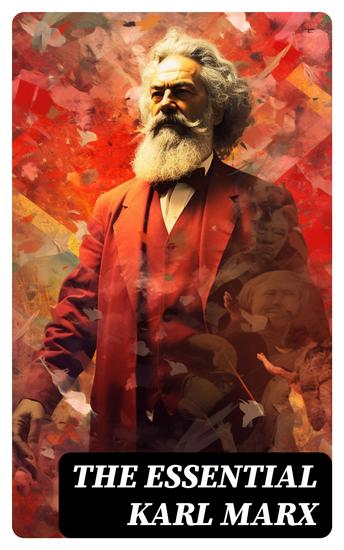
The Essential Karl Marx - Capital Communist Manifesto Wage Labor and Capital Critique of the Gotha Program Wages Price and Profit Theses on Feuerbach - cover

The Essential Karl Marx - Capital Communist Manifesto Wage Labor and Capital Critique of the Gotha Program Wages Price and Profit Theses on Feuerbach

Karl Marx, Florence Kelley, N.I. Stone

Traductor Friedrich Engels, Eleanor Marx Aveling, Daniel De Leon, Samuel Moore, Harriet E Lothrop

Editorial: DigiCat

  • 0
  • 0
  • 0

Sinopsis

The Essential Karl Marx assembles a compelling array of writings that encapsulate the core tenets of Marxist thought while showcasing a myriad of literary forms from essays to critiques. This anthology adeptly illuminates the revolutionary ideas of Karl Marx against the backdrop of 19th-century socio-economic upheaval. Standout pieces ponder concepts such as class struggle and capitalist critique, without losing sight of the intricate interplays that underpin Marx's broader philosophical inquiry. This diverse collection not only underscores Marx's intellectual legacy but also echoes with the resounding implications of his works on modern social structures. The contributing voices of Florence Kelley and N.I. Stone provide rich, contextual layers by engaging with Marx's ideologies through the lens of social reform and economic thought, respectively. Florence Kelley's involvement with labor rights and gender equality intertwines seamlessly with Marx's critique of industrial capitalism, while N.I. Stone's economic analysis enriches the discourse on Marxism. Their collective backgrounds epitomize the intersection of advocacy and economic expertise, drawing linkages to historical movements like Marxism's role in 20th-century social reform agendas. This anthology is a scholarly treasure for readers eager to traverse an intellectual journey that unifies disparate yet harmonious views on socio-economic paradigms. It offers a unique vantage into the evolution of thought provoked by Marx's theories while cultivating dialogues on equity and disparity. Engaging with this collection promises a profound educational experience, where readers gain multidimensional insights into the tenets of Marxism and their enduring relevance in contemporary discussions.
Disponible desde: 28/12/2023.
Longitud de impresión: 2607 páginas.

Otros libros que te pueden interesar

  • The Hitler Youth - How Germany Indoctrinated a New Generation - cover

    The Hitler Youth - How Germany...

    Julian Flanders

    • 0
    • 0
    • 0
    In this fascinating book, Julian Flanders examines the impact of the Hitlerjugend (Hitler Youth Movement) on Germany's young people and how it shaped German society under Adolf Hitler. By 1940 membership had reached eight million - more than 90 per cent of German children. Between 1933 and the outbreak of World War II in 1939, the movement drove a wedge between youth, the educational system, and even their own dissenting families, producing a generation of anti-intellectuals indoctrinated with Nazi ideology. On the eve of war, the Hitler Youth constituted the single most successful mass movement in the Third Reich and comprised many of its most committed Nazis. Members of Hitlerjugend went on to play a substantial role in World War II, as many underage troops fought and died for their country.
    Ver libro
  • The Tech Coup - How to Save Democracy from Silicon Valley - cover

    The Tech Coup - How to Save...

    Marietje Schaake

    • 0
    • 0
    • 0
    Under the cover of "innovation," technology companies have successfully resisted regulation and have even begun to seize power from governments themselves. Facial recognition firms track citizens for police surveillance. Cryptocurrency has wiped out the savings of millions and threatens the stability of the global financial system. Spyware companies sell intelligence tools to anyone who can afford them. This new reality—where unregulated technology has become a forceful instrument for autocrats worldwide—is terrible news for democracies and citizens. 


    In The Tech Coup, Marietje Schaake explains how technology companies crept into nearly every corner of our lives and our governments. She takes us beyond the headlines to high-stakes meetings with human rights defenders, business leaders, computer scientists, and politicians to show how technologies have gone from being heralded as utopian to undermining the pillars of our democracies. To reverse this existential power imbalance, Schaake outlines solutions to empower elected officials and citizens alike. Democratic leaders can—and must—resist the influence of corporate lobbying and reinvent themselves as dynamic, flexible guardians of our digital world. Schaake offers a frightening look at our modern tech-obsessed world—and a clear-eyed view of how democracies can build a better future before it is too late.
    Ver libro
  • The Shortest History of War - From Hunter-Gatherers to Nuclear Superpowers—A Retelling for Our Times - cover

    The Shortest History of War -...

    Gwynne Dyer

    • 0
    • 0
    • 0
    War has always been a defining feature of human society. This new addition to the Shortest History series explains why we do it—and how we can stop. 


    Russia's invasion of Ukraine has punctured the longest stretch of peace between major powers since WWII, bringing the horrors of warfare—past, present, and future—to the forefront of listeners' minds. In The Shortest History of War, internationally acclaimed historian Gwynne Dyer adds urgently needed context. 


    Dyer ably charts the evolution of violent conflict: tribal aggression, classical combat, limited war, total war, and cold war—followed by present-day terrorism, nuclear threats, and the development of lethal autonomous weapons systems (LAWS). His brilliant, brisk history is a harrowing must-listen for all who wonder: How will rival superpowers with unprecedented weapons shape the future of our interconnected world?
    Ver libro
  • Everyday Freedom - Designing the Framework for a Flourishing Society - cover

    Everyday Freedom - Designing the...

    Philip K. Howard

    • 0
    • 0
    • 0
    Something basic is missing in our culture. Americans know it. Nothing much works as it should. Simple daily choices seem impossible, or fraught with peril. In the workplace, we walk on eggshells. Big projects get stalled in years of review. Endemic social problems such as homelessness become, well, more endemic. 


    Everyday Freedom offers a radical reinterpretation of the corrosion of American culture. The assault on authority after the 1960s, aimed at enhancing freedom, instead created a plague of powerlessness. The teacher in the classroom, the principal in a school, the nurse in the hospital, the official in Washington, the parent on a field trip . . . all have their hands tied. Things don't work, and Americans have lost the freedom to be themselves. 


    Everyday Freedom offers a radical vision for change: Re-empower Americans in their everyday choices. The massive legal structures erected since the 1960s were based on flawed notions that human judgment could be replaced by elaborate dictates. These failed structures must be replaced with simpler frameworks activated by human responsibility and accountability. Nothing will work sensibly until Americans are free to draw on their skills, intuitions, and values when confronting daily challenges. This is the only cure to alienation. This is also the only way to deliver good government.
    Ver libro
  • Twilight's Last Gleaming - Can America Be Saved? - cover

    Twilight's Last Gleaming - Can...

    Todd Starnes

    • 0
    • 0
    • 0
    "Todd Starnes is a fierce defender of freedom and a great patriot. He has seen, and understands, what is happening to our country like few others—his book is absolutely terrific, a must read!" —President Trump 


    President Biden ushered in a dark winter of malaise across our great nation. He snuffed out Lady Liberty's bright beacon of hope and brought despair to the land. And now we stand at a time of great choosing. Do we choose the path that leads to freedom or the path that leads to tyranny? 


    We face difficult days, but not hopeless days. Together, we can restore the Republic and reclaim our standing in the world. But first, we must remember our roots and return to the values that made our nation great. A deep and abiding desire for freedom and liberty, girded by faith in God, is the essence of who we are. Those are the precepts that must be reaffirmed if America is to be saved.
    Ver libro
  • Anarchism and Society - How Anarchism Proposes to Organize a Stateless Society - cover

    Anarchism and Society - How...

    Arlo Holders

    • 0
    • 0
    • 0
    Anarchism, as a political philosophy, is fundamentally concerned with the question of authority and its rightful place in society. The central tenet of anarchism is the belief that no individual or institution should have absolute power over others. This idea rejects hierarchical structures and the idea of the state as a necessary or legitimate institution. Anarchism calls for a society where individuals govern themselves through voluntary cooperation and mutual aid, without the need for a coercive state apparatus. 
    Historically, anarchism has evolved from a series of intellectual traditions and movements that have sought to challenge the dominant power structures in society. It draws heavily on the ideas of early political thinkers such as Pierre-Joseph Proudhon, who famously declared, "Property is theft!" and Mikhail Bakunin, who argued for the abolition of the state and the establishment of a society based on collective freedom and self-management. These thinkers were critical of the state, capitalism, and other forms of social hierarchy that limit human freedom. 
    Anarchism is often misunderstood or misrepresented as a chaotic or violent ideology. However, at its core, anarchism advocates for a peaceful and just society where individuals are free to govern themselves without external control. Anarchists argue that true freedom can only be achieved when people are no longer subject to the oppressive structures of the state, capitalism, or other forms of authoritarian control. They advocate for the dismantling of oppressive institutions and the creation of a more equitable and cooperative society.
    Ver libro