Rejoignez-nous pour un voyage dans le monde des livres!
Ajouter ce livre à l'électronique
Grey
Ecrivez un nouveau commentaire Default profile 50px
Grey
Abonnez-vous pour lire le livre complet ou lisez les premières pages gratuitement!
All characters reduced
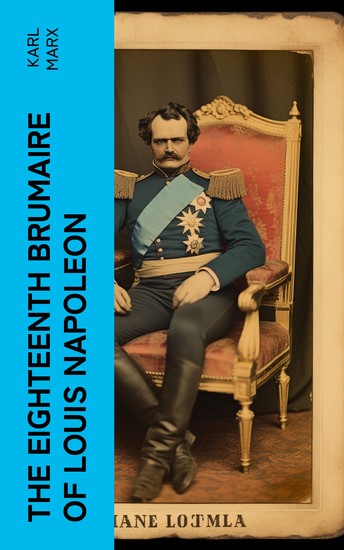
The Eighteenth Brumaire of Louis Napoleon - cover

The Eighteenth Brumaire of Louis Napoleon

Karl Marx

Traducteur Daniel De Leon

Maison d'édition: e-artnow

  • 0
  • 0
  • 0

Synopsis

This book about Napoleon Bonaparte's coup d'etat of 1851 in France allows Marx to explain why he thinks the earlier French Revolution of 1848, gave Napoleon the wings to achieve his triumph. This event, which occurred on 8th-9th November 1851, is often regarded as the end of the Revolution and the one that allowed Napoleon to establish his power over France. Karl Marx gives his particular views on this event and on Napoleon.
Disponible depuis: 08/12/2023.
Longueur d'impression: 109 pages.


D'autres livres qui pourraient vous intéresser

  • Democracy in America - cover

    Democracy in America

    Alexis de Tocqueville

    • 0
    • 0
    • 0
    Explore the timeless insights of Alexis de Tocqueville in his masterpiece, Democracy in America. This profound work, originally published in the 19th century, remains a cornerstone of political philosophy and social science, offering a detailed examination of the American democratic system, its principles, and its implications for liberty and equality.
     
    Through keen observations and eloquent analysis, Tocqueville explores the unique strengths and challenges of democracy. He delves into topics such as the balance between individual freedom and social equality, the role of religion in public life, the impact of a free press, and the dynamics of civil society.
     
    The audiobook offers a captivating journey through the mind of one of history’s greatest political thinkers, examining the foundations of democracy and its relevance to contemporary society. With a tone that is both reflective and motivational, this audiobook will engage listeners who are curious about governance, civic engagement, and the enduring quest for a just society.
     
    Perfect for leaders, scholars, and anyone passionate about understanding the roots of modern democratic values, Democracy in America is a vital resource for navigating the complexities of politics and culture today.
    Voir livre
  • The First Landing - cover

    The First Landing

    Santiago Machain

    • 0
    • 0
    • 0
    When a fleet of Norse ships braves the stormy Atlantic and lands on the wild shores of Vinland, a new chapter in history begins. Led by Leif Erikson, the settlers must confront the challenges of an unknown land, forge uneasy alliances with the indigenous Skraeling peoples, and navigate the tensions of their own traditions and ambitions. As the seasons turn, the Norse community faces hardship, hope, and the birth of a new society—one shaped by courage, cooperation, and the enduring spirit of adventure. The First Landing is a sweeping tale of survival, cultural encounter, and the seeds of a colony that could change the fate of two worlds.
    Voir livre
  • Picturing America - The Golden Age of Pictorial Maps - cover

    Picturing America - The Golden...

    Stephen J. Hornsby

    • 0
    • 0
    • 0
    Instructive, amusing, colorful—pictorial maps have been used and admired since the first medieval cartographer put pen to paper depicting mountains and trees across countries, people and objects around margins, and sea monsters in oceans. More recent generations of pictorial map artists have continued that traditional mixture of whimsy and fact, combining cartographic elements with text and images and featuring bold and arresting designs, bright and cheerful colors, and lively detail. In the United States, the art form flourished from the 1920s through the 1970s, when thousands of innovative maps were mass-produced for use as advertisements and decorative objects—the golden age of American pictorial maps.  Picturing America is the first book to showcase this vivid and popular genre of maps. Geographer Stephen J. Hornsby gathers together 158 delightful pictorial jewels, most drawn from the extensive collections of the Library of Congress. In his informative introduction, Hornsby outlines the development of the cartographic form, identifies several representative artists, describes the process of creating a pictorial map, and considers the significance of the form in the history of Western cartography. Organized into six thematic sections, Picturing America covers a vast swath of the pictorial map tradition during its golden age, ranging from “Maps to Amuse” to “Maps for War.” Hornsby has unearthed the most fascinating and visually striking maps the United States has to offer: Disney cartoon maps, college campus maps, kooky state tourism ads, World War II promotional posters, and many more. This remarkable, charming volume’s glorious full­-color pictorial maps will be irresistible to any map lover or armchair traveler.
    Voir livre
  • Genghis Khan - The Empire Conquests and Plunder of the Mongols - cover

    Genghis Khan - The Empire...

    Kelly Mass

    • 0
    • 0
    • 0
    Genghis Khan was the Mongol emperor who has expanded his region to the biggest empire on the face of the earth ever. His empire stretched from East Asia all the way to various European countries, the Middle East, and beyond. 
    What made Genghis Khan so successful? 
    Was he a brute, rapist, and pillaging dictator, or did he have a tolerant side as well? 
    How do the people in Mongolia see him, or the people in China? 
    All o these questions and more will be answered in this comprehensive overview of the history of Genghis Khan. You will learn more about his early life, his relationships, marriage, families and children, his attacks, his unification of the Mongolian Federations, his death, succession, and the continuing of the Mongolian Empire after his death.
    Voir livre
  • Mystics of the Empire - Magic and Rule in Ancient Rome - Volume 1 - cover

    Mystics of the Empire - Magic...

    Davis Truman

    • 0
    • 0
    • 0
    In Mystics of the Empire, this groundbreaking study delves into the often-overlooked relationship between Roman emperors and magic, offering a fresh perspective on how sorcery and power intersected in the ancient world. While the lives and reigns of emperors have long captivated scholars, the fascinating role of magic in their rule remains a largely unexplored area of historical inquiry. This book examines how emperors were depicted as patrons of magical practices and as victims and persecutors of sorcery, revealing the complex political, social, and religious ramifications of magic in the Roman Empire. 
    From the mystical associations of the early emperors to the later, more controversial reigns of figures like Elagabalus, Mystics of the Empire analyzes the twofold nature of magic’s role — whether it was used as a tool for imperial authority or as a threat to Roman stability. The book explores how emperors employed magicians for their own purposes and how their engagement with magic could be a source of political intrigue and downfall. Drawing on ancient sources and case studies, the narrative illuminates how these magical associations shaped the representation of emperors while also addressing the motivations behind these portrayals. 
    By offering a detailed examination of the magical context from the establishment of the Principate to the end of the Severan dynasty, Mystics of the Empire reveals the intricate interplay between the mystical and the political in ancient Rome. This work challenges traditional understandings of Roman governance, providing readers with a deeper appreciation of how magic was used as a tool of power, control, and subversion in one of history’s most enduring empires.
    Voir livre
  • The Great Famine of 1315-1317 - Europe's Darkest Hour - cover

    The Great Famine of 1315-1317 -...

    Sarah Willards

    • 0
    • 0
    • 0
    The Great Famine of 1315-1317 stands as one of the darkest periods in European history, marking a time of immense suffering, social upheaval, and devastation. It was not a single event but rather a prolonged crisis, which compounded existing vulnerabilities within medieval European society. The origins of the famine can be traced back to a confluence of environmental, social, and economic factors, all of which led to one of the worst food shortages ever experienced on the continent. 
    The famine’s roots can be found in the dramatic climatic changes of the early 14th century. The period known as the Little Ice Age brought cooler temperatures, and the years leading up to the famine saw unusual weather patterns. Prolonged rain, particularly during the summer months of 1315, led to flooding and crop failure, especially in regions dependent on staple grains like wheat, oats, and barley. The disastrous harvests were compounded by already strained food supplies and a growing population. 
    The impact of the famine was felt most acutely by the poorer classes, whose subsistence farming could not sustain them through such harsh conditions. The majority of the population in rural areas relied on farming for food and income, and with crops failing, their livelihoods were destroyed. Urban centers, though slightly better equipped to withstand hardship, faced sharp increases in food prices, making it difficult for even the wealthier classes to procure sustenance. Starvation, malnutrition, and poverty became widespread, leading to mass suffering across the continent.
    Voir livre