Rejoignez-nous pour un voyage dans le monde des livres!
Ajouter ce livre à l'électronique
Grey
Ecrivez un nouveau commentaire Default profile 50px
Grey
Abonnez-vous pour lire le livre complet ou lisez les premières pages gratuitement!
All characters reduced
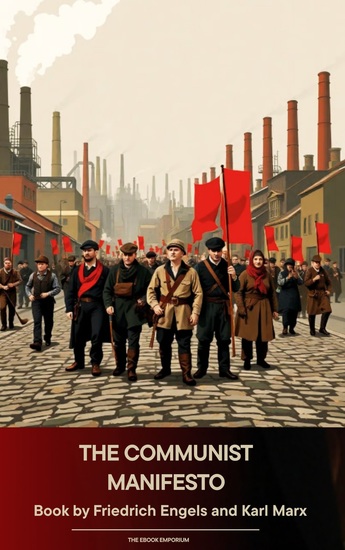
The Communist Manifesto - cover

The Communist Manifesto

Friedrich Engels, Karl Marx

Traducteur Samuel Moore

Maison d'édition: The Ebook Emporium

  • 0
  • 0
  • 0

Synopsis

"A spectre is haunting Europe—the spectre of communism."

In a world transformed by the Industrial Revolution, Marx and Engels set out to decode the hidden mechanics of society. They argue that all of human history is the history of class struggles: the constant friction between those who own the means of production and those who sell their labor to survive. The Communist Manifesto is a call to action that envisions a future beyond exploitation, predicting the inevitable rise of the working class and the transition to a classless, stateless society. Whether viewed as a historical artifact or a living critique of global economics, this text remains essential for understanding the modern world.

The Great Divide: Bourgeoisie vs. Proletariat: The Manifesto famously defines the two warring camps of the industrial age. The Bourgeoisie (the ruling capitalist class) are described as a revolutionary force that "shattered" feudalism but created a system of "naked self-interest." Opposing them is the Proletariat (the working class), whom Marx describes as the "grave-diggers" of the very system that created them.

The Ten-Point Program: In the second section, the authors lay out a controversial and radical set of measures for the "most advanced countries," including the abolition of private land ownership, a heavy progressive income tax, and the centralization of credit and communication in the hands of the state. These points sparked over a century of political experimentation and debate across every continent.

A Legacy of Global Change: From the revolutions of 1917 to the modern labor movements of the 21st century, the rhetoric of the Manifesto has been used to challenge the status quo. Its closing cry—"Working Men of All Countries, Unite!"—remains one of the most famous slogans in human language, symbolizing the birth of international political solidarity.

Analyze the roots of the modern world. Purchase "The Communist Manifesto" today.
Disponible depuis: 13/01/2026.
Longueur d'impression: 105 pages.

D'autres livres qui pourraient vous intéresser

  • Patagonia: The History of the Southernmost Region in South America - cover

    Patagonia: The History of the...

    Editors Charles River

    • 0
    • 0
    • 0
    The name, "Patagonia" comes from an observation made by Ferdinand Magellan, who visited the region during his historic expedition around the world. Marveled by the height of the indigenous people, he referred to the region as a “land of giants.” Those giants were the Tehuelches, named by Magellan’s expedition as Patagones, and the chronicles of that trip, written by Antonio Pigafetta, popularized the term “Patagones,” a term that refers to their big feet (in Spanish, “patones” means "of big feet"). This description would later derive in the name Patagonia. 
    	From its discovery until the 20th century, the borders of Patagonia as well as those elements that define it as such have gone through several changes and names. The main thing for understanding its limits during the Spanish conquest is that Patagonia referred to the land south of the European area of influence. Back then, Patagonia was under control of indigenous inhabitants and, as such, outside European control or only partly influenced. It is no wonder, then, that the earliest limit was the Río de la Plata itself, where in 1536 (and again in 1580) the city of Buenos Aires was founded. Later on, the conquest of the territory, along with the work of cartographers from around the world, gave shape to the region.
    Voir livre
  • Summer of 1876 The: Book Summary & Analysis - cover

    Summer of 1876 The: Book Summary...

    Alexander Pike

    • 0
    • 0
    • 0
    This content is an independent and unofficial summary created for informational and educational purposes only. It is not affiliated with, authorized, approved, licensed, or endorsed by the original author or publisher. All rights to the original work belong to its respective copyright holders. This summary is not intended to substitute the original book, but to offer a concise overview and interpretation of its main ideas.


    Step into one of the most pivotal seasons in American history—a time of invention, ambition, and reckoning. The Summer of 1876 brings to life a whirlwind of events that reshaped a nation on the edge of transformation. From the smoky battlefields of Little Bighorn to the clinking poker chips of Deadwood, from the rising hum of telegraphs to the thunder of trains racing across the plains, this gripping chronicle captures a summer when destiny galloped forward.
     
    Meet iconic figures like George Armstrong Custer, Wild Bill Hickok, and Wyatt Earp—not as legends, but as men driven by urgency, ego, and fate. Witness how innovation collided with conflict, and how small choices sparked massive consequences. With vivid detail and cinematic pace, this audiobook transforms the past into a blueprint for personal growth, leadership, and decision-making in high-stakes environments.
    Voir livre
  • Start with Welcome - The Journey toward a Confident and Compassionate Immigration Conversation - cover

    Start with Welcome - The Journey...

    Bri Stensrud, Jamie Ivey

    • 0
    • 0
    • 0
    Read by the author. 
    Asking the hard questions about immigration in light of Jesus' call to love our neighbors as ourselves. 
    You've seen the headlines. You've watched the TV footage. People around the world are in dire situations and on the move. Current estimates suggest over 100 million people are forcibly displaced from their homes and seeking refuge in other countries. It seems as if everyone wants to come to the U.S., and if we're honest, that gives many of us pause. 
    We wonder how it would impact our culture and communities if we showed welcome to the world, and many of us wonder how to separate the political rhetoric and talking points on present day immigration from what the Bible really has to say about immigrants and strangers. 
    Start with Welcome dives into the whole narrative of Scripture to better understand what God calls us to do concerning immigrants and refugees. Bri Stensrud will guide you through pressing questions that will ignite your compassion and leave you curious about our calling as followers of Christ—questions like:Is Immigration a Pro-Life Issue?What does the Bible say about Immigrants?Who is Welcome here?What does Christlike Welcome look like? 
      
    You have questions. You have fears. But you also have compassion. 
    So, let's start there. 
    Bri Stensrud welcomes you into the conversation—a conversation that’s more urgent now than ever. It all starts with one word: Welcome. 
    Pictures and discussion questions can be found in the audiobook companion PDF download. 
     
    Voir livre
  • Applied Psychology - Making Your Own World - cover

    Applied Psychology - Making Your...

    Warren Hilton

    • 0
    • 0
    • 0
    "Applied Psychology: Making Your Own World" by Warren Hilton delves into practical techniques for harnessing the power of the mind to achieve success and happiness. It explores methods for self-improvement, goal setting, and mastering one's thoughts, empowering readers to shape their destinies through psychological principles. Read in English, unabridged.
    Voir livre
  • Brandy Station and the March to Gettysburg: The History of the Confederate Invasion of Pennsylvania Before the Biggest Battle of the Civil War - cover

    Brandy Station and the March to...

    Editors Charles River

    • 0
    • 0
    • 0
    As Lee’s army moved into Pennsylvania, Stuart’s cavalry screened his movements, thereby engaging in the more traditional cavalry roles, but it’s widely believed that he was still smarting over the results of June 9. As a result, many historians think it likely that he had already planned to remove the negative effect of Brandy Station by duplicating one of his now famous rides around the enemy army, much as he did to McClellan’s Army of the Potomac during the Peninsula Campaign in 1862. This time, however, as Lee began his march north through the Shenandoah Valley in western Virginia, it is highly unlikely that is what he wanted or expected. 
    To complicate matters even more, as Stuart set out on June 25 on what was probably a glory-seeking mission, he was unaware that his intended path was blocked by columns of Union infantry that would invariably force him to veer farther east than he or Lee had anticipated. Ultimately, his decision would prevent him from linking up with Ewell as ordered and deprive Lee of his primary cavalry force as he advanced deeper and deeper into unfamiliar enemy territory. According to Halsey Wigfall (son of Confederate States Senator Louis Wigfall) who was in Stuart’s infantry, “Stuart and his cavalry left [Lee’s] army on June 24 and did not contact [his] army again until the afternoon of July 2, the second day of the [Gettysburg] battle.” 
    As it would turn out, Lee’s army inadvertently stumbled into Union cavalry and then the Union army at Gettysburg on the morning of July 1, 1863, unaware of the force in their front. From July 1-3, Lee’s army tried everything in its power to decisively defeat George Meade’s Union Army of the Potomac, unleashing ferocious assaults that inflicted nearly 50,000 casualties in all. Lee would try and fail to dislodge the Union army with attacks on both of its flanks during the second day and Pickett’s Charge on the third and final day. 
    Voir livre
  • Diversify - cover

    Diversify

    June Sarpong

    • 0
    • 0
    • 0
    ‘A handbook for these troubled times’ Psychologies Magazine 
    ’Engaging and informative … highlights our common humanity’ Kofi Annan 
    ‘A passionately written polemic’ You MagazineThe truth is, INCLUSION is better for EVERYONE. 
    In this empowering call to arms, June Sarpong MBE proves why. 
    Putting the spotlight on groups who are often marginalised in our society, including women, ethnic minorities, those living with disabilities, and the LGBTQ+ community, Diversify uncovers the hidden cost of exclusion and shows how a new approach to how we learn, live and do business can solve some of the most stubborn challenges we face. 
    With unshakeable case studies, brand-new research from Oxford University, and six revolutionary steps to help you overcome unconscious bias, this book will help you become part of a better society. 
    The old way isn’t working. This is a case for change. 
    In Diversify, June Sarpong delves into the heart of social and economic disparity, shedding light on the discrimination faced by minority classes. The book is a top pick for those interested in understanding the intersection of race, ethics, and public policy. 
    For fans of Mary Ann Sieghart (The Authority Gap), Steve Silberman (Skeleton Key), Reni Eddo-Lodge (Why I’m No Longer Talking to White People About Race), Laura Bates (Fix the System, Not the Women), and Darren Chetty (How to Disagree).
    Voir livre