Join us on a literary world trip!
Add this book to bookshelf
Grey
Write a new comment Default profile 50px
Grey
Subscribe to read the full book or read the first pages for free!
All characters reduced
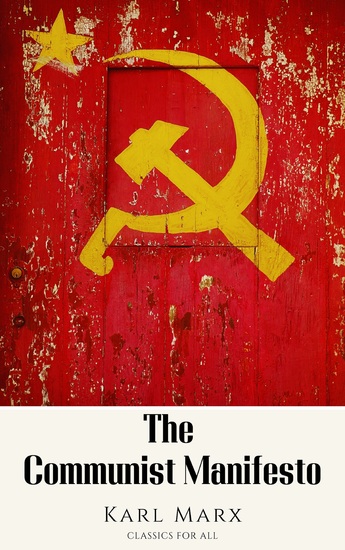
The Communist Manifesto - cover

The Communist Manifesto

Karl Marx, Classics for all

Translator Samuel Moore

Publisher: Classics for all

  • 0
  • 0
  • 0

Summary

Ignite your mind with the revolutionary ideas that shaped the world.
The Communist Manifesto by Karl Marx and Friedrich Engels is a seminal work that ignited a global movement. This groundbreaking text offers a scathing critique of capitalism and a visionary blueprint for a new social order.
Explore the core concepts that have influenced history, including:

- Class struggle: Understand the conflict between the bourgeoisie and the proletariat.
- Historical materialism: Explore the relationship between economic systems and social structures.
- The inevitability of revolution: Discover the authors' vision for overthrowing capitalism.Whether you're a student of history, a political enthusiast, or simply curious about the forces shaping our world, The Communist Manifesto is a must-read.
 
A foundational text in political science and sociology, studied by generations of thinkers."A powerful and enduring document that continues to provoke debate and inspire action." - The Guardian
Unleash the power of ideas. Download The Communist Manifesto today and join the global conversation.
Ignite your mind and shape the future. Scroll up and click "Buy Now!"
Available since: 08/05/2024.
Print length: 75 pages.

Other books that might interest you

  • New Moons For Sam - Becoming Kiwi - Life of a New Zealand Diplomat - cover

    New Moons For Sam - Becoming...

    Peter Hamilton

    • 0
    • 0
    • 0
    A personal, intimate, memoir spanning 70 years, in three parts, describing my childhood in the UK and New Zealand, my 35 years as a New Zealand diplomat, and the hundreds of amazing individuals I met on the way, from farming folk to Kings, Queens and Presidents. Part One is the story of an English boy growing up on a farm in rural Devon and Somerset in an extended family, and then, aged 9, moving to rural New Zealand. It covers my school years, my year as a volunteer teacher, aged 17, at an all boys school, in the South Pacific Kingdom of Tonga and my year as a university student in a still divided Germany. Part Two describes my career as a junior, then senior, New Zealand diplomat, and my postings in Fiji, Canada, Geneva, Samoa, Germany and Singapore, the last three as Ambassador. Part Three argues that New Zealand should become a republic in the Commonwealth, with its own Head of State. It describes, too, my liberating journey from Anglicanism to freedom from any religion. I have aimed to tell the memoir with a sense of humour, humility and (for the most part) optimism!
    Show book
  • NATO After Russia's Invasion of Ukraine - Threat Perceptions and Their Consequences - cover

    NATO After Russia's Invasion of...

    Jason W. Davidson

    • 0
    • 0
    • 0
    A revealing look at differing threat perceptions in six key NATO countries 
     
    When Russia began its full-scale invasion of Ukraine in February 2022, analysts and policymakers highlighted the unifying shock that NATO members experienced. However even before the return of US president Donald Trump, beneath this seeming cohesion lay deep-seated differences in how member states perceive and prioritize security threats. 
     
    NATO after Russia's Invasion of Ukraine analyzes the six most influential members of the alliance: the United States, the United Kingdom, France, Germany, Poland, and Italy. Through extensive interviews with current and former policymakers and a detailed examination of public statements and policies, Jason W. Davidson delivers a unique assessment of how divergent threat perceptions influence the NATO allies' major defense decisions, such as defense spending, and whether the alliance addresses each ally's most important threat and its view of NATO's most important challenges. With the rise in tumultuous geopolitical challenges posed by Russia, China, terrorism, mass refugee flows, and nationalism, this book provides the crucial context needed to navigate NATO's evolving role in international security.
    Show book
  • The Petroleum Papers - Inside the Far-Right Conspiracy to Cover Up Climate Change - cover

    The Petroleum Papers - Inside...

    Geoff Dembicki

    • 0
    • 0
    • 0
    Burning fossil fuels will cause catastrophic global warming: this is what top American oil executives were told by scientists in 1959. But they ignored that warning. Instead, they developed one of the biggest, most polluting oil sources in the world—the oil sands in Alberta, Canada. As investigative journalist Geoff Dembicki reveals in this explosive book, the decades-long conspiracy to keep the oil sands flowing into the US would turn out to be one of the biggest reasons for the world's failure to stop the climate crisis. 


    In The Petroleum Papers, Dembicki draws from confidential oil industry documents to uncover for the first time how companies like Exxon, Koch Industries, and Shell built a global right-wing echo chamber to protect oil sands profits—a misinformation campaign that continues to this day. He also tells the high-stakes stories of people fighting back: a Seattle lawyer who brought down Big Tobacco and is now going after Big Oil, a Filipina activist whose family drowned in a climate disaster, and a former Exxon engineer pushed out for asking hard questions. 


    With experts now warning we have less than a decade to get global emissions under control, The Petroleum Papers provides a step-by-step account of how we got to this precipice—and the politicians and companies who deserve our blame.
    Show book
  • The New Censorship - How the War on the Media is Taking Us Down - cover

    The New Censorship - How the War...

    Ayala Panievsky

    • 0
    • 0
    • 0
    'Essential' - Alan Rusbridger'Riveting' - Arash Azizi, The Atlantic'Exceptional' - Michael Hauser-Tov, Haaretz 'Profound, compelling, and fascinating' - Emily Maitlis, The News Agents'A must-read' - Jane Martinson, The GuardianAs we find ourselves in a time of democratic decay all over the world, with relentless attempts to undermine truth and facts and unprecedented technological tools to spread disinformation and incite violence, brave journalism is needed more than ever. In The New Censorship esteemed academic, former journalist and activist Ayala Panievsky focuses on the unfortunate and unexpected mechanisms through which today's media has inadvertently amplified the anti-democratic movement that looms over our societies. From the birth of 'the strategic bias' to weaponising liberal norms against liberal democracy, the populist right has found a way to exercise a more effective and socially acceptable type of silencing and manipulation. Instead of banning stories, they spread flows of disinformation, which take hours and days to debunk. Instead of silencing, they shout louder. Instead of blue-pencilling, they employ fake users, bots, and outrageous smear campaigns to dominate the conversation. Heavy-handed censorship is unnecessary when one can manipulate people to censor themselves, or simply stop listening. Based on cutting-edge empirical research, personal experience in newsrooms and parliament corridors and a decade of living under populism in power in Israel, Panievsky will not only explain how we got here but also lay out what we all could (and should) do to restart the conversation and protect our right to know.
    Show book
  • Henry David Thoreau: On The Duty of Civil Disobedience - original title: Resistance to Civil Government - cover

    Henry David Thoreau: On The Duty...

    Henry David Thoreau

    • 0
    • 0
    • 0
    "That government is best which governs least" is the famous opening line of this essay. The slavery crisis inflamed New England in the 1840s and 1850s. The environment became especially tense after the Fugitive Slave Act of 1850. A lifelong abolitionist, Thoreau delivered an impassioned speech which would later become Civil Disobedience in 1848, just months after leaving Walden Pond. The speech dealt with slavery, but at the same time excoriated American imperialism, particularly the Mexican–American War. Thoreau asserts that because governments are typically more harmful than helpful, they therefore cannot be justified. Democracy is no cure for this, as majorities simply by virtue of being majorities do not also gain the virtues of wisdom and justice. The judgment of an individual's conscience is not necessarily inferior to the decisions of a political body or majority, and so "[i]t is not desirable to cultivate a respect for the law, so much as for the right. The only obligation which I have a right to assume is to do at any time what I think right.... Law never made men a whit more just; and, by means of their respect for it, even the well-disposed are daily made the agents of injustice." He adds, "I cannot for an instant recognize as my government [that] which is the slave's government also.
    Show book
  • Confronting Political Intimidation and Public Bullying - A Handbook for the Trump Era and Beyond - cover

    Confronting Political...

    Roddey Reid

    • 0
    • 0
    • 0
    Bullying and intimidation are not accidental features of contemporary American life; they have become deliberate tools of power that increasingly define our politics. In Confronting Political Intimidation and Public Bullying, Roddey Reid examines how intimidation and bullying have been normalized across public life-from schools, workplaces, and new media ecosystems to electoral politics and civic institutions. Drawing on political analysis, real-world case studies, and practical strategies, the book shows how these tactics operate, why they are effective, and how citizens, residents, and institutions can respond without becoming consumed by fear or aggression. Reid traces the deep roots of these dynamics across the past two decades-from the post-9/11 era and the War on Terror to the rise of the Tea Party movement, the Obama years, the transformative 2016 election, and up to today--and explores how they have reshaped civic participation, electoral politics, and public discourse. He highlights how hostile rhetoric has been amplified, how political aggression has been normalized, and how far-right mobilization has contributed to the broader erosion of democratic norms. By revealing the strategies behind political coercion, psychological manipulation, and authoritarian identity politics, Confronting Political Intimidation and Public Bullying provides readers with a framework for recognizing and resisting the pressures that undermine democratic culture. Essential reading for citizens, educators, policymakers, and advocates, the book offers an urgent call for renewed civic engagement and a deeper understanding of the forces shaping American democracy today
    Show book