Rejoignez-nous pour un voyage dans le monde des livres!
Ajouter ce livre à l'électronique
Grey
Ecrivez un nouveau commentaire Default profile 50px
Grey
Abonnez-vous pour lire le livre complet ou lisez les premières pages gratuitement!
All characters reduced
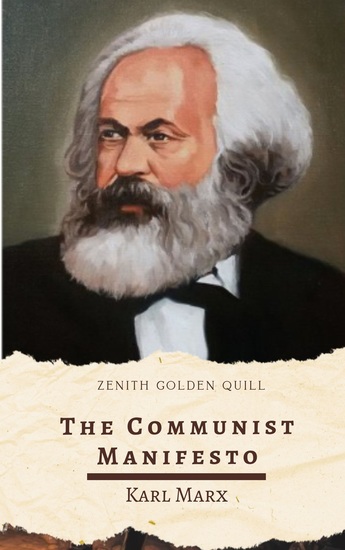
The Communist Manifesto - A Landmark in Political Theory and Global Social Movements - cover

The Communist Manifesto - A Landmark in Political Theory and Global Social Movements

Karl Marx, Zenith Golden Quill

Maison d'édition: Zenith Golden Quill

  • 0
  • 0
  • 0

Synopsis

"Workers of the world, unite!"

First published in 1848, The Communist Manifesto by Karl Marx and Friedrich Engels is a foundational text in political and economic thought. More than a political tract, this concise yet powerful document laid the ideological groundwork for movements, revolutions, and debates that continue to shape global discourse today.

Calling for the abolition of class hierarchies and private property, Marx and Engels propose a radical reimagining of society based on collective ownership, equality, and workers' rights. Despite its brevity, the manifesto continues to resonate as both a historical artifact and a living blueprint for anti-capitalist critique.

This edition includes annotations, a contextual introduction, and historical footnotes, making it ideal for students, scholars, and anyone seeking to understand one of the world's most influential documents.

"The most widely read political document after the Bible." — The Economist
"Essential reading for understanding both history and contemporary politics." — The New York Review of Books

Click Buy Now to explore the document that ignited revolutions and still challenges the world today.
Disponible depuis: 15/05/2025.
Longueur d'impression: 29 pages.
D'autres livres qui pourraient vous intéresser

  • Christmas Carol A (unabridged) - cover

    Christmas Carol A (unabridged)

    Charles Dickens

    • 0
    • 0
    • 0
    Experience the Timeless Classic with Crystal-Clear Clarity and Captivating Narration in A Christmas Carol Audiobook!Immerse yourself in the beloved tale of redemption and holiday magic as Charles Dickens' masterpiece, A Christmas Carol, comes to life in an audiobook like never before. With meticulous audio editing and a truly gifted narrator, this exceptional production guarantees an enchanting listening experience.Listen as the crisp and clear voice transports you to Victorian London, where the curmudgeonly Ebenezer Scrooge embarks on a transformative journey. Through the artful guidance of the talented narrator, each character springs to life with depth and emotion, painting a vivid tapestry of Dickens' unforgettable world.The audio editing process ensures a seamless and immersive experience, with careful attention paid to every detail. The result is a flawless audio performance that captures the essence of the story, bringing forth the joy, sorrow, and heartwarming moments that have captivated readers for generations.Whether you're a lifelong fan or new to this timeless classic, the A Christmas Carol audiobook is the definitive edition to own. Lose yourself in the magical combination of expertly crafted audio and exceptional narration, and let the transformative power of this cherished tale leave you filled with the spirit of compassion and redemption.Don't miss out on this unforgettable listening experience. Get your copy of the A Christmas Carol audiobook today and rediscover the magic of the holiday season!
    Voir livre
  • The Growing up of Cornelia - cover

    The Growing up of Cornelia

    Lucy Maud Montgomery

    • 0
    • 0
    • 0
    Lucy Maud Montgomery (November 30, 1874 – April 24, 1942), published as L. M. Montgomery, was a Canadian author best known for a series of novels beginning in 1908 with Anne of Green Gables. The book was an immediate success. The title character, orphan Anne Shirley, made Montgomery famous in her lifetime and gave her an international following.
    The Growing Up of Cornelia: Aunt Jemima gave me this diary for a Christmas present. It's just the sort of gift a person named Jemima would be likely to make. I can't imagine why Aunt Jemima thought I should like a diary. Probably she didn't think about it at all. I suppose it happened to be the first thing she saw when she started out to do her Christmas duty by me, and so she bought it. I'm sure I'm the last girl in the world to keep a diary.
    Voir livre
  • Hypnos (Unabridged) - cover

    Hypnos (Unabridged)

    H. P. Lovecraft

    • 0
    • 0
    • 0
    "Hypnos" is a first-person narrative, written from the perspective of an unnamed character living in Kent and later London, England. The narrator writes that he fears sleep, and is resolved to write his story down lest it drive him further mad, regardless of what people think after reading it. The narrator, a sculptor, recounts meeting a mysterious man in a railway station. The moment the man opened his "immense, sunken, and widely luminous eyes", the narrator knew that the stranger would become his friend--"the only friend of one who had never possessed a friend before." In the eyes of the stranger, he witnessed important knowledge of the mysteries he always sought to learn. From this point on, he would touch his friend and sculpt him daily. At night they would commence their adventures, exploring worlds beyond human comprehension. Over time, the narrator's companion begins to speak of using their ability to transcend into the unknown as a way to rule the universe (via a set of drugs). The narrator is frightened by the prospect and disavows such hubris to the reader. Soon the narrator is off on a foray with his friend, travelling through a void that he explains is beyond human sensation. Passing through several barriers, eventually the narrator comes to one he cannot cross, though his friend does. Opening his "physical eyes", the narrator wakes up and awaits the return of his friend, who awakes severely shaken and reticent, warning only that they must avoid sleep at all cost. From then on, with the aid of drugs, the two avoid sleep, as each time they succumb, they both seem to rapidly age and are plagued by nightmares that the narrator refuses to explain. The story ends with the narrator explaining that one night, his friend fell into a "deep-breathing sleep" and was impossible to arouse. The narrator shrieks, faints, and awakes surrounded by police and neighbors, who inform him that his friend was not real. There is only a bust of his friend in his room, engraved with the Greek word: _____ (Hypnos).
    Voir livre
  • Crime and Punishment - The Original Manuscript - cover

    Crime and Punishment - The...

    Fyodor Dostoyevsky

    • 0
    • 0
    • 0
    Crime and Punishment is the second of Fyodor Dostoyevsky's full-length novels following his return from 5 years of exile in Siberia, and is considered the first great novel of his "mature" period of writing. The novel focuses on the mental anguish and moral dilemmas of Rodion Raskolnikov, an impoverished ex-student in St. Petersburg who formulates and executes a plan to kill an unscrupulous pawnbroker for her cash. Raskolnikov, in an attempt to defend his actions, argues that with the pawnbroker's money he can perform good deeds to counterbalance the crime while ridding the world of a vermin, and to test a theory of his that some people are naturally superior and have the right to commit crimes if it is in pursuit of a higher purpose. 
    Voir livre
  • Frankenstein; or the Modern Prometheus - cover

    Frankenstein; or the Modern...

    Mary Wollstonecraft Shelley

    • 0
    • 0
    • 0
    Frankenstein; or, the Modern Prometheus 
    In the early nineteenth century, English author Mary Wollstonecraft (Godwin) Shelley penned a novel that would forever alter literature. Born in 1797, Mary’s unconventional upbringing shaped her worldview. During a summer near Lake Geneva in 1816, she conceived the tale of Victor Frankenstein, a brilliant but tormented scientist. 
    Driven by relentless ambition, Victor embarked on an unorthodox experiment: creating life itself. The result—the Creature, often called “Frankenstein’s Monster”—was stitched together from various body parts. Seeking understanding and acceptance, the Creature grappled with its existence and harsh treatment. 
    The novel delves into profound themes: ambition, nature vs. nurture, responsibility, and loneliness. Beyond horror, “Frankenstein” challenges us to consider science’s boundaries and creators’ roles. It serves as a cautionary tale, warning against unchecked ambition and dehumanization. 
    Because of time, some words in the novel may have changed meanings.
    Voir livre
  • Caterpillars - From their pens to your ears genius in every story - cover

    Caterpillars - From their pens...

    E F Benson

    • 0
    • 0
    • 0
    Edward Frederic Benson was born in Berkshire, England on 24th July 1867. 
    Educated at Marlborough and Kings College Cambridge he began his career as a writer at an early age and was published whilst still studying. 
    Benson was also a gifted athlete and represented his country at figure skating. 
    His career was prodigious and widely acknowledged.  Perhaps he is best known for his collection of novels about ‘Mapp & Lucia’ which have proved very popular throughout the decades.   
    Benson was also well regarded as a writer of ghost stories—‘spook stories’ in the then vernacular—as well as biographies.  His ghost and supernatural fiction covered a range of subjects but all were exceptionally well-written, drenched in atmosphere, riven with chills and have stood the test of popularity over the decades as testament to his literary talents.  
    Benson was never married and practised his homosexuality discreetly. 
    E F Benson died on 29th February 1940 at University College Hospital, London of throat cancer.  He was 72.
    Voir livre