Rejoignez-nous pour un voyage dans le monde des livres!
Ajouter ce livre à l'électronique
Grey
Ecrivez un nouveau commentaire Default profile 50px
Grey
Abonnez-vous pour lire le livre complet ou lisez les premières pages gratuitement!
All characters reduced
Manifesto of the Communist Party - cover

Manifesto of the Communist Party

Karl Marx, Friedrich Engels

Maison d'édition: DigiCat

  • 0
  • 0
  • 0

Synopsis

The "Manifesto of the Communist Party" stands as a seminal anthology of revolutionary thought, bringing together the incisive critiques of socio-economic structures and the call for radical transformation. This collection traverses the landscape of 19th-century political theory, capturing both the spirit of its age and timeless philosophical inquiries. The text weaves a tapestry of visions for a redefined social order, marked by profound explorations into class struggles. With its bold rhetoric and analytical profundity, the works within these pages underscore the mounting tensions and aspirations of an industrializing world, inviting readers into a dialogue that challenges existing power dynamics. The anthology is crafted through the collective genius of Karl Marx and Friedrich Engels, whose intellectual endeavors have laid the cornerstone of Marxist thought. Their partnership and shared interrogations of capitalist society stem from diverse academic and political engagements, uniting to critique and propose alternatives to the dominant socio-economic paradigms of their time. Their voices, steeped in the fervor of revolutionary fervor and deep historical insight, capture the essence of a movement that transcends borders, offering readers a penetrating examination of humanity's quest for equity and justice. Readers are invited to immerse themselves in this robust dissection of capitalist society, a foundational text for anyone seeking to understand the roots of Marxist ideology. "Manifesto of the Communist Party" serves not only as an urgent call to action but also as an intellectual journey through the ideological clashes of its era. This anthology promises a rich educational experience, fostering critical thought and engagement with the authors' enduring social critique, making it indispensable for students of history, politics, and economics alike.
Disponible depuis: 28/05/2022.
Longueur d'impression: 39 pages.


D'autres livres qui pourraient vous intéresser

  • Seven Things You Can't Say About China - cover

    Seven Things You Can't Say About...

    Tom Cotton

    • 0
    • 0
    • 0
    #1 New York Times Bestseller 
    Senator Tom Cotton offers an unflinching look at the deadly threat of Communist China and reveals the truth about America’s most dangerous enemy. “ 
    “As a member of the Senate Intelligence Committee, I’m often asked if the threat from China is as bad as it seems. My answer is no—it’s worse than you can imagine.” 
     Seven Things You Can’t Say About China is Tom Cotton’s provocative exposé about the gravest threat to American freedom. The media, Hollywood, academia, Wall Street, and most politicians can’t—or won’t—speak the truth about China. But Senator Cotton will, because America needs to know. 
     In this hard-hitting book, he reveals what others refuse to say, including:The inside story—drawn from his intelligence and national-security experience and knowledge—on how deeply the Chinese Communist Party has infiltrated America.How China persecutes Christians and commits genocide against religious and ethnic minorities.The alarming rise of China’s armed forces and nuclear arsenal, which will soon rival our own.The danger our children face from China’s influence on Hollywood, the NBA, TikTok, and so much more.How China lied, stole, and cheated its way to wealth while devastating America’s workers and businesses. 
     Seven Things You Can’t Say About China sounds the alarm about Communist China’s carefully crafted plans to defeat America in the coming decade—and what we must do to fight back.
    Voir livre
  • The Politics of Digital Pharmacology - Exploring the Craft of Collective Care - cover

    The Politics of Digital...

    Felix Heidenreich, Florian...

    • 0
    • 1
    • 0
    Digitization is transforming our world economically, culturally, and psychologically. The influx of new forms of communication, networking, and business opportunities, as well as new types of distraction, self-observation, and control into our societies represents an epochal challenge. Following Bernard Stiegler's concept of pharmacology, Felix Heidenreich and Florian Weber-Stein propose to view these new forms as digital pharmaka. Properly dosed, they can enable new self-relationships and forms of sociality; in the case of overdose, however, there is a risk of intoxication.
    In this essay, Felix Heidenreich, Florian Weber-Stein, and, in a detailed interview, Bernard Stiegler analyze this complex change in our world and develop new skills to use digital pharmaka.
    Voir livre
  • The Invented State - Policy Misperceptions in the American Public - cover

    The Invented State - Policy...

    Emily Thorson

    • 0
    • 0
    • 0
    In The Invented State, Emily Thorson argues that a problematic and understudied aspect of political misinformation reflects widespread public misperception about what the government does. Because much of public policy is invisible to the public, there is fertile ground for false beliefs to flourish, leading to what Thorson terms the "invented state": systematic misperceptions about public policy. However, people get the facts wrong not because they are stupid or blinded by partisan loyalty. Misperceptions are created when three conditions are met: when citizens have incomplete information about an issue, when their own biases color their understanding of it, and when they feel that the issue is important. The invented state is created by exposure to misinformation and by individuals' cognitive errors. 


    Correcting these policy misperceptions is highly effective at reducing false beliefs. Providing people with corrective information has downstream effects on attitudes. When they learn how policies really work, their approval increases and they also shift their policy priorities. Contrary to pundits' assumptions of a public who is largely indifferent to policy, there is a deep public desire to learn basic facts about how the government works. Thorson meets that desire with analysis on how the media can identify and correct substantive policy misperceptions.
    Voir livre
  • Hillbilly Nationalists Urban Race Rebels and Black Power - Interracial Solidarity in 1960s-70s New Left Organizing - cover

    Hillbilly Nationalists Urban...

    James Tracy, Amy Sonnie

    • 0
    • 0
    • 0
    Some of the most important and little-known activists of the 1960s were poor and working-class radicals. Inspired by the Civil Rights movement, the Black Panthers, and progressive populism, they started to organize significant political struggles against racism and inequality during the 1960s and into the 1970s. 


    Historians of the period have traditionally emphasized the work of white college activists who courageously took to the streets to protest the war in Vietnam and continuing racial inequality. Poor and working-class whites have often been painted as spectators, reactionaries, and, even, racists. But authors James Tracy and Amy Sonnie disprove that narrative. 


    Through over ten years of research, interviewing activists along with unprecedented access to their personal archives, Tracy and Sonnie tell a crucial, untold story of the New Left. Their deeply sourced narrative history shows how poor and working-class individuals from diverse ethnic, rural and urban backgrounds cooperated and drew strength from one another. The groups they founded redefined community organizing, and transformed the lives and communities they touched.
    Voir livre
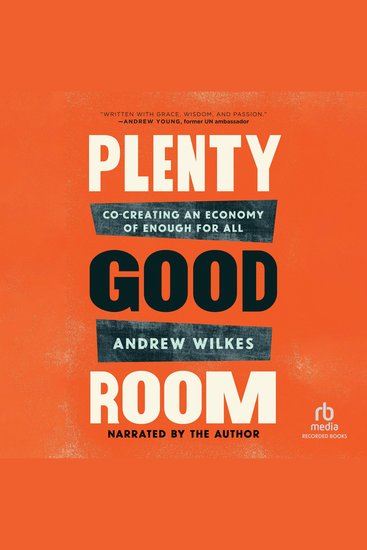
  • Plenty Good Room - Co-creating an Economy of Enough for All - cover

    Plenty Good Room - Co-creating...

    Andrew Wilkes

    • 0
    • 0
    • 0
    Plenty Good Room lays out in clear terms the hope of democratic socialism for a world ravaged by intensifying racial capitalism and social injustice. Unleash your ingenuity for systems that offer plenty good room—not for just a few but for all. 
     
    Economic inequality yawns as wide as ever. Capitalism is working as it was designed: replicating an uneven balance of power, constraining life chances, and limiting imaginations. Those of us concerned about injustice often confine ourselves to issue-by-issue activism. The end result? Owners, investors, and a politics of inequality win. 
     
    But what if there's another way to organize our common life—and what if it's as homegrown as sweet potato pie? What if we could become moral engineers who co-create the world we all deserve? 
     
    Plenty Good Room helps readers understand Black Christian socialism, a stream of the Black radical tradition, from the perspective of a Brooklyn pastor and political scientist's civic awakening. As the former director of the Drum Major Institute, founded by America's most famous democratic socialist, Dr. Martin Luther King Jr., Rev. Andrew Wilkes mounts a challenge to the endless greed, inequality, and profiteering of racial capitalism. 
     
    Tugging on the threads of history and scripture and pointing to the work of Black radicals like W. E. B. Du Bois, Rev. Addie Wyatt, and Fannie Lou Hamer, Wilkes weaves a narrative of "plenty good room moments": times in which communities and individuals had sufficient resources, human rights, and beauty. He invites us to join a movement that a day-laboring Christ initiated as he organized the dispossessed, the disinherited, and those pushed to the edges of society. Wilkes also introduces contemporary efforts pushing for reparations, community ownership, participatory democracy, and solidarity economies. These stories show us that we can create a world of care and reciprocity by envisioning an economy of enough for all—one rooted in justice, equity, and the God whose spirit falls on all flesh.
    Voir livre
  • Looking Backward: 2000-1887 - cover

    Looking Backward: 2000-1887

    Edward Bellamy

    • 0
    • 0
    • 0
    "Looking Backward: 2000–1887" is a utopian novel by Edward Bellamy, a journalist and writer from Massachusetts. It was the third largest bestseller of its time, after Uncle Tom's Cabin and Ben-Hur: A Tale of the Christ. It influenced many intellectuals, and appears by title in many socialist writings of the day. "It is one of the few books ever published that created almost immediately on its appearance a political mass movement". The novel also inspired several utopian communities.
    Voir livre