Join us on a literary world trip!
Add this book to bookshelf
Grey
Write a new comment Default profile 50px
Grey
Subscribe to read the full book or read the first pages for free!
All characters reduced
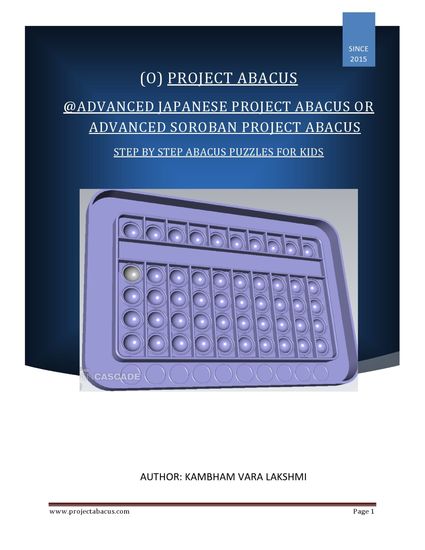
Advanced Japanese Project Abacus (or) Advanced Soroban Project Abacus - Advanced Japanese Project Abacus (or) Advanced Soroban Project Abacus - cover

Advanced Japanese Project Abacus (or) Advanced Soroban Project Abacus - Advanced Japanese Project Abacus (or) Advanced Soroban Project Abacus

Kambhamm Vara Lakshmi

Publisher: Publishdrive

  • 0
  • 0
  • 0

Summary

The Abacus, a humble device with a rich history, has been a companion to mathematicians for centuries. Its origins can be traced back to ancient Mesopotamia, where civilizations like the Sumerians used it for calculations. Over time, the abacus took on different forms in various cultures, but its core principle remained the same – manipulating beads on rods to represent numbers and perform arithmetic operations.Despite the rise of modern calculators, the abacus is still used in some parts of the world, particularly in Asia. It's also gaining popularity as a mental math tool, as studies show that using an abacus can improve mental ability and calculation skills.Example: Shepherds have used pebbles for centuries as a simple and effective way to keep track of their sheep or goats. Each time a goat passes through a gate or enclosure, the shepherd moves a pebble from one pile to another. By the end of the day, the pebbles tell the shepherd exactly how many goats they have. Once all the goats have been counted, the shepherd can simply count the pebbles in the pouch to determine the total number of goats. This method is especially useful for shepherds who may not be able to read or write, or who find it easier to manipulate physical objects than numbers.


Early counting tools evolved into the Abacus we know today. Here's a brief history of its development:* Mud Lines and Pebbles: The earliest ancestors of the abacus were likely simple markings in mud or sand, perhaps alongside pebbles or sticks to represent quantities.* Wooden Frame and Rods: Later, counting boards made of wood with grooves or rods emerged, allowing for a more permanent and organized way of calculating.* Beads on Rods: Finally, beads were added to the rods, making it easier to manipulate and keep track of numbers. This is the type of abacus most commonly associated with the tool today.Learning to use an Abacus can offer a number of benefits for children, including:* Stronger math skills: Abacus use can help kids develop a better understanding of mathematical concepts, improve their mental math abilities, and increase their calculation speed and accuracy.* Enhanced memory and concentration: Abacus programs often involve memorization techniques and require focused attention to manipulate the beads and solve problems. This can lead to improved memory and concentration in other areas of life as well.* Boosted confidence: As children master Abacus skills and see their math abilities improve, their confidence can grow. This can have a positive impact on their overall academic performance.* Improved cognitive skills: Abacus use may enhance cognitive skills such as visual-spatial reasoning, problem-solving, and critical thinking math skills and improve their confidence in math.
Available since: 02/25/2025.
Print length: 61 pages.

Other books that might interest you

  • Origins of Chinese Civilization The: A History of China - cover

    Origins of Chinese Civilization...

    Hui Wang

    • 0
    • 0
    • 0
    "Origins of Chinese Civilization: A History of China" by Hui Wang takes you on a journey through China's ancient past, told in a way that feels like you're listening to an elder recounting myths around a campfire. The book starts with Fuxi, the first leader, whose inventions like the Eight Trigrams and fishing nets shaped early Chinese culture. The story moves through key figures like Nüwa, who patched the sky and shaped humanity from clay, and the Yan Emperor, who pioneered agriculture and medicine. Finally, the legendary Yellow Emperor, known as a creator of civilization, brings the narrative into a more organized and developed era. 
    The legends are filled with fascinating myths—like Fuxi's miraculous birth from a footprint, or Nüwa molding people from earth, and the rise of agriculture through Emperor Yan's curiosity about plants. The author doesn't simply recite the historical figures but adds warmth, humor, and a sense of connection, making it easy to see why these stories have endured for thousands of years. It's not just about dates and events; it's about people trying to live better, inventing things that changed their daily lives, and facing challenges with creativity and resilience. This book is perfect for those who want to explore Chinese history not through dry facts but with lively storytelling that brings ancient China to life.
    Show book
  • Essential Information After High School Graduation - cover

    Essential Information After High...

    Michael Anthony White

    • 0
    • 0
    • 0
    Many subjects critical to personal growth have slowly become regarded as inflammatory: Communication. Culture. Money. Nutrition. Science. Social Media. Politics. Equality. Feminism. 
    Refreshingly operating without bias, these “hot seat” topics are constructively discussed with intelligence and heart — going far beyond the offerings of public school curriculum.
    Show book
  • Che Guevara – Revolutionary Icon and Guerrilla Fighter - The Life and Legacy of Latin America’s Most Controversial Revolutionary - cover

    Che Guevara – Revolutionary Icon...

    David Morrish

    • 0
    • 0
    • 0
    Che Guevara—doctor, revolutionary, guerrilla fighter, and global icon. From his early days as an idealistic medical student to his rise as one of the most recognizable faces of revolution, his story is filled with ambition, conflict, and ultimate sacrifice. 
    This audiobook explores the life of the man behind the legend. How did a young Argentine traveler become a key figure in the Cuban Revolution? What were his ideals, his battles, and the controversial actions that made him both admired and feared? 
    Che Guevara – Revolutionary Icon and Guerrilla Fighter is an in-depth look at the life, philosophy, and military strategies of one of the 20th century’s most polarizing figures. Perfect for history lovers, political enthusiasts, and those intrigued by revolutionary movements.
    Show book
  • Finding Voice For Authentic Conversation - cover

    Finding Voice For Authentic...

    Terry Tempest Williams

    • 0
    • 0
    • 0
    Terry takes us on a whirlwind tour of what it means to give voice to our own authenticity. It requires deep listening and fertile silences. She encourages us to speak “Mother Tongue” — speaking from the belly rather than the mind. 
    She laments that in Western culture “the language of economics has power, the language of the law has power, the language of science has power. But an intelligence of the heart, an emotional intelligence, or a poetic sensibility, or even a sensibility that comes from the side, from a different angle, from a different point of view, asks us to form a different kind of shape of conversation.” 
    In this delightfully warm and thoughtful program you’ll be dazzled by the mystery of Terry’s dying mother’s request for her to read her journals, but not until after her death. Terry found 3 shelves of journals only to discover all of them were blank. Puzzle along with Terry as she takes us from the Red Rock Wildlands of Utah to the Plains of Kenya in a far-reaching dialogue about finding one’s authentic voice. (hosted by Justine Willis Toms)
    Show book
  • Dom Perignon: A short biography - 5 Minutes: Short on time - long on info! - cover

    Dom Perignon: A short biography...

    5 Minutes, 5 Minute Biographies,...

    • 0
    • 0
    • 0
    Dom Perignon, French monk and inventor of champagne: Life and work in a short biography! Everything you need to know, brief and concise. Infotainment, education and entertainment at its best!
    Show book
  • Mātauranga Māori - cover

    Mātauranga Māori

    Hirini Moko Mead

    • 0
    • 0
    • 0
    In Mātauranga Māori, Hirini Moko Mead explores the Māori knowledge system and explains what mātauranga Māori is. He looks at how the knowledge system operates, the branches of knowledge, and the way knowledge is recorded and given expression in te reo Māori and through daily activities and formal ceremonies. Mātuaranga Māori is a companion publication to Hirini Moko Mead's best-selling book
    Tikanga Māori.
    Mātauranga Māori is integrated into every activity people engage in. It touches the lives of people in whatever they do, in the way they act, in the way they think, in the way they learn and in the way their knowledge is shared with others. (Mātauranga Māori)
    Show book