Begleiten Sie uns auf eine literarische Weltreise!
Buch zum Bücherregal hinzufügen
Grey
Einen neuen Kommentar schreiben Default profile 50px
Grey
Jetzt das ganze Buch im Abo oder die ersten Seiten gratis lesen!
All characters reduced
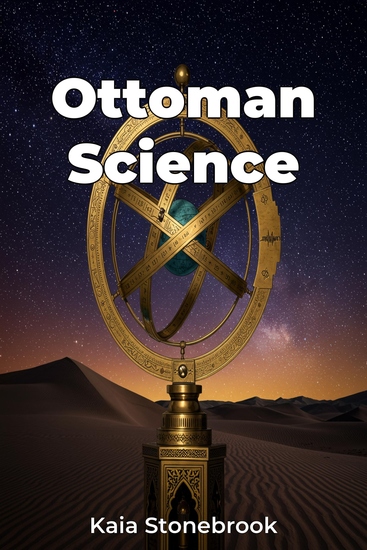
Ottoman Science - cover

Ottoman Science

Kaia Stonebrook

Übersetzer A AI

Verlag: Publifye

  • 0
  • 0
  • 0

Beschreibung

Often overshadowed by narratives of conquest, the Ottoman Empire significantly contributed to scientific knowledge. Ottoman Science reveals these accomplishments, focusing on medicine, engineering, and astronomical studies. Ottoman scholars didn't just receive knowledge; they innovated, building upon Greek, Persian, and Indian traditions. For instance, Ottoman hospitals were advanced for their time, incorporating practices that reflected a deep understanding of medicine.

 
The book challenges Eurocentric views of scientific progress by highlighting the Ottoman Empire's active role in global knowledge exchange. It explores how libraries and observatories fostered innovation. The book progresses through medicine, engineering, and astronomical studies, showcasing the empire's lasting impact. Delving into original manuscripts and architectural plans, this book adopts a formal, academic tone to ensure clarity.
Verfügbar seit: 20.03.2025.
Drucklänge: 65 Seiten.

Weitere Bücher, die Sie mögen werden

  • Too Big for a Single Mind - How the Greatest Generation of Physicists Uncovered the Quantum World - cover

    Too Big for a Single Mind - How...

    Tobias Hürter, David Shaw -...

    • 0
    • 0
    • 0
    The epic, page-turning history of how a group of physicists toppled the Newtonian universe in the early decades of the twentieth century 
    The epic true story of how a global team of physics luminaries—Einstein, Curie, Schrödinger, and more—toppled the Newtonian universe amid the turmoil of two World Wars 
     
    There may never be another era of science like the first half of the twentieth century, when many of the most important physicists ever to live—Marie Curie, Max Planck, Wolfgang Pauli, Niels Bohr, Werner Heisenberg, Ernst Schrödinger, Albert Einstein, and others—came together to uncover the quantum world: a concept so outrageous and shocking, so contrary to traditional physics, that its own founders rebelled against it until the equations held up and fundamentally changed our understanding of reality. 
     
    In cinematic, page-turning chapters, Tobias Hürter takes us back to this uniquely momentous and harrowing time, when war and revolution upended the lives of his renegade scientists. As they crisscross Europe, Hürter reveals these brilliant thinkers anew, as friends and enemies, lovers and loners, and indeed, men and women just like us. Hürter compellingly casts quantum mechanics as a concept Too Big for a Single Mind—and its birth as a testament to the boundless potential of genius in collaboration.
    Zum Buch
  • Take A Walk With Me - cover

    Take A Walk With Me

    Simon Ingram

    • 0
    • 0
    • 0
    “I felt honoured to be involved in the production/proof reading of Simon’s 4th book, Parkinson’s - Take a Walk With Me. The book is written with humour on a subject which could very easily be melancholy, and whilst not avoiding the truth about this degenerative neurological condition, Simon takes you on a journey with earnest compassion. A great read for everyone, especially for anyone remotely connected to Parkinson’s Disease, this is an uplifting, supportive and reaffirming read; life is still to be enjoyed no matter what the adversity.” - Sharon Timms
    Zum Buch
  • Zero to Engineer - The Unconventional Blueprint to Securing a 6-Figure Tech Career - cover

    Zero to Engineer - The...

    Terry Kim

    • 0
    • 0
    • 0
    Zero to Engineer: The Unconventional Blueprint to Securing a 6-Figure IT Career is an intensely practical, no-nonsense guide to starting or rebooting your career in technology. Author and IT industry veteran Terry Kim gives you a first-person view of how to conquer the tech and cybersecurity realms, drawing on his own two decades' experience in the field.You'll learn how to get job-ready in less than four months, regardless of your educational background, and enjoy complimentary NGT Academy bonuses, including unlimited access to the CompTIA Network+ Certification Course, a free one-on-one career strategy session with trained IT career specialists, and membership in the Zero to Engineer Community Group.The book offers common and intuitive IT career pathways, showing you how to get from A-to-Z in the most direct way possible, as well as IT employment contract negotiation tips that make it easier to get your first six-figure job offer. Perfect for anyone interested in starting a brand-new and exciting career in technology, Zero to Engineer is also a must-listen for career changers and professionals interested in pivoting to a new job in tech.
    Zum Buch
  • Comet Madness - How the 1910 Return of Halley's Comet (Almost) Destroyed Civilization - cover

    Comet Madness - How the 1910...

    Richard J. Goodrich

    • 0
    • 0
    • 0
    Since the dawn of civilization, humans had believed comets were evil portents. In 1705, Edmond Halley liberated humanity from these primordial superstitions, proving that Newtonian mechanics rather than the will of the gods brought comets into our celestial neighborhood. Despite this scientific advance, when Halley's Comet returned in 1910, newspapers gleefully provoked a global hysteria that unfolded with tragic consequences. 


    In Comet Madness, author and historian Richard J. Goodrich examines the 1910 appearance of Halley's Comet and the ensuing frenzy sparked by media manipulation, bogus science, and outright deception. 


    As the comet neared Earth, scientists and journalists alike scrambled to get the story straight as citizens the world over panicked. 


    As a result, workmen shelved their tools, farmers refused to plant crops they would never harvest, and formerly reliable people stopped paying their creditors. Others suffered mental breakdowns, and some took their own lives. 


    Comet Madness reveals how humans confront the unknown, how scientists learn about the world we inhabit, and how certain people—from outright hucksters to opportunistic journalists—harness fear to produce a profit.
    Zum Buch
  • Light's Opponent - The Battle between Energy and Darkness in Space - cover

    Light's Opponent - The Battle...

    Dirk Fallon

    • 0
    • 0
    • 0
    The universe is a vast and mysterious place, full of wonders and unknowns. At its core, there are two forces that define the very fabric of existence: light and darkness. These forces are not just opposites; they are intertwined in a constant struggle that shapes the cosmos. This battle between energy and darkness is a fundamental aspect of the universe, influencing everything from the birth of stars to the formation of galaxies. 
    Light, in its most basic form, is energy. It travels through space at incredible speeds, illuminating everything it touches. It powers the stars and sustains life on planets. Without light, the universe would be a cold and dark place, devoid of warmth and energy. But light’s role is not just to bring warmth and life; it also plays a crucial part in the balance of the universe. Light can be a force of creation, but it can also be a force of destruction. It can burn, blind, and erase everything in its path. 
    On the opposite side of the spectrum is darkness. Darkness is not just the absence of light; it is a powerful force in its own right. It is often associated with the unknown, with mystery, and with the things that lie beyond the reach of our understanding. Darkness is present in the vastness of space, in the black holes that devour everything in their proximity, and in the cold reaches of the universe where light cannot penetrate. While darkness may seem passive, it is far from it. It is a force that can shape the universe, exerting influence over the formation of galaxies, stars, and even life itself.
    Zum Buch
  • Dividing Lines - How Transportation Infrastructure Reinforces Racial Inequality - cover

    Dividing Lines - How...

    Deborah N. Archer

    • 0
    • 0
    • 0
    Our nation's transportation system is crumbling. But as acclaimed scholar and ACLU president Deborah Archer warns in Dividing Lines, before we can think about rebuilding and repairing, we must consider the role race has played in transportation infrastructure, from the early twentieth century and into the present day. 


    As Archer demonstrates, the success of the Civil Rights movement and the fall of Jim Crow in the 1960s did not mean the end of segregation. With state-sanctioned racism no longer legal, officials across the country turned to transportation infrastructure to keep Americans divided. A wealthy white neighborhood could no longer be "protected" by racial covenants and segregated shops, but a multilane road, with no pedestrian crossings, could be built along its border to make it difficult for people from a lower-income community to visit. Highways could not be routed through Black neighborhoods based on the race of their residents, but those neighborhoods' lower property values—a legacy of racial exclusion—could justify their destruction. 


    Drawing on a wealth of sources, including interviews with people who now live in the shadow of highways and other major infrastructure projects, Archer presents a sweeping, national account—from Atlanta and Houston to Indianapolis and New York City—of our persistent divisions.
    Zum Buch