Begleiten Sie uns auf eine literarische Weltreise!
Buch zum Bücherregal hinzufügen
Grey
Einen neuen Kommentar schreiben Default profile 50px
Grey
Jetzt das ganze Buch im Abo oder die ersten Seiten gratis lesen!
All characters reduced
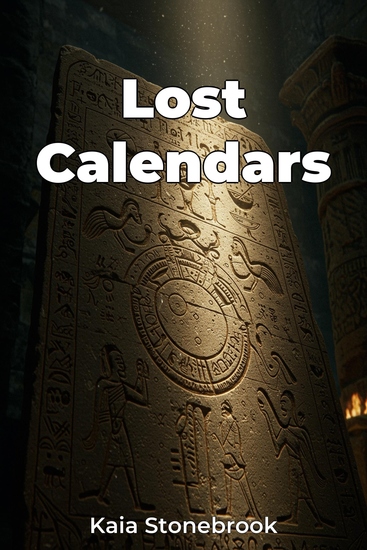
Lost Calendars - cover

Lost Calendars

Kaia Stonebrook

Übersetzer A AI

Verlag: Publifye

  • 0
  • 0
  • 0

Beschreibung

Lost Calendars explores the fascinating history of timekeeping by delving into ancient and often forgotten calendrical systems. It reveals how civilizations tracked time, embedding sophisticated science and deep cultural significance into their methods. These lost calendars offer insights into the worldviews of past societies and challenge our assumptions about the universality of time. For example, the intricate Mayan calendar system showcased remarkable mathematical precision linked to complex cosmological beliefs. Similarly, Mesopotamian calendars were closely tied to agriculture and early record-keeping practices, demonstrating the vital role of timekeeping in daily life. The book examines the technological and astronomical expertise needed to construct these calendars and their connection to social, religious, and agricultural practices. It progresses from introducing fundamental concepts like solar and lunar calendars to specific case studies, ultimately discussing why these systems were abandoned due to factors like conquest or the adoption of standardized timekeeping. By treating calendars as cultural artifacts, Lost Calendars provides invaluable insights into the intellectual and spiritual lives of past civilizations, offering alternative ways of understanding our place in the cosmos.
Verfügbar seit: 04.03.2025.
Drucklänge: 59 Seiten.


Weitere Bücher, die Sie mögen werden

  • Conversational Phrases Hungarian Audiobook - Level 1 - Absolute Beginner - cover

    Conversational Phrases Hungarian...

    HungarianPod101.com, Innovative...

    • 0
    • 0
    • 0
    Are you trying to learn Hungarian…but having trouble speaking?
     
    Do you struggle coming up with your own Hungarian sentences?
     
    Are you tired of not understanding how Hungarian grammar works?


    If you answered yes to any of these questions, …


    ...then the Conversational Phrases Audiobook, Level 1 - Absolute Beginner is for you!


    In this beginner-level Audiobook, you will master over 25 common sentence patterns across 25 simple lessons. By the end, you’ll be able to ask common questions and answer them in your own way, all while acquiring over 100 Hungarian words. 


    Most importantly, you’ll be able to have real conversations in various social situations.


    How, you may ask? Each lesson introduces a new conversation reflecting a real-world situation, including casual chats between friends as well as dialogues in more formal settings. Learning is made easy with three simple steps:


    1. Get familiar: First, you get a sample conversation and its translation.
     
    2. Understand: Then, we explain an underlying sentence pattern, so you can grasp the grammar and actually understand how the Hungarian works.
     
    3. Practice: Lastly, you create your own responses… and start speaking Hungarian!


    Lessons in this audiobook include:
     
    - Going Sightseeing
     
    - Going to a Restaurant
     
    - Giving Directions
     
    - Going to the Movies
     
    - Renting an Apartment
     
    And much more!


    Conversational Phrases Audiobook, Level 1 - Absolute Beginner contains:
     
    - 25 Lessons 
     
    - 4 Hours+ of Content
     
    - 1 Core Pattern Per Lesson
     
    - 100+ Hungarian Vocabulary Words
     
    - 28 Page Accompanying PDF eBook


    Download the PDF and read along
    Zum Buch
  • Aristotle for Novelists - 14 Timeless Principles on the Art of Story - cover

    Aristotle for Novelists - 14...

    Douglas Vigliotti

    • 0
    • 0
    • 0
    In many ways, we've been telling the same stories, over and over, for the last 2300 years. This book will show you why, and how you can do it too. 
    For centuries, dramatic writers have relied on Aristotelian principles to write their stories for the screen and stage—the same stories you stream and watch today. But for the first time ever, the timeless principles from Aristotle’s esteemed Poetics have been adapted for novelists. 
    With succinct clarity, novelist Douglas Vigliotti shows you exactly how to write a novel using tried-and-true principles that have been used since antiquity to tell great stories. These principles are the foundation on which any story can be written. Whether you are writing your first or tenth novel, Aristotle for Novelists has something to offer any serious writer of fiction. It is both a challenge to writers to simplify their craft and a no-frills, impassioned outcry for novelists everywhere.
    Zum Buch
  • From Boom to Bust - Venezuela's Economic Journey - cover

    From Boom to Bust - Venezuela's...

    Anya Solace

    • 0
    • 0
    • 0
    Venezuela’s economic history is a tale of immense wealth and devastating collapse, shaped by its vast oil reserves and the policies that governed them. Once one of the richest countries in Latin America, Venezuela’s rise was fueled by oil, an abundant resource that transformed the nation’s fortunes. However, overreliance on this single commodity, combined with political instability and economic mismanagement, led to one of the most severe financial crises in modern history. Understanding Venezuela’s economic journey requires a closer look at how it soared to prosperity, the warning signs that were ignored, and the policies that ultimately triggered its downfall.  
    The discovery of oil in the early 20th century set Venezuela on a path of rapid economic growth. As global demand for oil skyrocketed, so did Venezuela’s revenues, allowing the country to modernize its infrastructure, expand public services, and improve living standards. By the mid-20th century, Venezuela was among the most prosperous nations in Latin America, boasting a strong middle class and a high standard of living. The government used oil wealth to fund social programs, subsidize goods, and invest in national development, creating an illusion of economic stability. Yet, beneath the surface, a dangerous dependence on oil was forming, leaving the economy vulnerable to external shocks.  
    Despite periods of prosperity, warning signs of economic instability were evident long before the country entered crisis. As oil prices fluctuated, so did Venezuela’s financial health. Instead of diversifying the economy, successive governments doubled down on oil dependency, making the country highly susceptible to global market shifts.
    Zum Buch
  • Mixtec Empire - Skilled Artisans and the Masters of Codices in Mesoamerica - cover

    Mixtec Empire - Skilled Artisans...

    Rolf Hedger

    • 0
    • 0
    • 0
    The Mixtec civilization, known as the Ñuu Savi or "People of the Rain," emerged in the rugged mountains and fertile valleys of what is now Oaxaca, Mexico. Their origins date back to the Preclassic period, around 1500 BCE, when small agricultural communities began to flourish in the Mixteca Alta, Mixteca Baja, and Mixteca de la Costa regions. These early settlements were shaped by the challenging geography, with steep hills and limited arable land requiring innovative farming techniques. Over centuries, the Mixtec people developed sophisticated agricultural systems, including terracing and irrigation, which allowed them to sustain growing populations and establish permanent communities. 
    Mythology played a central role in Mixtec identity, reinforcing their connection to the land and legitimizing the rule of their elite class. The Mixtec creation story, recorded in their intricate codices, tells of divine ancestors emerging from a sacred place known as Apoala, a cave associated with the origins of humanity. These ancestors, believed to be both human and divine, established the first Mixtec lineages, which would later claim authority over the various city-states. This mythology was not just a story but a political tool that reinforced the power of Mixtec rulers, linking them directly to the gods and the forces of nature. 
    The early Mixtec communities were organized into small chiefdoms, each ruled by a hereditary elite. These leaders controlled land, resources, and religious ceremonies, ensuring stability and continuity within their societies. Over time, as populations expanded and rivalries grew, these chiefdoms evolved into larger political entities, forming the foundation for the powerful Mixtec city-states that would dominate the region in later centuries.
    Zum Buch
  • Living Well with Bipolar Disorder - Practical Strategies for Improving Your Daily Life - cover

    Living Well with Bipolar...

    David J. Miklowitz

    • 0
    • 0
    • 0
    What does it take to achieve a successful career, healthy habits, and fulfilling relationships--even with bipolar disorder (BD)? 
    What common stressors do you need to look out for, and how can you cope with them? 
    No one is better suited to provide people with BD with practical problem-solving help than leading expert David J. Miklowitz. From managing mood swings to dealing with anxiety, getting enough sleep, defusing family conflicts, and troubleshooting medications, this book offers keys to effective self-care. 
    Short, easy-to-understand chapters help you tackle challenges as they arise and plan for trouble spots that lie ahead. With Dr. Miklowitz's empowering guidance, navigate your own unique path to living well.
    Zum Buch
  • The Constitutional Bind - How Americans Came to Idolize a Document That Fails Them - cover

    The Constitutional Bind - How...

    Aziz Rana

    • 0
    • 0
    • 0
    An eye-opening account of how Americans came to revere the Constitution and what this reverence has meant domestically and around the world. 
    Some Americans today worry that the Federal Constitution is ill-equipped to respond to mounting democratic threats and may even exacerbate the worst features of American politics. Yet for as long as anyone can remember, the Constitution has occupied a quasi-mythical status in American political culture, which ties ideals of liberty and equality to assumptions about the inherent goodness of the text’s design. The Constitutional Bind explores how a flawed document came to be so glorified and how this has impacted American life. 
    In a pathbreaking retelling of the American experience, Aziz Rana shows that today’s reverential constitutional culture is a distinctively twentieth-century phenomenon. Rana connects this widespread idolization to another relatively recent development: the rise of US global dominance. Ultimately, such veneration has had far-reaching consequences: despite offering a unifying language of reform, it has also unleashed an interventionist national security state abroad while undermining the possibility of deeper change at home. 
    Revealing how the current constitutional order was forged over the twentieth century, The Constitutional Bind also sheds light on an array of movement activists—in Black, Indigenous, feminist, labor, and immigrant politics—who struggled to imagine different constitutional horizons. As time passed, these voices of opposition were excised from memory. Today, they offer essential insights.
    Zum Buch