Rejoignez-nous pour un voyage dans le monde des livres!
Ajouter ce livre à l'électronique
Grey
Ecrivez un nouveau commentaire Default profile 50px
Grey
Abonnez-vous pour lire le livre complet ou lisez les premières pages gratuitement!
All characters reduced
Babylonian Astronomy - cover

Babylonian Astronomy

Kaia Stonebrook

Traducteur A AI

Maison d'édition: Publifye

  • 0
  • 0
  • 0

Synopsis

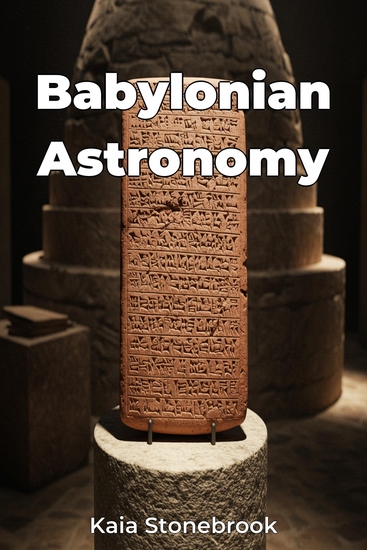
Babylonian Astronomy explores how ancient Mesopotamian civilizations meticulously observed the night sky, creating astronomical records that laid the foundation for later scientific revolutions. The book reveals the Babylonians' remarkable precision in astronomical observation and their sophisticated mathematical techniques. Their use of a sexagesimal (base-60) number system, for example, allowed for advanced calculations and predictions of celestial events. This knowledge wasn't confined to Babylonia; the book details its transmission to other cultures, particularly influencing Greek and Asian astronomy. The book's approach involves historical context and detailed analysis of cuneiform texts and astronomical diaries, offering a comprehensive view of Babylonian contributions. It delves into the social and religious roles of astronomy in Babylonian society, including its connections to astrology and calendar systems. The central argument highlights that Babylonian astronomy was a highly refined system of empirical observation and mathematical prediction, not a primitive endeavor. The book progresses from the historical context and methodology, through the development of mathematical techniques, to the transmission of Babylonian knowledge to the Greeks and its influence on astronomical practices in Asia.
Disponible depuis: 20/03/2025.
Longueur d'impression: 51 pages.


D'autres livres qui pourraient vous intéresser

  • The Mysteries and Their Emissaries - cover

    The Mysteries and Their Emissaries

    Manly Palmer Hall

    • 0
    • 0
    • 0
    Did that divine knowledge which constituted the supreme possession of the pagan priestcrafts survive the destruction of their temples? Is it yet accessible to mankind, or does it lie buried beneath the rubbish of ages, entombed within the very sanctuaries that were once illuminated by its splendor? "In Egypt," writes Origen, "the philosophers have a sublime and secret knowledge respecting the nature of God. What did Julian imply when he spoke of the secret initiations into the sacred Mysteries of the Seven-Rayed God who lifted souls to salvation through His own nature? Who were the blessed theurgists who understood them profundities concerning which Julian dared not speak? If this inner doctrine were always concealed from the masses, for whom a simpler code had been devised, is it not highly probable that the exponents of every aspect of modern civilization--philosophic, ethical, religious, and scientific-are ignorant of the true meaning of the very theories and tenets on which their beliefs are founded? Do the arts and sciences that the race has inherited from older nations conceal beneath their fair exterior a mystery so great that only the most illumined intellect can grasp its import? Such is undoubtedly the case.
    Voir livre
  • Victimization - The Process of Making Someone a Victim - cover

    Victimization - The Process of...

    Cito Harder

    • 0
    • 0
    • 0
    Victimization is a complex and multifaceted process that occurs when an individual or group is subjected to harm, oppression, or injustice. It is not merely the result of a singular event but often an ongoing experience shaped by societal structures, personal relationships, and systemic forces. Understanding victimization requires examining both the immediate and long-term effects on those who suffer, as well as the roles played by perpetrators, bystanders, and institutions that enable or prevent such harm. 
    At its core, victimization involves the exercise of power and control, where one party imposes harm—whether physical, psychological, emotional, or financial—upon another. This harm can be intentional, as in cases of abuse, assault, or discrimination, or unintentional, where systems and structures create disadvantages that lead to victimhood. The process of victimization is not always overt; it can be subtle, embedded within social norms, policies, and expectations that gradually erode a person’s autonomy, dignity, and sense of self-worth. 
    One of the key challenges in defining victimization lies in the perception of victims themselves. Some individuals openly recognize and acknowledge their victim status, while others may resist the label due to fear, shame, or social stigma. Society often imposes expectations on victims—either portraying them as weak and helpless or, conversely, blaming them for their circumstances. This duality can make it difficult for individuals to seek support or justice, reinforcing cycles of suffering and silence.
    Voir livre
  • The Shortest History of Democracy - cover

    The Shortest History of Democracy

    John Keane

    • 0
    • 0
    • 0
    'DEMOCRACY HAS A LONG, EVENTFUL PAST. DOES IT HAVE A FUTURE?The roots of democracy stretch back beyond Athens to Syria- Mesopotamia and the Indian subcontinent, where citizens' assemblies held privilege and power to account over 3,000 years before the French Revolution. In this timely and illuminating new global history, John Keane ('one of the world's leading political thinkers' ,The Times) gets to the heart of a complex, ever-evolving ideal.Today, American-style democracy may appear to be in decline, but Keane shows that this isn't the whole story. In many places, such as Taiwan and Senegal, India and South Africa, distinctly local varieties are coming into being. Yet it's impossible to ignore the proliferation of populist strongmen on every continent: the Putins and the Bolsonaros, the Trumps and Lukashenkos. Is democracy past its sell-by date, as they would have us believe? Or is it time to embrace the true, radical potential of an ancient idea?
    Voir livre
  • Hippias Major - What Is Beauty? – Plato’s Dialogue on Aesthetics and the Search for Universal Truth - cover

    Hippias Major - What Is Beauty?...

    Plato, Tim Zengerink

    • 0
    • 0
    • 0
    What if beauty isn’t just what we see—but a reflection of deeper truth? 
    In Hippias Major, Plato invites us into one of philosophy’s earliest investigations into aesthetics. Socrates questions the sophist Hippias on the definition of beauty, leading to a challenging and often humorous journey through false starts, flawed logic, and unexpected insights. 
    This modern translation delivers Plato’s wit and wisdom in accessible, engaging language, making the search for beauty as relevant today as it was in ancient Greece. 
    What you'll discover inside: 
    •	A Timeless Dialogue on Beauty – Socrates seeks a definition that transcends physical appearance 
    •	Plato’s Foundations of Aesthetics – Understand the roots of Western thought on art and form 
    •	A Sharp Critique of Superficial Wisdom – Watch Socrates expose hollow definitions of truth and beauty 
    •	A Modern, Thoughtful Translation – Designed to resonate with today’s listener while preserving Plato’s philosophical depth 
    Uncover the essence of beauty with Socrates as your guide—and see how the search for the ideal can reshape how we see the world.
    Voir livre
  • World War I and II for Kids: A Captivating Guide to the First and Second World War - cover

    World War I and II for Kids: A...

    Captivating History

    • 0
    • 0
    • 0
    Two manuscripts in one audiobook:World War 1 for Kids: A Captivating Guide to the First World WarWorld War 2 for Kids: A Captivating Guide to the Second World War 
    In the first part of this audiobook, you will discover:How it all started because of just one manWhy soldiers spent most of their time sitting around in wet, muddy ditchesThe new inventions that changed the face of war foreverHow dogs, horses, pigeons, and even goldfish helped in the warSoldiers—poets that didn’t know itWhy you could go to jail if you refused to fightBoy Scout and Girl Guide spies?The longest, biggest, and bloodiest battlesOnly twelve years old and going to war!How the "war to end all wars" may have actually caused the Second World War 
    In the second part of this audiobook, you will discover:Why were children in Britain sent to live hundreds of miles away with strangers?Could you budget and enjoy your favorite foods on wartime rations?Why the first atomic bomb was used and how it ended the war for good.How one fifteen-year-old girl’s diary won a Pulitzer Prize and has sold over 30 million copies.Why some people had no choice but to fight, even if they didn’t want to.Being a dictator wasn’t Adolf Hitler’s first choice of career. What do you think he first tried (and failed) to be?Why you couldn’t say “hamburger” in the United States during WWII.Could you make a great escape from a prison camp?Thirty years later—the soldiers who refused to believe the war was over!Girl power! How women helped the war effort. 
    Scroll up and click the “add to cart” button to learn more about World Wars!
    Voir livre
  • A Rare Recording of David Lloyd George - cover

    A Rare Recording of David Lloyd...

    David Lloyd George

    • 0
    • 0
    • 0
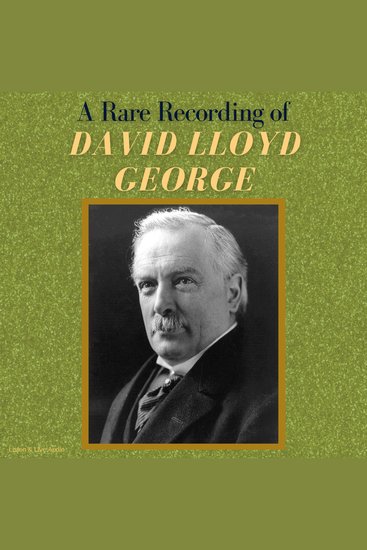
    David Lloyd George (Jan. 17, 1863 - March 26, 1945) was a British politician of great audacity, charm, wit, and mastery of the art of debate. A champion of liberal causes throughout his career, Lloyd George entered Parliament in 1890, and was later was appointed to the president of the Board of Trade in 1906. As Prime Minister, from 1916 to 1922, Lloyd George led Britain to victory in World War I. In this recording, Lloyd George discusses the famous "People’s Budget" of 1909.
    Voir livre