Begleiten Sie uns auf eine literarische Weltreise!
Buch zum Bücherregal hinzufügen
Grey
Einen neuen Kommentar schreiben Default profile 50px
Grey
Jetzt das ganze Buch im Abo oder die ersten Seiten gratis lesen!
All characters reduced
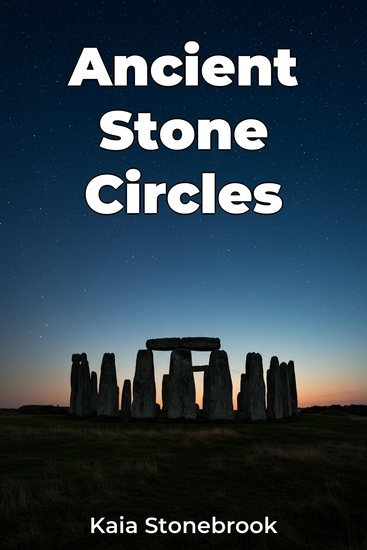
Ancient Stone Circles - cover

Ancient Stone Circles

Kaia Stonebrook

Übersetzer A AI

Verlag: Publifye

  • 0
  • 0
  • 0

Beschreibung

Ancient Stone Circles explores the purpose and significance of these ancient monuments in societies worldwide. It argues that stone circles were not merely primitive relics but sophisticated centers for astronomical observation, social gatherings, and ceremonial practices. Intriguingly, archaeological findings suggest deliberate designs incorporating celestial alignments, reflecting advanced knowledge of astronomy and social organization. The book delves into the cultural context of stone circles, examining the belief systems, social structures, and technological capabilities of the indigenous societies that built them. It challenges previous interpretations by integrating quantitative astronomical data with qualitative cultural interpretations, offering a nuanced understanding of these enigmatic structures. Case studies from the British Isles, Africa, and the Americas showcase the astronomical alignments, architectural features, and associated artifacts, revealing potential uses in maintaining social cohesion and transmitting knowledge. Structured methodically, Ancient Stone Circles introduces archaeoastronomy and social archaeology before exploring specific examples and their social contexts. The book uses historical records, archaeological findings, and astronomical research to build its argument, providing a comprehensive overview of major sites and theoretical frameworks, ultimately revealing the ingenuity and cultural complexity encoded within these ancient monuments.
Verfügbar seit: 29.03.2025.
Drucklänge: 63 Seiten.

Weitere Bücher, die Sie mögen werden

  • My Vanishing Country - A Memoir - cover

    My Vanishing Country - A Memoir

    Anonym

    • 0
    • 0
    • 0
    What J. D. Vance did for Appalachia with Hillbilly Elegy, CNN analyst  and one of the youngest state representatives in South Carolina history Bakari Sellers does for the rural South, in this important book that illuminates the lives of America’s forgotten black working-class men and women. 
    Part memoir, part historical and cultural analysis, My Vanishing Country is an eye-opening journey through the South's past, present, and future. 
    Anchored in in Bakari Seller’s hometown of Denmark, South Carolina, Country illuminates the pride and pain that continues to fertilize the soil of one of the poorest states in the nation. He traces his father’s rise to become, friend of Stokely Carmichael and Martin Luther King, a civil rights hero, and member of the Student Non-Violent Coordinating Committee (SNCC) , to explore the plight of the South's dwindling rural, black working class—many of whom can trace their ancestry back for seven generations. 
    In his poetic personal history, we are awakened to the crisis affecting the other “Forgotten Men & Women,” who the media seldom acknowledges. For Sellers, these are his family members, neighbors, and friends. He humanizes the struggles that shape their lives: to gain access to healthcare as rural hospitals disappear; to make ends meet as the factories they have relied on shut down and move overseas; to hold on to precious traditions as their towns erode; to forge a path forward without succumbing to despair.  
    My Vanishing Country is also a love letter to fatherhood—to Sellers' father, his lodestar, whose life lessons have shaped him, and to his newborn twins, who he hopes will embrace the Sellers family name and honor its legacy.
    Zum Buch
  • A Madman's Will - John Randolph 400 Slaves and the Mirage of Freedom - cover

    A Madman's Will - John Randolph...

    Gregory May

    • 0
    • 0
    • 0
    Few legal cases in American history are as riveting as the controversy surrounding the will of Virginia Senator John Randolph (1773–1833), which—almost inexplicably—freed all 383 of his slaves in one of the largest and most publicized manumissions in American history. So famous is the case that Ta-Nehisi Coates has used it to condemn Randolph’s cousin, Thomas Jefferson, for failing to free his own slaves. With this groundbreaking investigation, historian Gregory May now reveals a more surprising story, showing how madness and scandal shaped John Randolph’s wildly shifting attitudes toward his slaves—and how endemic prejudice in the North ultimately deprived the freedmen of the land Randolph had promised them. Sweeping from the legal spectacle of the contested will through the freedmen’s dramatic flight and horrific reception in Ohio, A Madman’s Will is an extraordinary saga about the alluring promise of freedom and its tragic limitations.
    Zum Buch
  • Dangerous Jokes - How Racism and Sexism Weaponize Humor - cover

    Dangerous Jokes - How Racism and...

    Claire Horisk

    • 0
    • 0
    • 0
    People often get away with belittling others if they frame their speech as jokes—speech that would be condemned if stated seriously. "It's just a joke," they say. But what is different or special about joking? And if jokes about lawyers and politicians are morally acceptable, then what is wrong with joking about race or gender? Furthermore, if we may joke about a politician's shirts, may we joke about his weight? People who are targeted by demeaning jokes feel their impact but may not be able to pinpoint where the harm lies. 


    Dangerous Jokes develops a novel, well-researched, and compelling argument that lays bare the power of demeaning jokes in ordinary conversations. Claire Horisk draws on her expertise in philosophy of language and on evidence from sociology, law, and cognitive science to explain how the element of humor—so often used as a defense—makes jokes more potent than regular speech in communicating prejudice and reinforcing social hierarchies. She addresses the morality of telling, being amused by, and laughing at, derogatory jokes, and she gives a new account of listening that addresses the morality of listening to demeaning speech. She leaves us with no illusions about whether "it's just a joke" is an excuse for demeaning humor.
    Zum Buch
  • Slow Dancing with a Stranger - Lost and Found in the Age of Alzheimer's - cover

    Slow Dancing with a Stranger -...

    Anonym

    • 0
    • 0
    • 0
    Emmy-award winning broadcast journalist and leading Alzheimer’s advocate Meryl Comer’s Slow Dancing With a Stranger is a profoundly personal, unflinching account of her husband’s battle with Alzheimer’s disease that serves as a much-needed wake-up call to better understand and address a progressive and deadly affliction. 
    When Meryl Comer’s husband Harvey Gralnick was diagnosed with early onset Alzheimer’s disease in 1996, she watched as the man who headed hematology and oncology research at the National Institutes of Health started to misplace important documents and forget clinical details that had once been cataloged encyclopedically in his mind. With harrowing honesty, she brings readers face to face with this devastating condition and its effects on its victims and those who care for them. Detailing the daily realities and overwhelming responsibilities of caregiving, Comer sheds intensive light on this national health crisis, using her personal experiences—the mistakes and the breakthroughs—to put a face to a misunderstood disease, while revealing the facts everyone needs to know. 
    Pragmatic and relentless, Meryl has dedicated herself to fighting Alzheimer’s and raising public awareness. “Nothing I do is really about me; it’s all about making sure no one ends up like me,” she writes. Deeply personal and illuminating, Slow Dancing With a Stranger offers insight and guidance for navigating Alzheimer’s challenges. It is also an urgent call to action for intensive research and a warning that we must prepare for the future, instead of being controlled by a disease and a healthcare system unable to fight it.
    Zum Buch
  • Eddie Rickenbacker and Dick Bong: The Lives of America's Top Fighter Aces during the World Wars - cover

    Eddie Rickenbacker and Dick...

    Editors Charles River

    • 0
    • 0
    • 0
    At first, airplane improvements occurred in an ad hoc, almost accidental manner during World War I. However, when pilots’ mounting of armaments on airplanes proved a successful means of defeating other aircraft and even attacking men on the ground, a much more active and systematic development of warplanes began across the continent. Each advance prompted a countermeasure, as the two sides strove for primacy in a deadly, unforgiving environment which rewarded real advances in equipment and tactics with survival and punished poor ideas with death. Before long, relatively powerful, heavily armed aircraft buzzed through the skies over battle-stained Europe, tearing each other apart with furious gusts of machine gun fire and sending many of the vaunted dirigibles plunging, burning, to the ground. The new era of fighting aircraft arrived in dramatic fashion, raising successful pilots to celebrity or heroic status, and laying the groundwork for the tremendous potential of airpower to achieve its next logical expansion in World War II and beyond.  
    Rickenbacker's World War I service won him the Medal of Honor, along with more awards for valor than any other person fighting in World War I. But participating in the wars was not nearly enough time in the air for the ambitious Rickenbacker. When he was not setting new records in the air, he was setting new speed records on the ground, most notably as a first-generation race car driver who not only drove cars but designed them.  
    By the time World War II arrived, the fighter airplane was a much different beast than the purpose-built aircraft-hunting machines of 1917 and 1918. Though propellers still provided motive force, greatly increased engine power allowed these aircraft to slice through the sky at speeds of 200 miles per hour (mph), 300 mph, or even in excess of 400 mph when flying flat-out. Service ceilings jumped to 25,000 feet, 30,000 feet, or higher.
    Zum Buch
  • Dancing In The Breeze - The Discipline of Transcendence Vol4 - cover

    Dancing In The Breeze - The...

    Osho

    • 0
    • 0
    • 0
    The Sutra of 42 Chapters is a scripture complied in the first century CE.  Each saying comes from Buddha, but the whole work was a new anthology created especially for introducing Buddhism in a new country. That's why it makes such a good, basic introduction to the world view of Gautam Buddha. It is very simple in its approach, very direct. It is, in essence the whole of Buddha's message, but very simple, not elaborate and very scholarly as other Buddhist scriptures are.
    Osho extracts the kernel of Buddha's profound insight and understanding and presents his everlasting message to the contemporary listener in a manner that is lucid, straightforward and humorous. Far from being just a statue, here Buddha is an amazing human being so far ahead of his time that even now he is only just beginning to be more widely understood.
    In these talks Osho discusses the need for doubt and argument in the spiritual search, the nature of desire and the discipline of non-attachment.
    The talks in this audiobook are a series of original OSHO Talks, titled "The Discipline of Transcendence, Vol.2".
    Vol.04 DANCING IN THE BREEZE
    
    - The Eightfold Way: Move Step-by-Step and You Come Home
    - Pain: Accept it, Welcome It, Be with It
    - Remember the Middle and You Will Always Be Right
    - Mind Is a Soul Disturbed, and Soul Is Mind Silenced
    - The Discipline of Transcendence
    - Buddhahood: Awaken from Your So-called Awakened State
    - Prana, Breath: The Bridge from Body to Soul
    - Sleep and Awake: Both Are Dreams and Meaningless
    - Provisions for the Journey
    - Awareness: Always Begin with Simple Things
    - Buddha: the Greatest Anarchist in Human History
    An abridged edition of this series of talks was published as an audiobook under the title "The Buddha Said", which included only the chapters in which Osho comments on the original sutras by Buddha. This series is the full experience.
    ©1976 Osho International Foundation ℗ 2024 Osho International Foundation
    Zum Buch