Begleiten Sie uns auf eine literarische Weltreise!
Buch zum Bücherregal hinzufügen
Grey
Einen neuen Kommentar schreiben Default profile 50px
Grey
Jetzt das ganze Buch im Abo oder die ersten Seiten gratis lesen!
All characters reduced
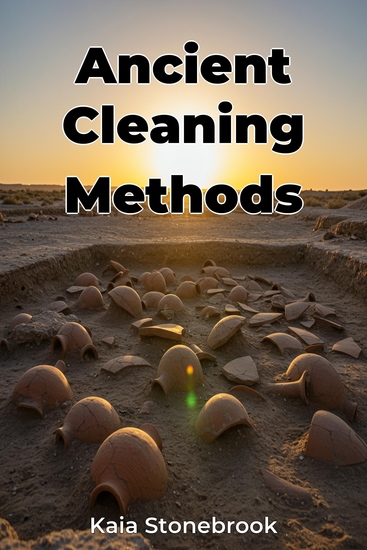
Ancient Cleaning Methods - cover

Ancient Cleaning Methods

Kaia Stonebrook

Übersetzer A AI

Verlag: Publifye

  • 0
  • 0
  • 0

Beschreibung

Ancient Cleaning Methods explores the fascinating history of how civilizations maintained cleanliness using natural resources. Long before modern chemicals, ancient societies utilized plant-based solutions like herbal infusions and mineral-based cleansers such as clays and ashes. Archaeological findings reveal that these early methods weren't just about surface cleaning; they were sustainable practices deeply rooted in ecological awareness.

 
The book journeys through time, analyzing cleaning practices from various cultures and continents. It highlights how fermented ingredients and biological processes served as early forms of germ control. By examining excavated sites and ancient texts, the book uncovers the cultural significance of hygiene and offers insights into eco-friendly cleaning alternatives valuable for environmental advocates and anyone seeking a healthier home.

 
The book progresses from plant-based agents to mineral-based cleansers, ultimately investigating biological methods. By combining archaeological evidence, scientific analysis, and cultural context, Ancient Cleaning Methods provides a unique perspective, revealing how ancient wisdom can inform sustainable cleaning practices for a cleaner, healthier future.
Verfügbar seit: 27.02.2025.
Drucklänge: 72 Seiten.

Weitere Bücher, die Sie mögen werden

  • Logos From Planet Blip - An Audio Adventure in Visual Design - cover

    Logos From Planet Blip - An...

    Claire L. Evans, Jona Bechtolt

    • 0
    • 0
    • 0
    This comprehensive design sourcebook provides a behind-the-scenes peek into the making of the Panic-produced video game Blippo+. Every logo and graphic element used in the game is reproduced faithfully, alongside notes from Blippo+ writer Claire L. Evans about the wide-ranging references that inspired the visual world of Planet Blip. 
    With never-before-seen designs for graphics that didn't make the final cut, technical details, iterations of familiar logos, anecdotes about the history of broadcast television, and tidbits of Blippian lore, this is a concise and vital reference for any serious Blippohead.
    Zum Buch
  • Weather for pilots - cover

    Weather for pilots

    Facundo Conforti

    • 0
    • 0
    • 0
    Weather for Pilots. A work created for anyone who wants to learn all the fundamental theoretical concepts about aeronautical meteorology. From basic knowledge about the atmosphere, to the most advanced knowledge about adverse weather. Everything, absolutely everything a pilot must learn about this fascinating topic 
    	The atmosphere, pressure, temperature and dew point, humidity, wind, darkening phenomena such as fog, clouds, storms, the main meteorological factors that affect aviation. All these topics explained in detail and with examples that will make it easy to understand. 
    	Predicting meteorological changes in the short term is not impossible, only the necessary tools are required, such as reports, maps and statistics. Here you will find the right way to interpret all this information, to make the right decision when making a flight, or during its development. 
    	A complete work, which meets all the requirements to offer, not only to pilots, but to all readers, a generalized knowledge of the climate, its behavior and its possible predictions.
    Zum Buch
  • Zetetic Astronomy - Earth Not A Globe - cover

    Zetetic Astronomy - Earth Not A...

    Samuel Rowbotham

    • 0
    • 0
    • 0
    Brought to you by Altrusian Grace Media and narrated by Matthew Schmitz. THE DEFINITIVE FLAT EARTH DOCUMENT! The unabridged and enhanced 2nd edition of Zetetic Astronomy, formulated in the 19th century by Samuel Rowbotham, presents a flat-earth cosmology grounded in direct sensory observation rather than theoretical abstraction. Rejecting Newtonian and Copernican astronomy, Rowbotham argued that the Earth is a flat, stationary plane with the Sun, Moon, and stars moving in circular paths above it, asserting that empirical evidence—such as the apparent flatness of horizons and the behavior of water surfaces—supports this model. The Zetetic method emphasizes skepticism toward authority and deductive reasoning, claiming truth arises only from firsthand, verifiable observation. This approach positioned itself as an “inquiry-based” science in opposition to what it viewed as speculative mathematics, laying the philosophical foundation for later flat-earth movements and epistemological distrust of institutionalized science.
    Zum Buch
  • Weird Universe - Everything We Don’t Know About Space (and Why It’s Important) - cover

    Weird Universe - Everything We...

    Dr. Erika Hamden

    • 0
    • 0
    • 0
    Unlock the wonders of space with a fresh and exciting perspective. 
     
    Erika Hamden, a renowned astrophysicist and educator, brings her passion for space to life in this engaging book. With years of experience studying the cosmos, Hamden specializes in making complex topics fun and easy to understand. Her expertise shines through as she leads listeners on an exploration of the strangest and most awe-inspiring phenomena in space. Whether you're fascinated by the biggest black holes, curious about the history of NASA, or simply want to explore the strange and magnificent things we've found in outer space, this book is for you. No prior knowledge required—just a desire to understand more about the cosmos and its connection to life here on Earth. 
     
    See how space exploration shapes our everyday world. Space isn't just an abstract concept—it plays a crucial role in shaping the technology we use every day. From NASA's breakthroughs to innovations inspired by our exploration of the cosmos, Hamden shows how space discoveries influence our world. You'll also gain insight into the process behind these findings, from the questions scientists ask to the groundbreaking answers they uncover. By the end of the book, you'll understand not just what we know about the universe, but how we've come to know it.
    Zum Buch
  • The Microscopic World Inside and Around Us - cover

    The Microscopic World Inside and...

    Martin K. Ettington

    • 0
    • 0
    • 0
    We live surrounded by an invisible world which affects our lives in many ways. 
     In this book we will take a journey from barely visible life, to cells, their structures, molecules, atoms, fundamental particles and even smaller. 
     We will explore not just the facts about this small world, but also try to unearth interesting facts to ponder too. 
     For example, what did paranormal investigators believe about the structure of atoms over one hundred years ago? 
     And what particles or forces might be smaller than the standard building block particles we know about today? 
     Also, what are the limitations of the standard model of subatomic particles? 
     There are many things in the microscopic world which you might not expect. 
     The journey from the small to the infinitely small starts here.
    Zum Buch
  • Robot Souls - Programming in Humanity - cover

    Robot Souls - Programming in...

    Eve Poole

    • 0
    • 0
    • 0
    Two of the biggest design problems in Artificial Intelligence are how to build robots that behave in line with human values and how to stop them ever going rogue. One under-explored solution to these alignment and control problems might be to examine how these are already addressed in the design of humans. 


    Looking closely at the human blueprint, it contains a suite of capacities that are so clumsy they have generally been kept away from AI. It was assumed that robots with features like emotions and intuition, that made mistakes and looked for meaning and purpose, would not work as well as robots without this kind of code. But on considering why all these irrational properties are there, it seems that they emerge from the source code of soul. Because it is actually this 'junk' code that makes us human and promotes the kind of reciprocal altruism that keeps humanity alive and thriving. 


    Robot Souls looks at developments in AI and reviews the emergence of ideas of consciousness and the soul. It places our 'junk code' in this context and argues that it is time to foreground that code, and to use it to look again at how we are programming AI.
    Zum Buch