Rejoignez-nous pour un voyage dans le monde des livres!
Ajouter ce livre à l'électronique
Grey
Ecrivez un nouveau commentaire Default profile 50px
Grey
Abonnez-vous pour lire le livre complet ou lisez les premières pages gratuitement!
All characters reduced
Big Tech Research - cover

Big Tech Research

Kai Turing

Traducteur A AI

Maison d'édition: Publifye

  • 0
  • 0
  • 0

Synopsis

Big Tech Research examines the increasing concentration of Artificial Intelligence research within major technology companies and its broader impact on the AI ecosystem. The book explores whether AI innovation will be driven by a diverse range of voices or primarily by a select few corporations. Readers gain insights into the evolution of AI, from academic roots to its current commercial imperative, without needing deep technical knowledge. The book argues that, while Big Tech's investment has accelerated AI progress, this concentration poses risks to innovation diversity and ethical considerations. The analysis is supported by data from academic publications, patent filings, and conference proceedings, using bibliometric and network analysis to map relationships between researchers and institutions. For example, the book highlights how talent acquisition strategies and data access policies within Big Tech contribute to this concentration.

 
Structured in four parts, the book begins by defining key concepts and establishing a framework. It then profiles major Big Tech research divisions, analyzes the implications of research concentration, and proposes alternative models for fostering greater openness and societal benefit. This approach offers a novel perspective by combining data analysis with commentary on the ethical dimensions of AI research, making it valuable for policymakers, business leaders, and anyone interested in understanding the forces shaping the future of AI.
Disponible depuis: 18/02/2025.
Longueur d'impression: 96 pages.

D'autres livres qui pourraient vous intéresser

  • Relativity: The Special and General Theory - cover

    Relativity: The Special and...

    Albert Einstein

    • 0
    • 0
    • 0
    In Relativity: The Special and General Theory, one of history's greatest scientific minds offers a lucid and engaging explanation of the theories that reshaped our understanding of the universe. Written for readers without advanced mathematical training, this landmark work guides us through the principles of special relativity - where time dilates and mass bends light - and into the profound depths of general relativity, where gravity is no longer a force but a curvature of spacetime itself.
    Einstein's clarity, insight, and humility make this more than a scientific treatise - it's a philosophical reflection on reality, perception, and the power of human thought. Whether you're a curious beginner or a seasoned thinker, this timeless classic invites you to explore the elegant logic behind the cosmos.
    Voir livre
  • Summary of Neil deGrasse Tyson's Take Me to Your Leader - cover

    Summary of Neil deGrasse Tyson's...

    Milkyway Media

    • 0
    • 0
    • 0
    Listen now to get the key ideas from Neil deGrasse Tyson's, Take Me to Your Leader. 
    Take Me to Your Leader (2026) offers an entertaining and thought-provoking look at one of humanity’s oldest questions: Are we alone in the universe? In this engaging blend of science, history, and popular culture, renowned astrophysicist Neil deGrasse Tyson explores humanity’s enduring fascination with extraterrestrial life. Tyson separates scientific possibilities from speculation while addressing questions about UFO sightings, Alien encounters, and the search for life beyond our planet. Drawing on physics and literature, he considers how Alien civilizations might perceive us. How should we respond if contact does occur? Tyson's got that covered, too.
    Voir livre
  • The Storytelling Manual for Architects - A heartfelt manifesto for a better way to write and talk about what you do - cover

    The Storytelling Manual for...

    Juliette Mitchell

    • 0
    • 0
    • 0
    Storytelling is one of the most powerful tools we have. But we're not talking about a story as a nice-to-have or an occasional distraction from the real work you do. We’re talking about story as the backbone and the underlying structure, and story as a way of ordering your thoughts and connecting with those around you.
    If you want to make the most of every page on your website, every email to your clients and every conversation on site, this is the guidebook you need. It gives you a simple, flexible structure to tell the stories of your practice, your projects, your process, and your team. And, more than that, it reframes writing not as a chore but as an act of clarity and connection.
    The Storytelling Manual for Architects is a short, practical book with a very human mission – to help you find common ground, convey your worth, and show your clients the difference you can make. It’s a heartfelt manifesto for a better way to write and talk about what you do.
    Juliette Mitchell set up Architypal, a writing consultancy for architects, after many years as an editor at Penguin Books. The Storytelling Manual for Architects is both her step-by-step messaging strategy and her personal act of resistance in the face of AI and things to come.
    
    ‘It’s a great little book – both succinct and spirited!’ Ceri Davies, director at Allford Hall Monaghan Morris
    ‘This book is so good, I don’t want to recommend it to other architects. I want to keep it all to myself.’ Lee Holmes, associate director at Wainwrights
    ‘Joyous, loving, accessible, practical, and just what the doctor ordered.’ Barbara Iddon, co-author of Blueprints for the Soul: Why we need emotion in architecture
    ‘I devoured about 80% of it in the first sitting. Full of good and clear ideas.’ Paul Sheeran, principal at Architexture
    ‘Part guidebook, part pep talk, part love letter to clearer, kinder architectural communication. Practical, readable, and quietly radical.’ Simon Drayson, director at George & James Architects
    Voir livre
  • COVID-19 - A History - cover

    COVID-19 - A History

    Jacalyn Duffin

    • 0
    • 0
    • 0
    For two years the COVID-19 pandemic has upended the world. The physician and medical historian Jacalyn Duffin presents a global history of the virus, with a focus on Canada.  
    Duffin describes the frightening appearance of the virus and its identification by scientists in China; subsequent outbreaks on cruise ships; the relentless spread to Europe, the Americas, Africa, and elsewhere; and the immediate attempts to confront it. COVID-19 next explores the scientific history of infections generally, and the discovery of coronaviruses in particular. Taking a broad approach, the book explains the advent of tests, treatments, and vaccines, as well as the practical politics behind interventions, including quarantines, barrier technologies, lockdowns, and social and financial supports. In concluding chapters Duffin analyzes the outcome of successive waves of COVID-19 infection around the world: the toll of human suffering, the successes and failures of control measures, vaccine rollouts, and grassroots opposition to governments’ attempts to limit the spread and mitigate social and economic damages.  
    Closing with the fraught search for the origins of COVID-19, Duffin considers the implications of an “infodemic” and provides an cautionary outlook for the future.
    Voir livre
  • Neurofeedback For Trauma - Past Present & Future - How to add neurofeedback to your service - cover

    Neurofeedback For Trauma - Past...

    Stuart R Black

    • 0
    • 0
    • 0
    It's not clear how change will come, but it's clear that change is coming. The current paradigms of treating mental health fall short. 
    The psychiatric view of mental health disorders as imbalances in brain chemistry treated by medication fails to address the root cause. 
    The psychological view of mental health disorders as learned behavioural issues has severe limitations. Psychosocial therapies that require the trauma to be reimagined (talking therapies, EMDR) are ineffective for many traumatised children, adolescents and adults. 
    Neurofeedback therapy reaches the parts other therapies cannot reach. It works at the physiological level first, building the scaffolding for psychological change. 
    The challenge has been understanding, adopting and scaling this obscure approach. 
    Stuart Black explains how these challenges can be addressed, makes the case for Neurofeedback for trauma, and describes how you can incorporate Neurofeedback therapy into your service.
    Voir livre
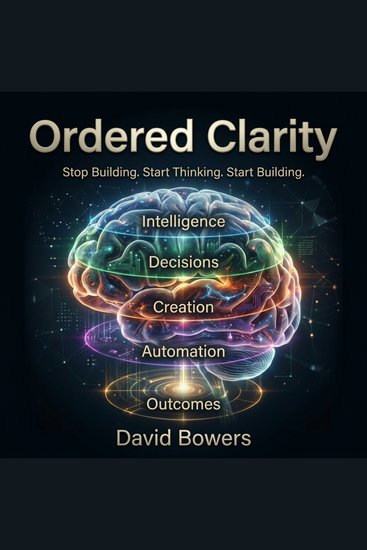
  • Ordered Clarity - Stop Building Start Thinking Start Building - cover

    Ordered Clarity - Stop Building...

    David Bowers

    • 0
    • 0
    • 0
    You don't have a tool problem. You have an order problem. 
    You bought the AI tools. You built the workflows.  
    You did the work. And somehow the business still feels like motion that never adds up. 
    Here's the part nobody told you: doing the right things in the wrong order gets you the same result as doing the wrong things.  
    You stay busy. You get tired. Nothing compounds. 
    Ordered Clarity is the map.  
    Five layers, built top to bottom, that turn a pile of tools into a system that works:  
    Intelligence - what you actually know about your customer, not what you assume 
    Decisions - the choices that give everything below them direction 
    Creation - content and offers that do a specific job 
    Automation - the repeatable work the system handles while you think 
    Outcomes - results that feed back to the top and make the next cycle smarter 
    Most solo operators build this in reverse. They start with automation and wonder why it produces nothing. They create content with no decision behind it and wonder why it lands on no one. The system works - but only in order. 
    Each chapter ends with one action. Do it before you move on. By the end you'll have the foundation of a business that doesn't just own AI tools - it uses them for something. 
    A clearer stack beats a bigger stack. Tools need jobs. The order is the point. 
    Stop building. Start thinking. Then build.
    Voir livre