Begleiten Sie uns auf eine literarische Weltreise!
Buch zum Bücherregal hinzufügen
Grey
Einen neuen Kommentar schreiben Default profile 50px
Grey
Jetzt das ganze Buch im Abo oder die ersten Seiten gratis lesen!
All characters reduced
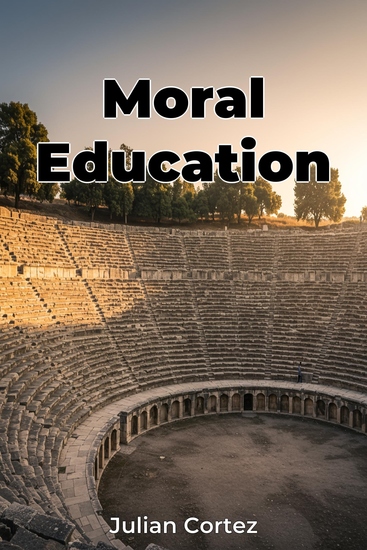
Moral Education - cover

Moral Education

Julian Cortez

Übersetzer A AI

Verlag: Publifye

  • 0
  • 0
  • 0

Beschreibung

Moral Education explores how societies have historically sought to instill ethics and values in their citizens, viewing moral education as a dynamic process shaped by context, needs, and philosophical thought. The book examines the foundational values prioritized by different societies, revealing how these values evolved and were transmitted through various pedagogical methods, from ancient storytelling to modern programs. It also analyzes the impact of socio-political forces like war and economic shifts on moral education, providing insight into the relationship between individual character and social order. The book uniquely underscores that moral education reveals a persistent desire to cultivate virtue and responsible citizenship, while acknowledging the difficulties in agreeing on the definition of "good."

 
Beginning with ancient approaches in Greece, Rome, and the East, Moral Education progresses chronologically through the medieval period, the Enlightenment, and the modern era, examining the influence of nationalism, industrialization, and globalization. It culminates with an analysis of contemporary challenges, such as diversity and social justice, using philosophical traditions and historical accounts to inform modern citizenship.
Verfügbar seit: 11.03.2025.
Drucklänge: 73 Seiten.
Weitere Bücher, die Sie mögen werden

  • Belonging - A History of Indian South Africans - cover

    Belonging - A History of Indian...

    Ashwin Desai, Goolam Vahed

    • 0
    • 0
    • 0
    What does it mean to belong? 
    Across oceans and centuries, this sweeping narrative shuttles between the corridors of the Colonial Office in London, the contested streets of Durban, and the changing power dynamics within the British Raj.  
    The first boatload of indentured Indians arrived in Natal in 1860. Thousands were to follow. In haunting detail, the book captures the plight of these labourers as well as the vicious onslaught faced by the merchant class for daring to outpace their colonial rivals. At its core are the untold struggles of Indian South Africans as they confront the ever-present threat of repatriation.  
    Sensitive to shifting political terrains, the book weaves together seismic events – the independence of India, the coming of apartheid and the threat once more of mass expulsions – with the texture of everyday life. The granting of citizenship in 1961 is accompanied by mass relocations as the Group Areas Act rips communities from their roots. Yet, out of this despair, barren townships on the edges of cities are turned into places of hope.  
    In the final chapters, the fall of apartheid offers a moment of transcendence. Yet it also asks: what does it mean, at last, to belong? It is a fascinating story of the global and the local, of resistance and collaboration, and undefeated optimism. This is a book for anyone who has ever sought a place to call home.
    Zum Buch
  • Rise of Islam in the Balkans The: The History of the Ottoman Empire’s Islamization Efforts in Eastern Europe - cover

    Rise of Islam in the Balkans...

    Editors Charles River

    • 0
    • 0
    • 0
    In terms of geopolitics, perhaps the most seminal event of the Middle Ages was the successful Ottoman siege of Constantinople in 1453. The city had been an imperial capital as far back as the 4th century, when Constantine the Great shifted the power center of the Roman Empire there, effectively establishing two almost equally powerful halves of antiquity’s greatest empire. Naturally, the Ottoman Empire would also use Constantinople as the capital of its empire after their conquest effectively ended the Byzantine Empire. 
    In the wake of taking Constantinople, the Ottoman Empire would spend the next few centuries expanding its size, power, and influence, bumping up against Eastern Europe and becoming one of the world’s most important geopolitical players. It was a rise that would not truly start to wane until the 19th century. In fact, its decline would be brought about not just because of military setbacks and government corruption, but also because of nationalist uprisings among its multiethnic territories. The fact that the other existing multicultural empire, the Austro-Hungarian Empire, also did not survive World War I makes clear just how hard governing such a vast expanse of land can be. The Ottoman Empire’s inability to create a shared identity, a weak central state, and growing inner dissensions were some of the main factors explaining its long demise. 
    Of course, before that demise, the Ottomans brought plenty of their own cultural influence to the lands they reached, and nowhere is that more evident than in the spread of Islam. While Ottoman conflicts with European powers were often portrayed as religious conflicts, the fact is that the Ottomans managed to bring Islam with them into parts of Europe, especially the Balkans, and Islam took hold in various regions, adding even more demographic complexity to a place that already had no shortage of it.
    Zum Buch
  • Secrets of the Special Forces: How They Changed War Forever - Discover How Special Forces Changed War Forever with Engaging Audio Lessons for Mastery! - cover

    Secrets of the Special Forces:...

    Graham Winslow

    • 0
    • 0
    • 0
    Discover How Special Forces Transformed Modern Combat Strategies 
    ⭐⭐ Simplified Audio Guide with Explanations ⭐⭐ 
    Are you eager to enhance your understanding of Special Forces and their pivotal role in modern warfare? 
    Seeking a comprehensive guide that provides all essential insights and strategies? 
    Your search ends here! 
    This audiobook serves as your definitive companion for deepening your knowledge, applying your skills, and exploring hands-on accounts of Special Forces operations. With this, you're geared for success. 
    Updated for the latest insights and historical context. 
    Key features of this enriched guide: 
    - Profound insights into how Special Forces have changed modern combat 
    - Detailed explanations of Special Forces missions and techniques 
    - Effective strategies for understanding and analyzing Special Forces operations 
    Our guide distinguishes itself through comprehensive coverage that is essential for your understanding. Concepts aren't merely skimmed; they are delved into with precision. 
    Please note that this guide is not affiliated with any official military entity and is purely an independent resource for your benefit. 
    Designed with a clear structure and easy-to-understand language, our Special Forces Guide ensures smooth transitions between topics. Say goodbye to dense jargon and welcome clear, precise, and technically accurate content. 
    So, why wait? Click the BUY NOW button, secure your guide, and begin your journey to discovering how Special Forces changed the face of modern combat!
    Zum Buch
  • Gilgamesh - The Mesopotamian Hero of an Epic Poem Written in Akkadian - cover

    Gilgamesh - The Mesopotamian...

    Kelly Mass

    • 0
    • 0
    • 0
    Perhaps you have heard about Gilgamesh, or perhaps you know what he was but would like to know more about him. 
    Gilgamesh was an age-old Mesopotamian hero and the lead character of the Impressive of Gilgamesh, a legendary poem written in Akkadian throughout the late 2nd millennium BC. He could have been a posthumously deified historic emperor of the Sumerian city-state of Uruk. Despite the fact that he ended up being a crucial figure in Sumerian legend throughout the Third Dynasty of Ur (from 2112 to 2004 BC), his rule was more than likely throughout the start of the Early Dynastic Period (Mesopotamia) (henceforth ED), from 2900 to 2350 BC. 
    Gilgamesh's famous deeds are stated in 5 Sumerian poems that have endured. The earliest of these is most likely "Gilgamesh, Enkidu, and the Netherworld," in which Gilgamesh saves the goddess Inanna from the satanic forces that have plagued her huluppu tree. 
    These stories were later weaved into a meaningful story in Babylonian times. 
    Learn more by going through this quick, comprehensive guide.
    Zum Buch
  • The Sickness Unto Death and Other Fun Danish Party Games - Kierkegaard Without the Prozac - cover

    The Sickness Unto Death and...

    Sophia Blackwell

    • 0
    • 0
    • 0
    he Sickness Unto Death, and Other Fun Danish Party Games: Kierkegaard Without the Prozac is your gloriously sarcastic, brutally insightful, and occasionally soul-crushing guide to philosophy’s original sadboy, Søren Kierkegaard. 
    Tired of reading philosophy that feels like intellectual sandpaper? This book unpacks Kierkegaard’s anxiety-fueled, despair-drenched theology with the humor and honesty it desperately needs. From aesthetic dead-ends to existential panic, from absurd leaps of faith to spiritual ghosting, this irreverent (but accurate!) guide doesn’t just explain Kierkegaard—it translates him for the modern reader who’s spiritually curious and emotionally exhausted. 
    Perfect for readers who love philosophy but hate philosophers, theology with a side of dark humor, and the occasional mental breakdown in pursuit of authenticity. 
    What you’ll get inside: 
    Pseudonyms, despair, and that one time Abraham almost committed murder in the name of faith 
    The aesthetic life: fun until it isn’t 
    Why being a good person might still mean you’re completely lost 
    Faith, absurdity, and how to jump into the void without looking down 
    Kierkegaard’s existential glow-up in modern philosophy (yes, Sartre, we see you) 
    A roadmap for reading his actual books without losing your will to live 
    And a final call to wake up and stop living someone else’s life 
    No prior philosophy degree required—just a sense of humor, a tolerance for paradox, and maybe a journal for emotional damage control.
    Zum Buch
  • History of India - Learn about the Mughal Empire and the Taj Mahal (2 in 1) - cover

    History of India - Learn about...

    Kelly Mass

    • 0
    • 0
    • 0
    This book consists of two titles:Mughal Empire - The Mughal Empire, also referred to as the Mogul or Moghul Empire, was one of the most powerful and influential early modern Islamic empires in South Asia. Established in the 16th century, it controlled vast regions for over two centuries, encompassing territories from the peripheries of the Indus basin in the west, extending to northern Afghanistan, Kashmir in the north, present-day Bangladesh in the east, and stretching as far south as the Deccan Plateau's uplands.Taj Mahal - The Taj Mahal stands as a breathtaking testament to Indo-Islamic architecture, celebrated as one of the most exquisite examples of this style in the world. Its origins are steeped in the emotional backdrop of its commission, reflecting the rich culture and history of the Mughal Empire, which wielded power over vast regions of India during the 16th and 17th centuries. The monument was commissioned by Mughal Emperor Shah Jahan in memory of his beloved wife, Mumtaz Mahal, who died during childbirth in 1631. Her passing left an indelible mark on the emperor, inspiring him to create a monument that would embody his love and devotion.
    Zum Buch