Rejoignez-nous pour un voyage dans le monde des livres!
Ajouter ce livre à l'électronique
Grey
Ecrivez un nouveau commentaire Default profile 50px
Grey
Abonnez-vous pour lire le livre complet ou lisez les premières pages gratuitement!
All characters reduced
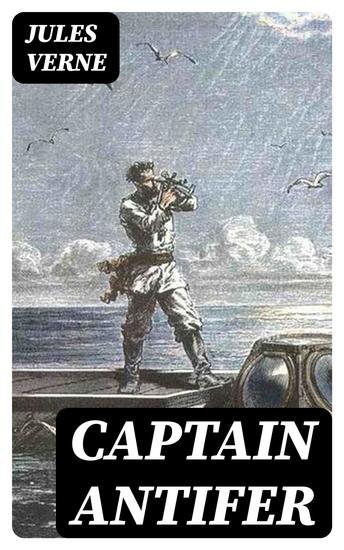
Captain Antifer - Including "The Star of the South" - cover

Captain Antifer - Including "The Star of the South"

Jules Verne

Traducteur Anonyme

Maison d'édition: DigiCat

  • 0
  • 0
  • 0

Synopsis

In "Captain Antifer," Jules Verne crafts a captivating maritime adventure intertwined with themes of wealth, exploration, and human ambition. The narrative follows the titular character, a spirited captain whose obsession with retrieving a hidden treasure leads him and his crew into perilous waters, both literally and metaphorically. Written in Verne's characteristic style, the novel combines rich descriptive passages with scientific detail, engaging the reader in the pursuit of knowledge and adventure. Set against the backdrop of the late 19th century, the book reflects the era's spirit of discovery, even as it delves into the folly and greed that can accompany the quest for fortune. Jules Verne, often hailed as the father of science fiction, was profoundly influenced by the technological advances of his time and a deep-rooted love for exploration. His background in law and theater infused his storytelling with structural precision and engaging dialogue. "Captain Antifer," published in 1894, exemplifies his ability to weave thrilling plots with thought-provoking questions about humanity's relationship with nature and morality, drawing from Verne's own extensive travels and fascination with the sea. For readers seeking a rich tapestry of adventure and introspection, "Captain Antifer" offers both. Verne's intricate characters and evocative settings underscore the timeless allure of exploration and the complexities of ambition. This novel is a must-read for those captivated by maritime tales or the philosophical undercurrents of literature that examine the human condition.
Disponible depuis: 11/10/2022.
Longueur d'impression: 423 pages.
D'autres livres qui pourraient vous intéresser

  • The Venetian Silk-Mercere - A glimpse into 18th Century Venice - cover

    The Venetian Silk-Mercere - A...

    Carlo Gozzi

    • 0
    • 0
    • 0
    The bookshelves of European literature are incredible collections that have gathered together centuries of very talented authors.  From this continent their fame spread and whilst among their number many are now forgotten or neglected their talents endure.  Among them is Grazia Deledda.
    Voir livre
  • The Aeneid - Revised and Expanded Edition - cover

    The Aeneid - Revised and...

    Vergil

    • 0
    • 0
    • 0
    A powerful and poignant translation of Vergil’s epic poem, newly equipped with introduction and notes 
     
    "Ruden set the bar for Aeneid translations in 2008, and has raised it now with this revision. I am confident it will be a long time before a translator exceeds the standard that she has set."—A.M. Juster, Athenaeum Review 
     
    This is a substantial revision of Sarah Ruden’s celebrated 2008 translation of Vergil’s Aeneid, which was acclaimed by Garry Wills as “the first translation since Dryden’s that can be read as a great English poem in itself.” Ruden’s line-for-line translation in iambic pentameter is an astonishing feat, unique among modern translations. Her revisions to the translation render the poetry more spare and muscular than her previous version and capture even more closely the essence of Vergil’s poem, which pits national destiny against the fates of individuals, and which resonates deeply in our own time. 
     
    This distinguished translation, now equipped with introduction, notes, and glossary by leading Vergil scholar Susanna Braund, allows modern readers to experience for themselves the timeless power of Vergil’s masterpiece. 
     
    Praise for the First Edition: 
     
    “Fast, clean, and clear, sometimes terribly clever, and often strikingly beautiful. . . . Many human achievements deserve our praise, and this excellent translation is certainly one of them.”—Richard Garner, The New Criterion 
     
    “Toning down the magniloquence, Sarah Ruden gives us an Aeneid more intimate in tone and soberer in measure than we are used to—a gift for which many will be grateful.”—J. M. Coetzee 
     
    “An intimate rendering of great emotional force and purity. . . . The immediacy, beauty, and timelessness of the original Latin masterpiece lift off these pages with gem-like originality.”—Choice
    Voir livre
  • Love of Life (Unabridged) - cover

    Love of Life (Unabridged)

    Jack London

    • 0
    • 0
    • 0
    Jack London (born John Griffith Chaney, January 12, 1876 - November 22, 1916) was an American author, journalist, and social activist. He was a pioneer in the then-burgeoning world of commercial magazine fiction and was one of the first fiction writers to obtain worldwide celebrity and a large fortune from his fiction alone.
    LOVE OF LIFE: They limped painfully down the bank, and once the foremost of the two men staggered among the rough-strewn rocks. They were tired and weak, and their faces had the drawn expression of patience which comes of hardship long endured. They were heavily burdened with blanket packs which were strapped to their shoulders. Head-straps, passing across the forehead, helped support these packs. Each man carried a rifle. They walked in a stooped posture, the shoulders well forward, the head still farther forward, the eyes bent upon the ground.
    Voir livre
  • Nobody's Story - cover

    Nobody's Story

    Charles Dickens

    • 0
    • 0
    • 0
    Who’s story is this? Nobody. - Who’s nobody? The average working man.
    This story is very old but very relevant. The common man’s opinions are disregarded. His needs are manipulated. But of course the story makes clear that he is key to society.
    The story shows that. Then the narrator comes in and rather dramatically reinforces that point in the final three paragraphs just in case you missed it the first time. Yes, there’s a pretty high soapbox. Yes, it’s pretty holier than thou. But hey, it’s Christmas time. What’s so funny ‘bout peace, love and understanding, anyway? And that’s quite a trick on Dickens’s part.
    Voir livre
  • In the Gulf Stream (Unabridged) - cover

    In the Gulf Stream (Unabridged)

    Charles Kingsley

    • 0
    • 0
    • 0
    Charles Kingsley (12 June 1819 - 23 January 1875) was a broad church priest of the Church of England, a university professor, social reformer, historian, novelist and poet. He is particularly associated with Christian socialism, the working men's college, and forming labour cooperatives, which failed, but encouraged later working reforms. He was a friend and correspondent of Charles Darwin.
    IN THE GULF STREAM: The appearance of the first fragments of gulf-weed caused quite a
    little excitement, and set an enthusiastic pair of naturalists, a midland hunting squire, and a travelled scientific doctor who had been twelve years in the Eastern Archipelago, fishing eagerly over the bows, with an extemporized grapple of wire, for gulf-weed, a specimen
    of which they did not catch.
    Voir livre
  • Ugly Customer An - From their pens to your ears genius in every story - cover

    Ugly Customer An - From their...

    Bernard Capes

    • 0
    • 0
    • 0
    Bernard Edward Joseph Capes was born on the 30th August 1854 in London.  He was one of 11 children. 
    His early work was as a journalist and this developed into writing many short stories for the periodicals of the time including Blackwood's, Cassell's, Cornhill Magazine, Illustrated London News, Macmillan's Magazine, Mall Magazine, Pearson's Magazine, The Idler, and The Queen. 
    It took him many years to decide that writing full-time could be a sustainable career path.  His initial success came with ‘The Mill of Silence’.  As well as being published it garnered second prize at a competition sponsored by the Chicago Record.  He exceeded that by winning it the following year with ‘The Lake of Wine’.   
    Capes quickly became both prolific and popular.  As well as his stories and articles for the periodicals he wrote around 40 volumes across novels, poetry, history as well as romance and mystery novels. 
    Bernard Capes died on 2nd November 1918 in the flu epidemic.
    Voir livre