Rejoignez-nous pour un voyage dans le monde des livres!
Ajouter ce livre à l'électronique
Grey
Ecrivez un nouveau commentaire Default profile 50px
Grey
Abonnez-vous pour lire le livre complet ou lisez les premières pages gratuitement!
All characters reduced
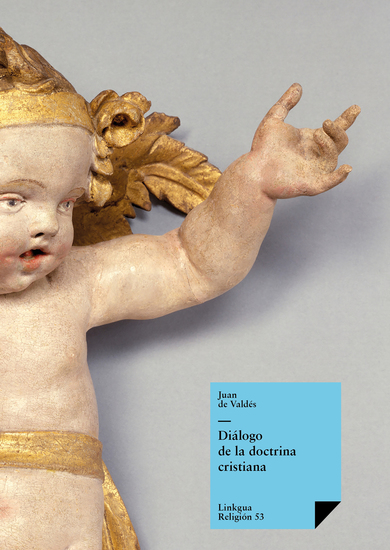
Diálogo de la doctrina cristiana - cover

Diálogo de la doctrina cristiana

Juan de Valdés

Maison d'édition: Linkgua

  • 0
  • 0
  • 0

Synopsis

Diálogo de doctrina cris­tiana constituye, una de las obras más representati­vas del influjo erasmiano en España. El contenido del Diálogo es muy parecido a otro libro de Juan de Valdés, el Alfabeto cristiano, escrito unos años después en Nápoles (y publicado también en versión italiana en 1546), donde sostiene la doctrina de la jus­tificación por la fe.
Valdés da a su Diálogo de la doctrina cristiana la forma de coloquio, tan difundida en el Renacimiento, y utilizada especialmente por Erasmo en sus escritos, e introduce a tres personajes: Antonio, Eusebio y Fray Pe­dro de Alba, arzobispo de Granada.
Disponible depuis: 01/01/2023.
Longueur d'impression: 196 pages.

D'autres livres qui pourraient vous intéresser

  • Eleanor of Aquitaine and Richard the Lionheart: The History of the Mother and Son Who Shaped Medieval Europe - cover

    Eleanor of Aquitaine and Richard...

    Charles River Editors

    • 0
    • 0
    • 0
    Laying next to the tomb effigy of King Henry II of England in France's Fontevraud Abbey is a curious coffin chiseled in the shape of a young woman in repose. The once vibrant paint on the effigy is flaking, and several areas of the centuries-old tombs are chipped, but her general features are still somewhat recognizable. The beautiful, crowned queen, depicted with a soft smile on her face, was dressed in a simple, but elegant gown in white and blue, and an open book in her arms. The effigy is for none other than Duchess Eleanor of Aquitaine. 
    	Over the years, this mysterious 12th century figure has been portrayed in countless ways, from a valiant warrior queen and resourceful politician to a control-obsessed and manipulative siren whose only objective in life was power. What is clear is that during her long life, Eleanor she played an outsized role in both French and English history, and she also had an impact on the course of the Crusades, not just with her first husband, France’s King Louis VII, but also through her offspring with her second husband, Henry II.  
    	The enduring figure of the Middle Ages is the chivalrous knight who served as a hero across much of Europe, and nobody played a more defining role in casting the popular image of medieval knights than Eleanor’s son Richard the Lionheart, one of the most famous English kings and crusaders. In many respects, it was ironic that Richard became one of the central characters of the Middle Ages, and his very popular legacy today belies centuries of controversy. Richard I Plantagenet, better known by his nickname “Coeur de Lion” (Lionheart), eventually became King of England, Grand Duke of Aquitaine, Duke of Poitou, and Duke of Anjou, but as the third son in a large family, he did not expect to or even want to rule England. Nevertheless, it was he who eventually came to the throne upon his father's death, assisted in great measure by his statesmanlike mother Eleanor.
    Voir livre
  • Railroad Robber Barons The: The Lives of the Magnates Who Dominated America’s Rail Industry in the 19th Century - cover

    Railroad Robber Barons The: The...

    Editors Charles River

    • 0
    • 0
    • 0
    The Gilded Age and the dawn of the 20th century are often remembered as an era full of monopolies, trusts, and economic giants in heavy industries like oil and steel. Men like Andrew Carnegie built empires like Carnegie Steel, and financiers like J.P. Morgan merged and consolidated them. The era also made names like Astor, Cooke, and Vanderbilt instantly recognizable across the globe. Over time, the unfathomable wealth generated by the businesses made the individuals on top incredibly rich, and that in turn led to immense criticism and an infamous epithet used to rail against them: robber barons.  
    	Dozens of men were called “robber barons”, and the industrial might wielded by some of these men in the late 19th century directly led to a public backlash and made President Teddy Roosevelt the “trust buster”, and there has since been countless regulations to attempt to avoid the types of monopolies found over 100 years ago. However, many 20th century historians and writers pushed back against the allegations hurled at the “robber barons” and even took issue with the name. Libertarian writer John Stossel argued, “They weren't robbers, because they didn't steal from anyone, and they weren't barons - they were born poor...” Ironically, one of America’s most famous robber barons, Andrew Carnegie, epitomized the American Dream, migrating with his poor family to America in the mid-19th century and rising to the top of the business world in his adopted country. And like Carnegie, railroad tycoon Cornelius Vanderbilt set a precedent of sorts with his philanthropy, most notably his gift to Vanderbilt University, which bears his name. Similarly, the West Coast's most famous railroad mogul became Leland Stanford, who also bequeathed a prestigious university after making it to the top of the industry.
    Voir livre
  • Ancient and Modern Celebrated Freethinkers - cover

    Ancient and Modern Celebrated...

    Charles Bradlaugh

    • 0
    • 0
    • 0
    Ancient and Modern Celebrated Freethinkers by Charles Bradlaugh: Charles Bradlaugh's "Ancient and Modern Celebrated Freethinkers" is a collection of biographical sketches and essays that celebrate the lives and ideas of prominent freethinkers throughout history. As an ardent advocate for secularism and freethought, Bradlaugh aims to promote rationalism, skepticism, and intellectual inquiry. The book features influential figures like Voltaire, Thomas Paine, and Giordano Bruno, shedding light on their contributions to science, philosophy, and the advancement of human knowledge. 
     
    Bradlaugh, a prominent British atheist, political activist, and writer, was a leading advocate for secularism and freethought. As a passionate proponent of free speech and social reform, Bradlaugh wrote extensively on topics related to atheism, politics, and social justice, challenging prevailing religious and societal norms.
    Voir livre
  • Fugitive! - On the run with Britain’s most wanted - cover

    Fugitive! - On the run with...

    Nick Reynolds

    • 0
    • 0
    • 0
    SHORTLISTED IN THE TRUE CRIME AWARDS 2024Ground-breaking audio original exploring the reality of life on the run.What is life on the run really like? Featuring never-before heard interviews, this ground-breaking audio original gets you closer to the reality than ever before.Join Nick Reynolds as he explores the reality of the life of a fugitive. Using his own experiences of growing up on the run with the Great Train Robbers in Central America, Nick talks with some infamous fugitives and their families as they share their extraordinary experiences. From the mental toll of staying constantly vigilant and the need for money, to caring for loved ones and the long shadows cast by their pasts, this audiobook is essential listening for true crime fans.Fleeing from the law, putting yourself beyond society, leaving friends and family behind, never feeling truly safe - it takes a certain sort of person to see life as a fugitive as preferable to facing justice.The life of a fugitive is often glamorised in films and media: it's anything but. It's tough and it leaves deep scars on everyone involved - but is it harder than prison time? Listen and make up your own mind.
    Voir livre
  • The Rebel Romanov - Julie of Saxe-Coburg the Empress Russia Never Had - cover

    The Rebel Romanov - Julie of...

    Helen Rappaport

    • 0
    • 0
    • 0
    In 1795, Catherine the Great of Russia was in search of a bride for her grandson Constantine, who stood third in line to her throne. In an eerie echo of her own story, Catherine selected an innocent young German princess, Julie of Saxe-Coburg, aunt of the future Queen Victoria. Though Julie had everything a young bride could wish for, she was alone in a court dominated by an aging empress and riven with rivalries, plotting, and gossip—not to mention her brute of a husband. She longed to leave Russia and her disastrous marriage, but her family in Germany refused to allow her to do so. 


    Finally, Tsar Alexander granted her permission to leave in 1801, even though her husband was now heir to the throne. Rootless in Europe, Julie gave birth to two—possibly three—illegitimate children, all of whom she was forced to give up for adoption. Despite entreaties from Constantine to return and provide an heir, she refused, eventually finding love with her own married physician. 


    At a time when many royal brides meekly submitted to disastrous marriages, Julie proved to be a woman ahead of her time, sacrificing her reputation and a life of luxury in exchange for the freedom to live as she wished. The Rebel Romanov is the inspiring tale of a bold woman who, until now, has been ignored by history.
    Voir livre
  • Whispers from the Valley of the Yak - A Memoir of Coming Full Circle - cover

    Whispers from the Valley of the...

    Jacquelyn Lenox Tuxill

    • 0
    • 0
    • 0
    Awarded a 2024 Independent Press Distinguished Favorite in Memoir, Whispers from the Valley of the Yak weaves an intergenerational story about the power of forgiveness and being true to oneself. When Jackie returns to her Chinese birthplace with her aging American parents (former medical missionaries), profound questions arise about love and family. These questions set her on a quest to understand her troubled childhood and what she wants from life. Living in Alaska for five years, Jackie discovers her soul-place and an affinity for mountains and begins three decades of environmental work. Several solo visits to China help her forge a bridge of understanding and forgiveness with her mother. After her parents’ deaths, Jackie takes her adult children to China to retrace her parents’ 1932 trek into eastern Tibet. In so doing, she realizes she has come full circle to the authentic life she has craved.
    Voir livre