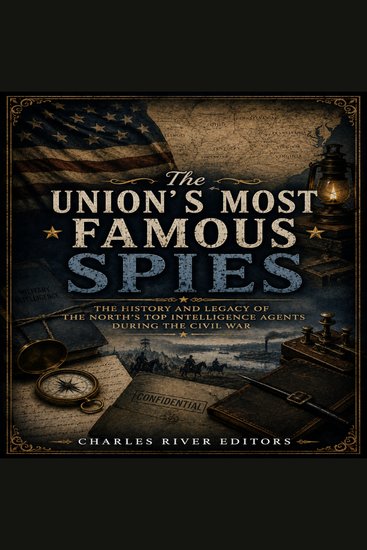
Union’s Most Famous Spies The:...
Charles River Editors
In September 1862, the Union had no intelligence service worthy of the name. It had detectives, scouts, scattered networks of informants, balloons, signal flags, and a great deal of luck, but the federal government did not have a coordinated system, to the extent that military commanders did not know enemy troop strength. By the end of the war, the Union would be running the most sophisticated intelligence operations in American history to that point, utilizing an integrated, all-source, professional service that fed the commanding generals daily reports on enemy strength, disposition, morale, and intent. Just as importantly, the Union also successfully maintained a network of spies inside the Confederate capital that intercepted enemy signal traffic; read Southern newspapers for what the editors had let slip, and used escaped slaves as sources of intelligence. Remarkably, the spy at the center of the efforts in Richmond was a Southern woman who hailed from the city itself.
In some ways, Pauline Cushman was able to take advantage of the fact she was a woman, but unlike regular civilians who could blend in, she had the disadvantage of being a recognizable actress. Near the end of the war, she was photographed by Matthew Brady, who had documented the Civil War's battlefields, generals, and, most memorably, casualties. The photograph was taken after she had been rescued and the nation had learned what she had done behind Confederate lines in the spring and summer of 1863. She was already famous as the “Spy of the Cumberland,” making her the greatest heroine of the year.
	The story of how the Union Army went from the bumbling improvisation of 1861 to the professional craft of 1865, and back to nothing in 1866, is a story of inflated estimates and accidental discoveries, of slaves who walked into federal lines with maps in their heads, of Richmond spinsters who carried coded messages in hollow eggs, and of New York lawyers who learned on the job how to count the enemy.
Voir livre