Rejoignez-nous pour un voyage dans le monde des livres!
Ajouter ce livre à l'électronique
Grey
Ecrivez un nouveau commentaire Default profile 50px
Grey
Abonnez-vous pour lire le livre complet ou lisez les premières pages gratuitement!
All characters reduced
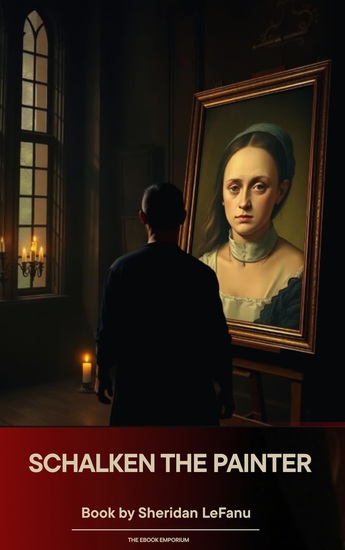
Schalken the Painter - cover

Schalken the Painter

Joseph Sheridan Le Fanu

Maison d'édition: The Ebook Emporium

  • 0
  • 0
  • 0

Synopsis

"He was not a man of this world, and the gold he paid with had a cold, ancient gleam."

In the workshops of 17th-century Leyden, the young and talented artist Godfried Schalken falls in love with Rose, the beautiful niece of his master, Gerard Douw. But their romance is shattered by the arrival of a mysterious suitor: Minheer Vanderhausen. Blue-skinned, breathless, and draped in magnificent but outdated finery, Vanderhausen offers a chest of gold so immense that Douw cannot refuse. Rose is bartered away to this living corpse, disappearing into a nightmare from which there is no return. Years later, Schalken is granted one final, terrifying glimpse of his lost love—and the horrific entity she now serves in the shadows.

The Horror of the Visual: Le Fanu, himself an admirer of art, uses the techniques of the Dutch masters to tell his story. He describes scenes as if they were paintings, utilizing chiaroscuro—the intense contrast between deep shadows and bright light—to hide the grotesque features of the supernatural antagonist. The result is a story that feels as textured and atmospheric as an oil painting come to life.

A Tale of Moral Decay: At its heart, the story is a critique of avarice. Gerard Douw's willingness to sell his niece for a chest of gold is the "true" horror that invites the supernatural in. Le Fanu explores the idea that human greed can be more monstrous than any phantom, leading to a tragedy that haunts the protagonist until his dying day.

The Legacy of the "Demon Lover": Schalken the Painter is a foundational text in the "demon lover" tradition of Gothic fiction. It avoids the typical "clanking chains" of 18th-century ghosts, opting instead for a quiet, physical, and deeply uncanny presence. The final image of the story—the "living" painting—remains one of the most famous and frightening endings in horror literature.

Don't look too closely at the shadows. Purchase this masterpiece of the macabre today.
Disponible depuis: 13/01/2026.
Longueur d'impression: 56 pages.

D'autres livres qui pourraient vous intéresser

  • A Perplexing Case - From their pens to your ears genius in every story - cover

    A Perplexing Case - From their...

    H D Everett

    • 0
    • 0
    • 0
    Henrietta Dorothy Huskisson was born in January 1851 in Gillingham, Kent. 
    Little reliable information on her life is available and almost nothing on her early life.   
    The first concrete information concerns her marriage at age 18 to the solicitor Isaac Edward Everett. 
    It was only at the age of 44 that she began her literary career under the pseudonym of Theo Douglas, a popular device in a society that still frowned upon women writing for income. 
    During her lifetime she was a popular author and wrote 22 books and those were published by 17 different publishers. 
    Although she wrote some historical novels her main output was centered on fantasy and supernatural themes. 
    Henrietta Dorothy Everett died in Weston-on-Trent in Derbyshire in September 1923.
    Voir livre
  • The Hollow Needle - Further Adventures of Arsène Lupin - cover

    The Hollow Needle - Further...

    Maurice Leblanc

    • 0
    • 0
    • 0
    In the third installment of the Arsène Lupin series, we find our gentleman burglar up against Isidore Beautrelet, a young but gifted amateur detective who is determined to foil Lupin once and for all. As he hunts down the Hollow Needle, a needle that contains secrets that have been passed down from French kings since Julius Caesar, Beautrelet is never too far behind.
    Voir livre
  • Enlargement - From their pens to your ears genius in every story - cover

    Enlargement - From their pens to...

    John Davys Beresford

    • 0
    • 0
    • 0
    John Davys Beresford was born on 17th March 1873.  His life was blighted by infantile paralysis which left him partially disabled. 
    After an education at Oundle school he trained to be an architect.  However, he quickly decided that his life was to be centred on a literary career.  His first offerings were in drama and as a journalist. 
    As well as being a book reviewer for the Manchester Guardian he contributed to New Statesman, The Spectator, Westminster Gazette, and the Theosophist magazine The Aryan Path.   
    His spiritual journey in early adulthood had claimed him as an agnostic, in defiance of his clergyman father.  This view he later abandoned in preference to describing himself as a Theosophist and a pacifist. 
    As well as many novels, many themed with spiritual and philosophical elements.  Beresford was also a gifted short story writer particularly across the science-fiction, horror and ghost genres. 
    All of these elements helped him to obtain a prominent place in Edwardian Literary London. 
    John Davys Beresford died on the 2nd February 1947. He was 73.
    Voir livre
  • The Haunted Baronet - cover

    The Haunted Baronet

    Joseph Sheridan Le Fanu

    • 0
    • 0
    • 0
    "The lake does not give up its dead easily, and the House of Mardykes has a long memory."
    
    Sir Bale Mardykes is a man of iron will and a cold heart, living in the ancestral home of Mardykes Hall near the secluded village of Golden Friars. He believes he is the master of his own fate, but he is haunted by a centuries-old prophecy of doom. When he cruelly causes the death of his secretary and distant relative, Philip Feltram, Sir Bale believes he has cleared a nuisance from his path. But when Feltram returns—changed, silent, and carrying the chill of the lake—Sir Bale realizes that the dead have a way of reclaiming what is theirs. It is a slow-burn masterpiece of Gothic tension, where the environment itself seems to conspire against the living.
    
    The Environment as Antagonist: Le Fanu utilizes the "Atmospheric Gothic" to its fullest potential here. The swirling mists of the Lake District, the echoes in the mountain passes, and the bottomless depths of the lake serve as metaphors for Sir Bale's mounting paranoia. The house and the land are not just settings; they are active participants in the baronet's downfall.
    
    A Study in Psychological Ruin: Unlike many contemporary ghost stories, the horror in The Haunted Baronet is deeply internal. We watch Sir Bale's skepticism slowly erode as the supernatural elements become undeniable. The figure of the "Returned" Feltram is one of Le Fanu's most effective creations—a ghost that doesn't just haunt, but inhabits the social space of the living.
    
    The Weight of Ancestry: Le Fanu explores the idea that we are never truly free from the actions of our forefathers. Sir Bale is a victim of his own bloodline as much as his own choices. The novella builds to a tragic and inevitable climax that proves that some debts can only be paid in lifeblood.
    
    Beware the calm waters of Golden Friars. Purchase "The Haunted Baronet" today.
    Voir livre
  • In Search of Lost Time - cover

    In Search of Lost Time

    Marcel Proust

    • 0
    • 0
    • 0
    Unlock the Secrets of the Human Heart and the Architecture of Memory.
    
    Marcel Proust's monumental work is widely considered the greatest novel of the 20th century—a vast, shimmering tapestry of life in Belle Époque France. This is not merely a story, but a profound philosophical journey that explores how we experience time, how we love, and how the smallest sensory detail can unlock an entire forgotten world.
    
    Inside this definitive collection, you will discover:
    
    The Revolution of Involuntary Memory: Witness the birth of one of literature's most famous concepts—where a simple taste or scent acts as a key to the treasure house of the past.
    
    A Panorama of High Society: Experience a meticulous and often satirical look at the aristocrats, social climbers, and artists of Parisian salons, exploring the shifting boundaries of class and prestige.
    
    The Complexity of Desire: Dive into one of the most thorough investigations of love, jealousy, and obsession ever written, told with a psychological depth that remains unmatched.
    
    The Transfigurative Power of Art: Explore Proust's belief that life only truly finds its meaning and permanence when it is translated into the realm of art and literature.
    
    Proust's prose is famous for its winding, beautiful complexity, inviting the reader to slow down and notice the intricate beauty of a single moment. This collection is an essential cornerstone for any library of world literature, modernist thought, and philosophical fiction.
    
    Step into the flow of time. Buy "In Search of Lost Time" today and experience the ultimate achievement in literary history.
    Voir livre
  • War and Peace - Book 5: 1806-07 (Unabridged) - cover

    War and Peace - Book 5: 1806-07...

    Leo Tolstoy

    • 0
    • 0
    • 0
    War and Peace is a literary work mixed with chapters on history and philosophy by the Russian author Leo Tolstoy. It was first published serially, then published in its entirety in 1869. It is regarded as one of Tolstoy's finest literary achievements and remains an internationally praised classic of world literature.
    Book 5: 1806-07: After his interview with his wife Pierre left for Petersburg. At the Torzhók post station, either there were no horses or the postmaster would not supply them. Pierre was obliged to wait. Without undressing, he lay down on the leather sofa in front of a round table, put his big feet in their overboots on the table, and began to reflect.
    Voir livre