Rejoignez-nous pour un voyage dans le monde des livres!
Ajouter ce livre à l'électronique
Grey
Ecrivez un nouveau commentaire Default profile 50px
Grey
Abonnez-vous pour lire le livre complet ou lisez les premières pages gratuitement!
All characters reduced
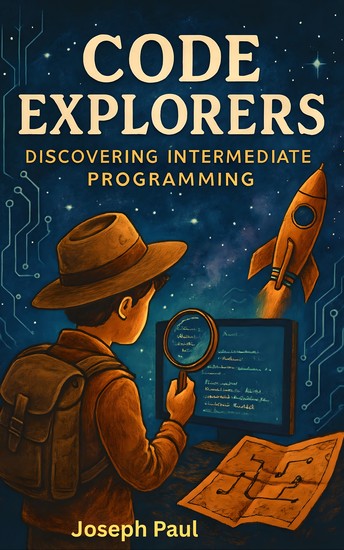
Code Explorers - Discovering Intermediate Programming - cover

Code Explorers - Discovering Intermediate Programming

Joseph Paul

Maison d'édition: Publishdrive

  • 0
  • 0
  • 0

Synopsis

"Code Explorers: Discovering Intermediate Programming" invites young and aspiring coders on an exhilarating journey through the vast and intriguing landscape of programming. This book transforms the learning experience into an adventurous expedition, with each chapter framed as a thrilling mission set in the mysterious “Tech Tundra.”
 
As the expedition begins, readers are introduced to the essential building blocks of programming through the lens of discovery. The first chapter delves into “Data Types,” where explorers learn to identify and utilize various types of data, from integers to strings, while navigating through the icy terrains of Tech Tundra. Each section is filled with engaging challenges that require readers to think critically and creatively, making the learning process both fun and interactive.In the next leg of the journey, “Decision Making” comes into play, as explorers face crucial choices that will determine the paths they take. Here, readers learn about conditional statements and logic, unraveling the mystery of how computers make decisions, much like detectives piecing together clues to solve a case in the “Detective Dilemma” chapter. Each decision they make in the narrative impacts the course of their adventure, reinforcing the importance of logical thinking in coding.Moving deeper into the Tech Tundra, readers embark on “Algorithm Adventures,” where they uncover the secrets of algorithms, learning how to break down complex problems into manageable steps. This chapter is designed to spark curiosity and empower readers to create their algorithms, realizing that coding is not just about writing commands but also about problem-solving and creativity.The thrill continues with “API Treasure Hunting,” guiding readers through the exciting world of Application Programming Interfaces. Here, they discover how to interact with external data sources and services, unlocking treasures of information that enhance their coding projects. The chapter emphasizes the interconnectedness of technology and how APIs can broaden the horizons of their coding capabilities.As the journey reaches its peak, “Data Sorcery: The Power of Data” reveals the magic behind data manipulation and analysis. Readers learn to wield data as a powerful tool for creation, encouraging them to visualize and interpret information in innovative ways. This chapter instills a sense of wonder and appreciation for the capabilities of coding, showcasing how data can fuel creativity and innovation.Throughout "Code Explorers," the narrative is infused with vivid imagery and sensory details, engaging readers’ imaginations while educating them on the intricacies of programming. The book concludes with a powerful message: coding is not merely a set of skills; it is a form of creation that empowers individuals to bring their ideas to life.With its unique approach to learning, "Code Explorers: Discovering Intermediate Programming" transforms coding into an exhilarating expedition, inspiring readers to embark on their journeys of discovery and creation in the vast world of technology.
Disponible depuis: 04/08/2025.
Longueur d'impression: 71 pages.

D'autres livres qui pourraient vous intéresser

  • Oology - The Egg and Its Secrets: A Study in Bird Reproduction - cover

    Oology - The Egg and Its...

    Mike Crawford

    • 0
    • 0
    • 0
    The egg is one of nature’s most remarkable biological innovations, serving as the foundation of avian reproduction. Long before birds existed, the ability to lay eggs developed as a survival strategy in early reptiles, eventually giving rise to the diverse eggs seen in birds today. The evolution of eggs is a story of adaptation, refinement, and resilience, shaping the reproductive success of countless species. 
    Egg-laying, or oviparity, predates birds by hundreds of millions of years. The first amniotic eggs emerged among ancient reptiles during the Carboniferous period, around 300 million years ago. These eggs were a major evolutionary breakthrough, allowing vertebrates to reproduce on land without relying on water, unlike amphibians. The development of a protective shell and internal membranes provided a self-contained environment, shielding the embryo from desiccation while supplying it with the necessary nutrients and gases for development. Over time, the egg’s structure became more specialized, leading to the hardened, calcified shells seen in modern birds. 
    As dinosaurs evolved into birds, their eggs underwent significant transformations to meet the demands of flight and avian lifestyles. Fossil evidence suggests that theropod dinosaurs, the ancestors of birds, laid eggs with increasingly sophisticated structures. Their eggshells contained microscopic pores that regulated gas exchange, similar to those of birds today. Some species even exhibited brooding behaviors, indicating that parental care played a role in egg survival long before the emergence of modern avians. These adaptations contributed to the success of birds, enabling them to occupy a wide range of ecological niches.
    Voir livre
  • Self-Love - A 12 Part Guide - cover

    Self-Love - A 12 Part Guide

    Barb Egan

    • 0
    • 0
    • 0
    If you're looking for a guide to self-love, common humanity, and gratitude look no further! 
    Registered Clinical Counsellor Barb Egan takes you through 12 chapters of examples, exercises, and meditations to shed light on the important topic of Self-Love. 
    You'll notice a change in overall self acceptance and self-kindness as your go through concrete examples and real life situations that may be hard to traverse on your own. So listen along and take notes as Barb talks you through strategies and modalities to help you challenge myths and empower yourself though self-love and mindfulness.
    Voir livre
  • General history of industry - cover

    General history of industry

    Albert Bleunard

    • 0
    • 0
    • 0
    From ancient forges to modern assembly lines, General History of Industry brings to life humanity’s epic journey of ingenuity and transformation. This audiobook unveils pivotal technological shifts, daring pioneers, and silent revolutions that have shaped the ways we produce, trade, and live. Blending vivid storytelling, economic insights, and surprising anecdotes, it traces the birth of factories, the rise of energy, standardization, globalization, and the digital era. An immersive panorama that reveals how industry reflects, at its core, the ambition, risks, and imagination of societies. Listen to understand the past, illuminate the present, and glimpse the future.
    Voir livre
  • The Enigma Story - The Truth Behind the 'Unbreakable' World War II Cipher - cover

    The Enigma Story - The Truth...

    Dermot Turing

    • 0
    • 0
    • 0
    The Enigma cipher was supposed to be the German's impenetrable defence for its military communications against prying eyes during World War II. All manner of secrets were entrusted to it. When the Allies finally managed to crack the code, it heralded a turning point in the war. 
     
    This is the fascinating story of how the code was created, adopted by the Nazis, and finally broken. Dermot Turing, the nephew of the great codebreaker Alan Turing, explores the twists and turns of German encryption efforts from the end of World War I through to Hitler's demise and the great lengths to which the Allies went to break it. 
     
    The Enigma Story reveals the efforts of the codebreakers at Bletchley Park, the machines called 'bombes' specially designed to break it, and the vast resources devoted in America to decrypting German messages. From the cloak-and-dagger heroics of men like Hans-Thilo Schmidt and Gustave Bertrand to the brilliant mathematical discoveries of men like Henryk Zygalski and Dilly Knox to the fraught decision-making of Allied High Command, the battle for the code was at the heart of the Allied victory in World War II. 
     
    This extraordinary tale of intrigue, ingenuity and courage brings to life the complete story of the Enigma in a lively and entertaining narrative.
    Voir livre
  • Waste Empire - Pollution Fast Fashion And The Circular Economy Revolution - cover

    Waste Empire - Pollution Fast...

    Davis Truman

    • 0
    • 0
    • 0
    Fast fashion has taken the world by storm, delivering trendy, affordable clothing at breakneck speed. But behind the allure lies a darker truth — one of environmental devastation, exploitative labor practices, and staggering waste. Waste Empire unravels the global impact of this multibillion-dollar industry, exposing how fast fashion fuels pollution and exacerbates climate change. 
    This compelling and insightful book explores the hidden cost of our obsession with disposable clothing, from toxic dyes polluting rivers to mountains of textile waste clogging landfills. It takes readers on a journey through the supply chains of major brands, revealing the human and ecological toll of unchecked consumerism. 
    But Waste Empire is not just a tale of destruction. It also illuminates a path forward, showcasing the revolutionary potential of the circular economy. Through real-world examples, innovative strategies, and interviews with thought leaders, the book highlights solutions that prioritize sustainability, ethical practices, and environmental stewardship. 
    Whether you’re a conscious consumer, industry professional, or sustainability advocate, Waste Empire offers a gripping look at the urgent need to transform the fashion industry — and a hopeful blueprint for a future where style meets sustainability.
    Voir livre
  • The History of Computing - From the Abacus to Artificial Intelligence - cover

    The History of Computing - From...

    Craig Dames

    • 0
    • 0
    • 0
    The story of computing begins not with electricity or screens, but with simple tools and the human need to solve problems. Long before the modern computer, ancient civilizations were already creating devices to aid in counting, measuring, and performing basic arithmetic. These early innovations laid the groundwork for centuries of progress in computing. 
    One of the most enduring tools from this era is the abacus. Believed to have originated in Mesopotamia over 4,000 years ago, the abacus evolved in various cultures, including Chinese, Roman, and Japanese societies. It was a portable, efficient device that allowed users to perform addition, subtraction, multiplication, and division by sliding beads along rods or grooves. Although simple in design, the abacus was powerful for its time and is still used in some regions for teaching arithmetic and mental calculation skills. 
    In addition to the abacus, ancient number systems were critical to the development of computation. The Babylonians used a base-60 numeral system, which influenced the way we measure time and angles today. The Egyptians employed a system based on units of ten, using hieroglyphs to represent values. Meanwhile, the Romans had a cumbersome numeral system that made complex calculations challenging. It wasn't until the adoption of the Hindu-Arabic numeral system, with its concept of zero and place value, that true advances in mathematical computation became possible.
    Voir livre