Rejoignez-nous pour un voyage dans le monde des livres!
Ajouter ce livre à l'électronique
Grey
Ecrivez un nouveau commentaire Default profile 50px
Grey
Abonnez-vous pour lire le livre complet ou lisez les premières pages gratuitement!
All characters reduced
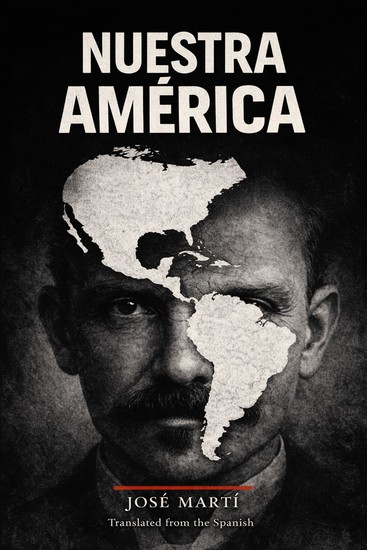
Nuestra América - English Version - cover

Nuestra América - English Version

José Martí

Maison d'édition: Legorreta

  • 0
  • 0
  • 0

Synopsis

Our America (Nuestra América, 1891) is one of José Martí's most influential political and cultural essays. Written as a call to unity and self-awareness, the text urges the nations of Latin America to reject foreign domination and to build their future based on their own realities, histories, and identities. Martí argues that true independence requires more than political separation from colonial powers—it demands intellectual and cultural emancipation. He criticizes Latin American elites who imitate European models without understanding the needs of their own people. Instead, Martí insists that governments must be rooted in local knowledge, shaped by the land, the traditions, and the diverse populations of the continent, including Indigenous and Afro-descendant communities. He warns that ignorance, internal division, and blind imitation create vulnerability to external intervention, especially from the growing power of the United States. Martí promotes education, justice, and dignity as essential foundations for national strength. His vision is not isolationist, but protective: Latin America must engage with the world without surrendering its identity. Combining poetic language with sharp political insight, Our America remains a timeless manifesto for sovereignty, cultural pride, and collective solidarity across the Americas.
Disponible depuis: 16/01/2026.
Longueur d'impression: 100 pages.
D'autres livres qui pourraient vous intéresser

  • The Egyptian Book of the Dead - The Papyrus Of Ani - cover

    The Egyptian Book of the Dead -...

    E. A. Wallis Budge

    • 0
    • 0
    • 0
    The Papyrus of Ani is a papyrus manuscript in the form of a scroll with cursive hieroglyphs and color illustrations that was created c.1250 BCE during the 19th Dynasty of the New Kingdom of ancient Egypt. Egyptians compiled an individualized book for certain people upon their death called the Book of Going Forth by Day, more commonly known as the Book of the Dead, typically containing declarations and spells to help the deceased in their afterlife. 
    The Papyrus of Ani is the manuscript compiled for the Theban scribe Ani. The scroll was discovered in Luxor in 1888 by Egyptians trading in illegal antiquities. It was acquired by E. A. Wallis Budge, as described in his autobiography By Nile and Tigris. Shortly after Budge first saw the papyrus, Egyptian police arrested several antiquities dealers and sealed up their houses, one of which contained the objects Budge had purchased from the dealers. Budge distracted the guards by offering them a meal while locals tunneled under the house's walls to retrieve the objects, including the Papyrus of Ani. Stored in several custom tin boxes, the papyrus and other objects Budge had acquired were then smuggled to the principal librarian at the British Museum. Budge was afterward paid a 150GBP "gratuity" from the British Treasury on behalf of the British Museum for acquiring the papyrus.
    Voir livre
  • How Do We Know Ourselves? - Curiosities and Marvels of the Human Mind - cover

    How Do We Know Ourselves? -...

    David G. Myers

    • 0
    • 0
    • 0
    “Each chapter is a gem of insight into the human experience, cut and polished to perfection by the renowned psychologist David Myers. Better than any book I can recall, this book answers questions about why we think, feel, and act as we do—but also makes us curious to learn more.” —Angela DuckworthA delightful tour of the wonders of our humanity from David G. Myers, the award-winning professor and author of psychology’s bestselling textbook.Over the past three decades, millions of students have learned about psychology from textbooks by David G. Myers. To create these books and to satisfy his own endless curiosity about the human mind, Myers monitors the leading journals to discover the most extraordinary new developments in psychological science.How Do We Know Ourselves? is a compendium of the most wondrous verities that Myers has found: a thought-provoking audiobook about psychological science’s insights into our everyday lives. His astute observations and sharp-witted wisdom enable listeners to think smarter and live happier.Myers’s explorations range from why we so often fear the wrong things to how simply going for a walk with someone can increase rapport and empathy. He explains why we repeatedly mishear song lyrics and how the color of President Obama’s suits aided in his decision-making. Myers also explores the powers and perils of our intuition, explaining why anything can seem obvious once it happens.Each of these forty essays offers fresh insight into our sometimes bewildering but ever-fascinating lives, all drawn from psychology’s latest research. Myers is engaging and intellectually provocative, and he brings a wealth of knowledge from more than fifty years of teaching and writing about psychology to this lively and informative collection. He inspires us to ponder timeless questions, including what might be the most intriguing one of all: How do we know ourselves?A Macmillan Audio production from Farrar, Straus and Giroux.
    Voir livre
  • Lincoln's Last Hours - cover

    Lincoln's Last Hours

    Charles Leale

    • 0
    • 0
    • 0
    Lincoln's Last Hours describe the assassination and last moments of President Lincoln's life. They were written by Dr. Charles Leale, the first doctor to attend to Lincoln after he was shot.
    Voir livre
  • State of the Union 1986 - cover

    State of the Union 1986

    Ronald Reagan

    • 0
    • 0
    • 0
    The 1986 State of the Union Address delivered February 4, 1986, was delayed following the Space Shuttle Challenger disaster which killed its seven crew members. Reagan reports the U.S. is the economic miracle to which the world once again turns, with record economic growth and inflation cut from over 12 to under 4 percent.  
    But the federal budget system is broken. “We do not face large deficits because American families are undertaxed; we face those deficits because the Federal Government overspends.” “We must proceed with Grace commission reforms against waste.” Tax cuts have done more to “help America's economy break free than any program since John Kennedy's tax cut almost a quarter century ago.” 
    We “must redouble our efforts for freer and fairer trade.” We oppose legislation touted as providing protection that raises prices for us all.  
    We see a renaissance in education and support “vouchers that give parents freedom of choice”. Hundreds of billions of dollars in poverty programs have led to a breakdown of the family and deteriorating schools. As Franklin Roosevelt said, “Welfare is a narcotic, a subtle destroyer of the human spirit.” Welfare “should be judged by how many of its recipients become independent of welfare.” 
    Reagan sees technology as the solution to “the greatest problem of the 20th century. A security shield can one day render nuclear weapons obsolete and free mankind from the prison of nuclear terror.”  
    “The American dream is a song of hope… to discover a new universe inside a tiny silicon chip or a single human cell.” “So, let us go forward to create our world of tomorrow in faith, in unity, and in love. God bless you, and God bless America.” 
    Audio recording courtesy of the Ronald Reagan Presidential Library. 
    AspenLeafMedia.com
    Voir livre
  • Colonization and Decolonization of Africa The: The History and Legacy of European Imperialism across the African Continent - cover

    Colonization and Decolonization...

    Editors Charles River

    • 0
    • 0
    • 0
    The modern history of Africa was, until very recently, written on behalf of the indigenous races by the white man, who had forcefully entered the continent during a particularly hubristic and dynamic phase of European history. In 1884, Prince Otto von Bismark, the German chancellor, brought the plenipotentiaries of all major powers of Europe together, to deal with Africa's colonization in such a manner as to avoid provocation of war. This event—known as the Berlin Conference of 1884-1885—galvanized a phenomenon that came to be known as the Scramble for Africa. The conference established two fundamental rules for European seizure of Africa. The first of these was that no recognition of annexation would granted without evidence of a practical occupation, and the second, that a practical occupation would be deemed unlawful without a formal appeal for protection made on behalf of a territory by its leader, a plea that must be committed to paper in the form of a legal treaty. 
    This began a rush, spearheaded mainly by European commercial interests in the form of Chartered Companies, to penetrate the African interior and woo its leadership with guns, trinkets and alcohol, and having thus obtained their marks or seals upon spurious treaties, begin establishing boundaries of future European African colonies. The ease with which this was achieved was due to the fact that, at that point, traditional African leadership was disunited, and the people had just staggered back from centuries of concussion inflicted by the slave trade. Thus, to usurp authority, to intimidate an already broken society, and to play one leader against the other was a diplomatic task so childishly simple, the matter was wrapped up, for the most part, in less than a decade. 
    This audiobook examines the turbulent history of imperialism across Africa and the consequences it has had.
    Voir livre
  • Samantha's Confession - cover

    Samantha's Confession

    Carol East, Carl

    • 0
    • 0
    • 0
    Samantha wants to confess to her friends that she is a Futanari but each time she tries the words won't come out. After talking with her mother she decides they either accept her or not and that's when the fun begins. 
     
    This tale is graphic in nature and is intended for adults only. All characters depicted are 18 or older. Enjoy
    Voir livre