Rejoignez-nous pour un voyage dans le monde des livres!
Ajouter ce livre à l'électronique
Grey
Ecrivez un nouveau commentaire Default profile 50px
Grey
Abonnez-vous pour lire le livre complet ou lisez les premières pages gratuitement!
All characters reduced
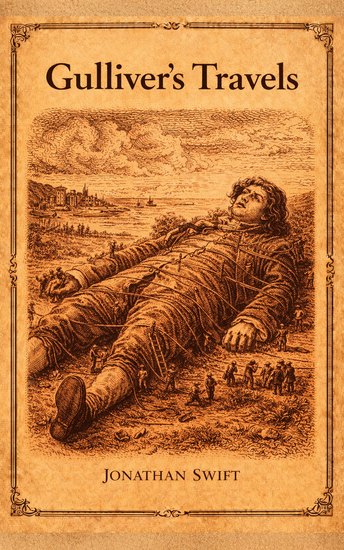
Gulliver's Travels - cover

Gulliver's Travels

Jonathan Swift

Maison d'édition: CLXBX

  • 0
  • 0
  • 0

Synopsis

A brilliant blend of adventure, satire, and sharp social commentary, Gulliver's Travels by Jonathan Swift is a timeless classic that continues to entertain and provoke readers centuries after its first publication. Beneath its imaginative voyages and fantastical lands lies a powerful critique of human nature, politics, and society.

The novel follows Lemuel Gulliver, a ship's surgeon whose journeys take him to extraordinary worlds beyond imagination. From the tiny inhabitants of Lilliput to the towering giants of Brobdingnag, from the abstract thinkers of Laputa to the rational horses of Houyhnhnmland, Gulliver encounters societies that mirror—and mock—the follies of his own.

Each voyage serves as both an adventure and a satirical lens, exposing the absurdities of political conflict, scientific obsession, pride, greed, and moral hypocrisy. Swift's wit is sharp, his irony biting, yet his storytelling remains captivating and accessible. Through exaggerated worlds and unforgettable characters, he challenges readers to question authority, examine their assumptions, and reflect on what it truly means to be civilized.

While often introduced as a tale of exploration and wonder, Gulliver's Travels is far more than a simple adventure story. It is a profound and sometimes unsettling examination of humanity's strengths and weaknesses. Swift masterfully balances humor with criticism, fantasy with realism, creating a work that is as thought-provoking as it is entertaining.

Rich in imagination, layered in meaning, and enduring in relevance, Gulliver's Travels stands as one of the greatest satirical works in English literature. It remains a compelling journey into distant lands—and an even deeper journey into the complexities of the human condition.
Disponible depuis: 14/02/2026.
Longueur d'impression: 357 pages.

D'autres livres qui pourraient vous intéresser

  • At the Villa Rose - cover

    At the Villa Rose

    Edward Woodley Mason

    • 0
    • 0
    • 0
    ""At the Villa Rose" is a captivating detective novel written by the British author A. E. W. Mason in 1910. It marks the debut of his character, Inspector Hanaud. The story unfolds against the backdrop of Aix-les-Bains, a picturesque French town.    Here's a glimpse into the intriguing plot:    The Crime: A wealthy widow named Mme Dauvray is found murdered at the Villa Rose. Her valuable jewels have vanished, and her maid, Hélène Vauquier, lies unconscious, chloroformed, and bound.  The Suspects: Suspicion falls on Mme Dauvray's young English companion, Celia Harland, who has mysteriously disappeared. Celia is in love with a fellow Englishman, Harry Wethermill, who pleads with Inspector Hanaud to prove her innocence.  Spiritualism and Deception: Mme Dauvray was fascinated by spiritualism, and Celia's role included staging séances for her. But beneath the veneer of mediumship lies trickery.  The Cunning Criminal: Enter Adèle Tacé, a seasoned criminal who arrives in Aix with the intent to steal Mme Dauvray's jewels. She goads the widow into holding a séance, where Celia is expected to perform while bound hand and foot.  The Unexpected Twist: Celia becomes a prisoner during the séance, and her life takes a dark turn. The true identity of the murderer remains shrouded in mystery.  Abduction and Pursuit: Celia is abducted and taken to Geneva, kept alive only to reveal the hidden location of the stolen jewels.  The Unraveling: As the investigation unfolds, Inspector Hanaud navigates deception, love, and betrayal to unmask the killer.  "At the Villa Rose" weaves together elements of suspense, illusion, and human frailty, making it a compelling read. The novel's success led to adaptations as a stage play and several films."
    Voir livre
  • Antigone - Full Cast Drama - cover

    Antigone - Full Cast Drama

    Sophocles

    • 0
    • 0
    • 0
    "Antigone" is a Greek tragedy written by Sophocles in the 5th century BCE. The play is part of a trilogy, but only "Antigone," the third installment, has survived. The narrative revolves around Antigone, the daughter of Oedipus, who defies the king's decree and buries her brother Polynices, in defiance of the law. The king, Creon, orders that Polynices' body should remain unburied as punishment for his rebellion against the city. 
     
    Antigone's act of burial is not only an expression of familial loyalty but also an assertion of divine laws over human laws. She believes in the moral duty to honor her brother, even in death and is willing to face the consequences. Creon, however, sees her actions as an affront to his authority and issues a decree that anyone attempting to bury Polynices will be put to death. 
     
    As the plot unfolds, the clash between divine and human laws intensifies. Antigone is caught and brought before Creon, where she staunchly defends her actions. Creon remains resolute in his decision to punish her, regardless of her familial ties. The play explores themes of morality, duty, and the consequences of pride and authoritarian rule. 
     
    Tragedy unfolds as Antigone is sentenced to be entombed alive. The narrative weaves the fates of various characters, including Antigone, Haemon (Creon's son and Antigone's fiancé), and Eurydice (Creon's wife). The play culminates in a series of tragic events, leading to Creon's realization of his own tragic flaw and the devastating consequences of his decisions.
    Voir livre
  • Making a Living - From their pens to your ears genius in every story - cover

    Making a Living - From their...

    Charlotte Perkins Gilman

    • 0
    • 0
    • 0
    Charlotte Perkins Gilman was born on 3rd July 1860 in Hartford, Connecticut, to an unaffectionate mother and a father who abandoned her and her older brother to a life of poverty. 
    Inevitably her schooling was limited and by 15 she had attended seven different schools but received only four years education.  However Charlotte was resourceful and did spend time with her father’s aunts – the suffragist Isabella Beecher Hooker and the ‘Uncle Tom Cabin’s’ author, Harriet Beecher Stowe as well as many hours at the public library studying ancient civilisations. 
    In 1878, she enrolled in classes at the Rhode Island School of Design where she met Martha Luther and they developed a close relationship until Luther married in 1881. Charlotte was devastated and detested romance and love until she met and married the artist Charles Walter Stetson.  
    Their only child, Katharine Beecher Stetson, was born in 1885 but left Charlotte with post-natal depression, then often dismissed as a case of hysteria or nerves.  Unsuited to domestic life she ruptured her life and moved to California with Katherine.  She divorced in 1894 and then sent Katharine east to live with her father and his second wife confirming that his paternal rights be acknowledged and that Katherine establish a relationship with her father. 
    After her mother died in 1893, Charlotte moved back east and became involved with her first cousin, Wall Street attorney, Houghton Gilman who she married in 1900. After his death she moved back to California, where Katherine now lived.   
    Her most popular story is ‘The Yellow Wallpaper’ which touched on her own post-partum depression and underlined the need for women to be responsible for their mental and physical well-being, as the narrator is ordered by her husband/doctor to take compete rest in her room where she is isolated and becomes obsessed with the revolting yellow wallpaper.   
    She wrote other notable short stories the best of which we also include.   
    Charlotte lectured widely for social reform, wrote important non-fiction works that questioned our patriarchal system and left a legacy as a leading and positive spokesperson for feminism.  
    She was diagnosed with incurable breast cancer in 1932 and, as she wrote in her suicide note and autobiography, she ‘chose chloroform over cancer’    
    Charlotte Perkins Gilman took her own life on 17th August 1935, aged 75, in Pasadena, California.
    Voir livre
  • The Pirate - cover

    The Pirate

    Walter Scott

    • 0
    • 0
    • 0
    The Pirate is a captivating historical novel that blends adventure, mystery, and romance against the wild and dramatic backdrop of the northern seas. Written by Sir Walter Scott, this compelling tale transports readers to the remote Orkney and Shetland Islands, where rugged landscapes and ancient traditions shape the lives of those who inhabit them.
    
    At the center of the story is a mysterious and brooding figure known as Cleveland, a man whose dark past and uncertain loyalties set him apart from the quiet communities he encounters. His arrival stirs curiosity and suspicion, as whispers of his connection to piracy and lawless seafaring begin to surface.
    
    The narrative unfolds through the experiences of Mordaunt Mertoun, a thoughtful and honorable young man who becomes entangled in the complex web of relationships and rivalries that define island life. His affection for the spirited and independent Minna Troil, along with her gentle sister Brenda, adds emotional depth to the story, while also introducing tensions that intertwine with the larger conflicts at play.
    
    Scott vividly portrays the unique culture and traditions of these northern islands, drawing on folklore, local customs, and the stark beauty of the natural environment. From stormy coastlines to quiet village gatherings, the setting becomes an integral part of the narrative, enhancing both its atmosphere and authenticity.
    
    As secrets are revealed and tensions rise, the novel explores themes of identity, redemption, loyalty, and the struggle between law and freedom. Cleveland's character, in particular, embodies the conflict between a turbulent past and the possibility of change, making him one of Scott's most intriguing and morally complex figures.
    
    The story also delves into the clash between different ways of life—between settled communities and wandering adventurers, between tradition and disruption. Through its richly drawn characters and layered storytelling, The Pirate offers both thrilling moments of action and thoughtful reflections on human nature.
    
    Blending romance, suspense, and historical insight, The Pirate stands as a powerful example of Walter Scott's storytelling mastery. It is a tale of danger and desire, of hidden truths and shifting loyalties, set in a world where the sea holds both promise and peril.
    Voir livre
  • The Call of Cthulhu - The Unabridged Classic Story That Defined Cosmic Horror - cover

    The Call of Cthulhu - The...

    H. P. Lovecraft

    • 0
    • 0
    • 0
    Are you ready to unlock the terrifying secrets of the universe? "The Call of Cthulhu" is more than a story—it's a gripping descent into a terrifying world where ancient gods sleep beneath the sea and nightmares bleed into reality. When a professor dies under strange circumstances, a trail of clues unravels into a chilling global mystery: cults, strange carvings, and whispers of a monstrous entity named Cthulhu. As you listen, you’ll feel the suspense build, your curiosity ignite, and your imagination expand into the dark unknown. This audiobook immerses you in Lovecraft’s most iconic tale, awakening your thirst for the mysterious and testing your grip on what’s real. You’ll come away with a deeper appreciation for the origins of modern horror and a thrilling reminder that some knowledge comes at a cost. Feel the fear, embrace the mystery, and let your mind wander where few dare to go. Press play—if you’re brave enough—and discover the story that changed the horror genre forever.
    Voir livre
  • 10 Masterpieces you have to read before you die Vol: 3 - cover

    10 Masterpieces you have to read...

    George Orwell, Charles Dickens,...

    • 0
    • 0
    • 0
    This Audiobook contains the following works :1. 1984 by George Orwell Start at Chapters 12. Animal Farm  by George OrwellSt art at Chapters 263. The Richest Man in Babylon by George S. Clason Start at Chapters 364. A Connecticut Yankee in King Arthur's Court  by Mark Twain Start at Chapters 555. Oliver Twist by Charles Dickens Start at Chapters 1006. Persuasion by Jane Austen Start at Chapters 1537. The Call of Cthulhu by H.P. Lovecraft Start at Chapters 1778. The Law of Success by Napoleon Hill   Start at Chapters 1809. The Picture of Dorian Gray by Oscar Wilde Start at Chapters 21110. The Professor by Charlotte Brontë Start at Chapters 232
    Voir livre