Rejoignez-nous pour un voyage dans le monde des livres!
Ajouter ce livre à l'électronique
Grey
Ecrivez un nouveau commentaire Default profile 50px
Grey
Abonnez-vous pour lire le livre complet ou lisez les premières pages gratuitement!
All characters reduced
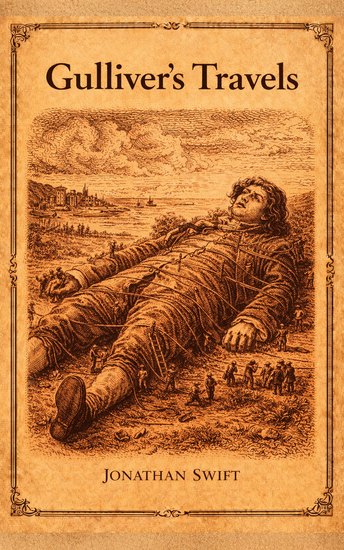
Gulliver's Travels - cover

Gulliver's Travels

Jonathan Swift

Maison d'édition: CLXBX

  • 0
  • 0
  • 0

Synopsis

A brilliant blend of adventure, satire, and sharp social commentary, Gulliver's Travels by Jonathan Swift is a timeless classic that continues to entertain and provoke readers centuries after its first publication. Beneath its imaginative voyages and fantastical lands lies a powerful critique of human nature, politics, and society.

The novel follows Lemuel Gulliver, a ship's surgeon whose journeys take him to extraordinary worlds beyond imagination. From the tiny inhabitants of Lilliput to the towering giants of Brobdingnag, from the abstract thinkers of Laputa to the rational horses of Houyhnhnmland, Gulliver encounters societies that mirror—and mock—the follies of his own.

Each voyage serves as both an adventure and a satirical lens, exposing the absurdities of political conflict, scientific obsession, pride, greed, and moral hypocrisy. Swift's wit is sharp, his irony biting, yet his storytelling remains captivating and accessible. Through exaggerated worlds and unforgettable characters, he challenges readers to question authority, examine their assumptions, and reflect on what it truly means to be civilized.

While often introduced as a tale of exploration and wonder, Gulliver's Travels is far more than a simple adventure story. It is a profound and sometimes unsettling examination of humanity's strengths and weaknesses. Swift masterfully balances humor with criticism, fantasy with realism, creating a work that is as thought-provoking as it is entertaining.

Rich in imagination, layered in meaning, and enduring in relevance, Gulliver's Travels stands as one of the greatest satirical works in English literature. It remains a compelling journey into distant lands—and an even deeper journey into the complexities of the human condition.
Disponible depuis: 14/02/2026.
Longueur d'impression: 357 pages.

D'autres livres qui pourraient vous intéresser

  • The Vendetta - From their pens to your ears genius in every story - cover

    The Vendetta - From their pens...

    Guy de Maupassant

    • 0
    • 0
    • 0
    Henri René Albert Guy de Maupassant was born on August 5th, 1850 near Dieppe in France.  
    Maupassant’s early life was badly torn when at age 11 (his younger brother Hervé was then five) his mother, Laure, a headstrong and independent-minded woman, risked social disgrace in order to obtain a legal separation from her husband. 
    After the separation, Laure kept custody of her two boys. With the father now forcibly absent, Laure became the most influential and important figure in the young boy's life.   
    Maupassant’s education was such that he rebelled against religion and other societal norms but a developing friendship with Gustave Flaubert began to turn his mind towards creativity and writing. 
    After graduation he volunteered for the Franco-Prussian war. With its end he moved to Paris to work as a clerk in the Navy Department.  Gustave Flaubert now took him under his wing.  Acting as a literary guardian to him, he guided the eager Maupassant to debuts in journalism and literature.  For Maupassant these were exciting times and the awakening of his creative talents and ambitions. 
    In 1880 he published what is considered his first great work, ‘Boule de Suif’, (translated as ‘Dumpling’, ‘Butterball’, ‘Ball of Fat’, or ‘Ball of Lard’) which met with a success that was both instant and overwhelming.  Flaubert at once acknowledged that it was ‘a masterpiece that will endure.’ Maupassant had used his talents and experiences in the war to create something unique.  
    This decade from 1880 to 1891 was to be the most pivotal of his career.  With an audience now made available by the success of ‘Boule de Suif’ Maupassant organised himself to work methodically and relentlessly to produce between two and four volumes of work a year.  The melding of his talents and business sense and the continual hunger of sources for his works made him wealthy. 
    In his later years he developed a desire for solitude, an obsession for self-preservation, and a fear of death as well as a paranoia of persecution caused by the syphilis he had contracted in his youth.  
    On January 2nd, 1892, Maupassant tried to commit suicide by cutting his throat.  Unsuccessful he was committed to the private asylum of Esprit Blanche at Passy, in Paris.  It was here on July 6th, 1893 that Henri René Albert Guy de Maupassant died at the age of only 42.
    Voir livre
  • The Piazza Tales - cover

    The Piazza Tales

    Herman Melville

    • 0
    • 0
    • 0
    "The Piazza Tales" by Herman Melville is a collection of short stories exploring the complexities of human experience. From the eerie "Bartleby, the Scrivener" to the adventurous "Benito Cereno," the tales traverse a range of themes. They delve into the enigmatic Bartleby's passive resistance, the dark secrets aboard a slave ship in "Benito Cereno," and the haunting quest for the White Whale in "The Encantadas." Through Melville's evocative prose, the collection offers a profound exploration of human nature, morality, and the mysteries that shape our lives.
    Voir livre
  • Wake Not the Dead - One of the earliest ever vampire stories this tale full of suspense and intrigue has been hugely influential - cover

    Wake Not the Dead - One of the...

    Ernest Raupach

    • 0
    • 0
    • 0
    Ernst Benjamin Salomo Raupach was born on 21st May 1784 at Straupitz in Silesia, a son of the village pastor.  
     
    After attending the gymnasium at Liegnitz, he studied theology at the university of Halle.  This led to a tutorship in St Petersburg in 1804 and occasionally some preaching in the German Lutheran church.  He was also hard at work writing his first dramatic tragedies and in 1817 he gained a professorship in German literature and history. 
     
    In 1822, after anti-German outbreaks in Russia, he left for Italy and thence to Berlin, where he would remain for the rest of his life.  In his career he wrote some 80 plays and other works which greatly influenced life and Culture in the Prussian capital across tragedies, comedies and historical dramas.  
     
    His seminal early prose vampire story ‘Wake Not the Dead’ was originally published in 1823 in Minerva Magazine.  When translated into English it was for many decades wrongly attributed to Johann Ludwig Tieck. 
     
    Ernst Raupach died in Berlin on 18th March 1852.   He was 67.
    Voir livre
  • The Mysterious Island - cover

    The Mysterious Island

    Jules Verne

    • 0
    • 0
    • 0
    The novel explores the survival and ingenuity of the protagonists as they work together to build a new life on the island. The group consists of Cyrus Smith, an engineer; Gideon Spilett, a journalist; Pencroff, a sailor; Harbert, a young boy; and Neb, a former slave. As they face various challenges, including hostile wildlife and strange occurrences, they discover that the island holds secrets, including a hidden benefactor who aids them in their endeavors.
    Voir livre
  • What the Bells Saw and Said - From their pens to your ears genius in every story - cover

    What the Bells Saw and Said -...

    Louisa May Alcott

    • 0
    • 0
    • 0
    Louisa May Alcott was born on 29th November 1832 in Germantown, Pennsylvania. 
    She is most definitely a writer of her own experiences.  Her father was a transcendentalist, philosopher and educational experimenter who founded, Fruitlands, a utopian community. Although poor, her liberal and progressive parents provided Louisa with much of her education, which was enhanced by many family friends that included Thoreau, Hawthorne and Emerson, a neighbour whose library she was often found reading in.    
    She started writing stories as a way of providing the family with some financial stability. Times were difficult and the effects of poverty were always close at hand.  During the Civil War she went to Washington to be a nurse and became ill with typhoid fever although she continued to write and build her success.  However, the treatment for typhus gave her mercury poisoning which caused further health issues for the rest of her life and eventually contributed to her death.   
    Alcott visited her father on his deathbed in Boston. Two days later on 6th March 1888 she also died resulting in a joint funeral.
    Voir livre
  • The New Food - From their pens to your ears genius in every story - cover

    The New Food - From their pens...

    Stephen leacock

    • 0
    • 0
    • 0
    Stephen P H Butler Leacock FRSC was born on 30th December 1869 in Swanmore, near Southampton, England.  He was the third of eleven children. 
    The family emigrated to Canada in 1876, settling on a 100-acre farm in Sutton, Ontario.  There Leacock was home-schooled until, funded by his grandfather, he was enrolled into the elite private school Upper Canada College in Toronto.  Academically he was very strong.  In 1887, at age 17, he became head boy and then proceeded on to the University of Toronto to study languages and literature.  Despite completing two years of study in only one, he was obliged to leave the university because his father, an alcoholic, had abandoned the family and finances could not be stretched to continue his attendance.  Leacock now enrolled in a three-month course at Strathroy Collegiate Institute to become a qualified high school teacher with a regular income. 
    He worked at Upper Canada College from 1889 through 1899 and later resumed his studies part-time at the University of Toronto, graduating with a B A in 1891.  It was during this period that he was first published in The Varsity, a campus newspaper.  But his passion was now economics and political theory.  In 1899 he enrolled for postgraduate studies at the University of Chicago and earned his PhD in 1903. 
    Leacock had married Beatrix Hamilton in 1900 and 15 years later the couple had their only child, Stephen.  In time father and son developed a love-hate relationship, partially caused by his son’s diminutive stature of only four feet.  
    Accepting a post at McGill University Leacock would remain there until he retired in 1936.  In 1906, he wrote ‘Elements of Political Science’, quickly adopted as a standard textbook for the next two decades and his most profitable book.  He also began public speaking and lecturing, and took a year's leave of absence in 1907 to speak throughout Canada on the subject of national unity.  
    Leacock had submitted humourous articles to the Toronto magazine Grip in 1894, and was soon published in other Canadian and US magazines.  In 1910, he printed privately a collection of these as ‘Literary Lapses’.  Acquired by the British publisher, John Lane, it was released in London and New York.   He was now a commercially successful writer.  There soon followed ‘Nonsense Novels’ (1911) and the sentimental favourite, ‘Sunshine Sketches of a Little Town’ (1912).  His ‘Arcadian Adventures with the Idle Rich’ (1914) is a darker collection that satirizes city life.  Collections of sketches continued to be published almost annually, filled with a mixture of light-hearted whimsy, parody, nonsense, and satire. 
    In later life, he wrote on the art of humour writing and published biographies on Twain and Dickens.  Together with continued speaking tours he also added to his non-fiction with many well-regarded and award-winning volumes on Canada. 
    Politically Leacock was a social conservative and a partisan Conservative.  He opposed women’s right to vote and had a varied record on non-English immigration.  He was a champion of Empire but an advocate of social welfare legislation and wealth redistribution, but he often caused friction with his racist views towards blacks and Indigenous peoples. 
    Leacock has for some time been forgotten as an economist, but it’s often quoted that in 1911 more people had heard of him than had heard of Canada.  For the decade after 1915 Leacock was the most popular humorist in the English-speaking world. 
    Stephen Leacock died on 28th March 1944 of throat cancer in Toronto, Canada.  He was 74.  He was buried in the St George the Martyr Churchyard, Sutton, Ontario.
    Voir livre