Begleiten Sie uns auf eine literarische Weltreise!
Buch zum Bücherregal hinzufügen
Grey
Einen neuen Kommentar schreiben Default profile 50px
Grey
Jetzt das ganze Buch im Abo oder die ersten Seiten gratis lesen!
All characters reduced
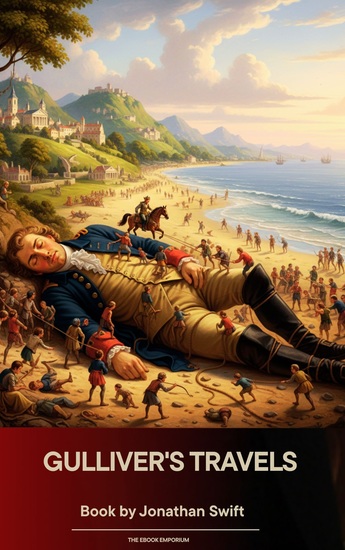
Gulliver's Travels - cover

Gulliver's Travels

Jonathan Swift

Verlag: The Ebook Emporium

  • 0
  • 0
  • 0

Beschreibung

"I told him that should he happen to see a man who was extremely tall, he would be very much mistaken if he thought him a giant."

Shipwrecked physician Lemuel Gulliver embarks on four extraordinary journeys that challenge his—and the reader's—perception of reality. From the tiny, war-mongering citizens of Lilliput to the towering, moral giants of Brobdingnag, and from the floating pseudo-intellectual city of Laputa to the noble, rational horses known as Houyhnhnms, Gulliver encounters civilizations that mirror the best and worst of humanity. What begins as a quest for discovery turns into a devastating critique of British society, religious conflict, and the very definition of being "human."

The Scale of Perspective: In the first two books, Swift uses physical size as a metaphor for moral stature. In Lilliput, Gulliver is a giant among petty, small-minded politicians who fight over which end of an egg to crack. In Brobdingnag, he becomes a literal "toy," forced to defend the "grandeur" of Europe to a King who views humans as "the most pernicious race of little odious vermin."

The Critique of Reason: The voyage to the flying island of Laputa serves as a hilarious yet biting attack on theoretical science and useless "intellectualism." Here, Swift mocks the Royal Society with "Projectors" who try to extract sunbeams from cucumbers while their people starve in the ruins of neglected farms.

The Final Epiphany: Man vs. Beast: The novel reaches its peak in the land of the Houyhnhnms, where rational horses rule over the filthy, impulsive Yahoos—creatures that Gulliver realizes, with horror, are actually human beings. This final encounter forces Gulliver into a state of misanthropy, forever changing how he views his own family and kind.

Experience the world through a different lens. Purchase "Gulliver's Travels" today and discover why it remains the most dangerous comedy ever written.
Verfügbar seit: 12.01.2026.
Drucklänge: 327 Seiten.

Weitere Bücher, die Sie mögen werden

  • Death Comes for the Archbishop - cover

    Death Comes for the Archbishop

    Willa Cather

    • 0
    • 0
    • 0
    "The air would have helped him to die as it had helped him to live."
    
    In the mid-19th century, a young French priest, Jean Marie Latour, is sent to the vast, rugged wilderness of the New Mexico Territory as its first Apostolic Vicar. What follows is a quiet yet epic story of a life spent building a cathedral out of the red earth and desert rock. Accompanied by his devoted friend and vicar, Father Joseph Vaillant, Latour navigates a landscape of ancient traditions, solitary canyons, and the complex meeting of cultures.
    
    A Portrait of Spiritual Grace: Rather than a traditional plot-driven novel, Cather presents a series of vivid, tapestry-like vignettes. From the miraculous appearance of a hidden oasis to the encounter with the legendary scout Kit Carson, the novel explores the interior life of a man of culture and intellect as he adapts to the lonely beauty of the desert.
    
    The Heart of the Desert: Death Comes for the Archbishop is celebrated for its stunning prose, which captures the shifting colors of the mesa and the clarity of the Southwestern sky. It is a profound meditation on the passage of time, the resilience of faith, and the deep bonds of human companionship. Cather weaves together the history of Spanish explorers, Indigenous peoples, and French missionaries into a seamless, timeless narrative.
    
    
    Experience a world where the landscape is as alive as the characters. Purchase "Death Comes for the Archbishop" today and discover one of the most enduring voices in American literature.
    Zum Buch
  • Les Misérables: Volume 2: Cosette - Book 8: Cemeteries Take That Which is Committed Them (Unabridged) - cover

    Les Misérables: Volume 2:...

    Victor Hugo

    • 0
    • 0
    • 0
    Victor-Marie Hugo (26 February 1802 - 22 May 1885) was a French poet, novelist, essayist, playwright, and dramatist of the Romantic movement. During a literary career that spanned more than sixty years, he wrote abundantly in an exceptional variety of genres: lyrics, satires, epics, philosophical poems, epigrams, novels, history, critical essays, political speeches, funeral orations, diaries, and letters public and private, as well as dramas in verse and prose.
    BOOK 8: CEMETERIES TAKE THAT WHICH IS COMMITTED THEM: It was into this house that Jean Valjean had, as Fauchelevent expressed it, "fallen from the sky." He had scaled the wall of the garden which formed the angle of the Rue Polonceau.
    Zum Buch
  • A Country Doctor - The plight of a doctor to save a sick boy meets many osbstacles - cover

    A Country Doctor - The plight of...

    Franz Kafka

    • 0
    • 0
    • 0
    Franz Kafka was born on 3rd July 1883 in Prague, then in Bohemia, the eldest of 6, into a middle-class Jewish family. 
     
    Life for the young Kafka and his passion for literature was often made an ordeal by his over-bearing and domineering entrepreneur of a father.   
     
    In 1889 Kafka was sent to the Deutsche Knabenschule, an elementary school in Prague. His father would only allow him to be educated in German-speaking schools and even went so far as to limit visits to the synagogue to four a year. 
     
    In 1901 he graduated from the classics-oriented Altstädter Gymnasium. Kafka did well there and across a large range of subjects.  He now enrolled at the Charles Ferdinand University, to study chemistry, but quickly switched to law for which he obtained his degree in June 1906 and then performed the mandatory year of unpaid service as clerk at the civil and criminal courts. 
     
    A job at an Italian insurance company left him little time to write and after a year he took another job with the Worker's Accident Insurance Institute for the Kingdom of Bohemia where he stayed until ill health led to his resignation in 1922. 
     
    Although he saw work as a means to pay the bills and to allow him time to write, he received several promotions and was noted as a good employee. 
     
    By 1917 Kafka was suffering from tuberculosis, which required frequent periods of convalescence. Interspersed with this, were several intense affairs before he settled in Berlin with Dora Diamant, a 25-year-old kindergarten teacher who herself having left the ghetto now influenced Kafka's interest in the book of Jewish law, the Talmud. 
     
    Kafka’s on-going health was littered with problems. Apart from TB there were several other ailments, including migraines, insomnia, boils, depression, all usually brought on by excessive stresses and strains. He attempted to counteract all of this by naturopathic treatments, a vegetarian diet and consuming large quantities of unpasteurized milk. 
     
    His tuberculosis still worsened. He returned to Prague, where he died on 3rd June 1924. He was 40. 
     
    His literary works are few in number but towering in influence.  His masterpieces include ‘The Trial’, ‘The Metamorphosis’ as well as a number of short stories which reveal facets of humankind that truthfully could only be born from Kafka’s brain and pen.
    Zum Buch
  • Her First Ball - cover

    Her First Ball

    Katherine Mansfield

    • 0
    • 0
    • 0
    "Her First Ball" is a 1921 short story by Katherine Mansfield. It was first published in The Sphere on 28 November 1921, and later reprinted in The Garden Party and Other Stories.
    A young girl called Leila has come to the city to stay with her cousins. They are going to a ball. Leila is very excited: this is her first ball. Once there, she is both excited and terrified. After dancing with several young boys her own age, she dances with a wrinkly balding man who has been coming to balls for a while. This spoils her mood until she dances with a good looking young gentleman where her worries disappear.
    Zum Buch
  • Russian Short Story The - Volume 3 - Fyodor Dostoyevsky to Leo Tolstoy - cover

    Russian Short Story The - Volume...

    Fyodor Dostoyevsky, Nikolai...

    • 0
    • 0
    • 0
    The Russian novel has a reputation that is immense, both in narrative and in length.  Unquestionably though the ideas, themes and characters make many novels rightly revered as world class, as icons of literature. 
     
    Perhaps an easier way to enjoy a wider selection of the Russian heritage, with its varied and glorious literary talents, is with the short story.  These gems sparkle and beguile the mind with their characters and narrative, exploring facets of society and the human condition that more Western authors somehow find more difficult to navigate, or to explore, explain and relate to.   
     
    The Russian short story is, in many respects, in a genre of its own.  It is at its captivating best whether it’s an exploration of real-life experiences, through fantasy and fables and on to total absurdity. 
     
    In a land so vast it is unsurprising that it is a world almost unto itself. Cultures and landscapes of differing hues are packed together bound only by the wilful bonds and force of Empire. 
     
    The stories in this collection traverse the decades where one might be a serf under an absolute monarch, and the reality of that was pretty near to slavery, into an emancipation of sorts in the fields, or towns under the despotic will of landowners and the rich into the upheavals of Empire and then the overthrow of the ruling class and its replacement by the communists, who promised equality for all and delivered a society where the down-trodden remained the lowest yet vital cog of the state machine and its will.  
     
    Whilst Tolstoy, Gogol, Dostoevsky, Pushkin and Chekhov are a given in any Russian collection we also explore and include Andreyev, Korolenko, Turgenev, Blavatsky and many others to create a world rich and dense across a sprawling landscape of diverse people, riddled with the class and unfairness in perhaps some of the most turbulent times that Russia has ever experienced. 
     
    01 - The Russian Short Story - Volume 3 - An Introduction 
    02 - An Honest Thief by Fyodor Dostoyevsky 
    03 - The Crocodile. An Extraordinary Incident - Part 1 by Fyodor Dostoyevsky 
    04 - The Crocodile. An Extraordinary Incident - Part 2 by Fyodor Dostoyevsky 
    05 - Bobok by Fyodor Dostoyevsky 
    06 - How a Muzhik Fed Two Officials by Nikolai Schedrin 
    07 - Diary of a Lunatic by Leo Tolstoy 
    08 - Aloysha the Pot by Leo Tolstoy 
    09 - How Much Land Does A Man Need by Leo Tolstoy 
    10 - The Snowstorm - Part 1 by Leo Tolstoy 
    11 - The Snowstorm - Part 2 by Leo Tolstoy 
    12 - God Sees The Truth But Waits by Leo Tolstoy
    Zum Buch
  • Unwritten Novel An - From their pens to your ears genius in every story - cover

    Unwritten Novel An - From their...

    Virginia Woolf

    • 0
    • 0
    • 0
    Adeline Virginia Woolf was born on the 25th January 1882 in South Kensington in London. 
    Although lauded as a founder of modernist writing with such classics as ‘Orlando’, ‘Mrs Dalloway’ and ‘To the Lighthouse’ and, of course, many classic short stories, her background is filled with elements of tragedy that she somehow overcame to become such a revered writer.   Her mother died when she was 13, her half-sister Stella two years later and with it her first of several nervous breakdowns.  Appallingly it was later found that three of her half-brothers had sexually abused her so darkness must have seemed ever present.   
    She began writing professionally at age 20 but her father’s death two years later brought a complete mental collapse and she was briefly institutionalised.  Somehow she found within herself a literary career and with it great innovations in writing; she was a pioneer of “stream of consciousness”.    
    Her tight circle of friends were the founders of the Bloomsbury Group, a movement whose legacy still influences across the arts and society in many way to this day.   
    Whilst the dark periods continued to interrupt her emotional state her rate of work never ceased.  Until, on 28th March 1941, Woolf put on her overcoat, filled up its pockets with stones, and walked into the River Ouse, in Lewes, East Sussex and drowned herself.  Her body was not recovered until the 18th April.  She was 59. 
    She left behind a note which read in part “Dearest, I feel certain that I am going mad again.  I feel we can't go through another of those terrible times.  And I shan't recover this time.  I begin to hear voices, and I can't concentrate.  So I am doing what seems the best thing to do”.
    Zum Buch