Begleiten Sie uns auf eine literarische Weltreise!
Buch zum Bücherregal hinzufügen
Grey
Einen neuen Kommentar schreiben Default profile 50px
Grey
Jetzt das ganze Buch im Abo oder die ersten Seiten gratis lesen!
All characters reduced
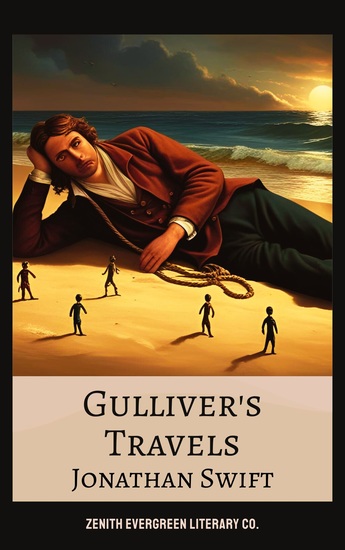
Gulliver's Travels - A Satirical Voyage Through Fantasy Politics and Human Nature - cover

Gulliver's Travels - A Satirical Voyage Through Fantasy Politics and Human Nature

Jonathan Swift, Zenith Evergreen Literary Co.

Verlag: Zenith Evergreen Literary Co.

  • 0
  • 0
  • 0

Beschreibung

One man. Four strange lands. Endless wit.

Gulliver's Travels by Jonathan Swift is more than just a children's adventure—it's a sharp satire of society, science, and power, wrapped in the fantastical journeys of Lemuel Gulliver. From the tiny citizens of Lilliput to the towering giants of Brobdingnag, from floating islands to talking horses, each voyage delivers new lessons—and biting social commentary.

Equal parts imaginative and incisive, this timeless novel critiques the absurdities of politics, war, and human pride while offering readers a wildly entertaining journey through extraordinary lands.

💬 "As funny as it is fearless—Swift's satire hits hard, even centuries later."

✨ Why You'll Love It:
An adventure story with intellect and bite

Ideal for fans of Robinson Crusoe, Treasure Island, and The Odyssey

Still relevant for modern readers interested in politics, satire, and social critique

📣 Set Sail on a Journey Through the Absurd.
Buy Gulliver's Travels today and experience a masterclass in wit, wonder, and literary rebellion.
Verfügbar seit: 17.04.2025.
Drucklänge: 327 Seiten.

Weitere Bücher, die Sie mögen werden

  • A Room with a View - cover

    A Room with a View

    E. M. Forster

    • 0
    • 0
    • 0
    First published in 1908, E. M. Forster’s “A Room with a View” is the story of a young English middle-class girl named Lucy Honeychurch. As the novel opens we find Lucy touring Italy with her overbearing older cousin and chaperone, Charlotte Bartlett. The two are upset over the views from their rooms. Having been promised views that overlook the river Arno, the two instead receive views of the courtyard. Their complaints are overheard by Mr. Emerson, who offers to swap rooms with them, citing the fact that he and his son George both have rooms that overlook the Arno. After a brief romantic encounter between George Emerson and Lucy while they are in Florence, the two travel on to Rome where Lucy is wooed by her friend from England Cecil Vyse. When Lucy learns from the vicar that a local cottage has been rented she discovers that the Emersons have arrived in Rome. Again the prospect of romance with George entices Lucy but she is torn between the more acceptable prospect of a union with Cecil. “A Room with a View” is the classic human struggle of choosing a partner who is the most socially acceptable versus the desire for true love.
    Zum Buch
  • Cat's Cradle - cover

    Cat's Cradle

    Anonym

    • 0
    • 0
    • 0
    Cat's Cradle is Vonnegut's satirical commentary on modern man and his madness. An apocalyptic tale of this planet's ultimate fate, it features a little person as the protagonist; a complete, original theology created by a calypso singer; and a vision of the future that is at once blackly fatalistic and hilariously funny.
    Zum Buch
  • The Red Badge of Courage - cover

    The Red Badge of Courage

    Stephen Crane

    • 0
    • 0
    • 0
    On a cold day, the 304th New York Infantry Regiment awaits battle beside a river. Eighteen-year-old Private Henry Fleming, remembering his reasons for enlisting as well as his mother's resulting protests, wonders whether he will remain brave in the face of fear or turn and run. The story follows Fleming on the fateful days to come, through flight and redemption, injury and the horrors of war. The Red Badge of Courage received generally positive reviews from critics on its initial publication; in particular, it was said to be a remarkably modern and original work., the original 1895 publication went through ten editions in the first year alone, making Crane an overnight success at the age of twenty-four. 
    This bestselling book in both the US and the States, praised for its sense of realism is reproduced here, narrated by Michael Ward.
    Zum Buch
  • A Rich Woman - From their pens to your ears genius in every story - cover

    A Rich Woman - From their pens...

    Katharine Tynan

    • 0
    • 0
    • 0
    Katharine Tynan was born on 23rd January 1859 into a large family in Clondalkin, County Dublin. 
    The family business was cattle rearing and the farmhouse, set with the mountains for a backdrop, was a wonderful world for a young mind to learn and imagine. 
    She was educated at the convent school, St Catherine of Sienna, in Drogheda.  A stubborn streak inhibited her ability to learn as easily as the school wished. However she did learn on her own terms and soon began to take her ‘forbidden literature’, hidden in her clothing, to her loft in a stable hideaway.  
    Until she turned seventeen nothing appeared to point to a literary career.  But some verse printed in a Dublin newspaper changed everything. It led to a sonnet being printed in the Spectator.  Thereafter the Graphic published several others and even paid a half guinea for the privilege.   
    In 1884 Katharine dispatched herself to London and made an abiding friendship in Alice Meynell.  Alice was an established poet and helped, with her husband Wilfred, to publish many poets. The following year it was arranged for the publication of her first poetry volume, ‘Louise de la Vallière’.  
    She formed valuable friendships with the poets Gerard Manley Hopkins, William Butler Yeats and later Francis Ledwidge.  
    As she gathered friends and contacts into her life her literary output began to gather pace. Katharine had begun to write prose for the Speaker and for the Scots and National Observer.  
    In 1892 she married Henry Albert Hinkson, a fellow writer and a barrister.  They moved to England and had five children although two were to tragically die in infancy.   
    By now her output was prolific and ranged from poetry to novels to short stories.  It would later include a biography and further extend to editing and reviewing.   
    In 1912 the family returned to Claremorris, County Mayo, when her husband was appointed magistrate, a post he held until his early death in 1919.     
    Tynan is sometimes grouped amongst the War Poets of the First World War. Her experience was not direct but as a Mother with one son serving in France and another in Palestine, the emotions, fears and doubts are expressed in a beautiful and heart-felt way.  
    Involved in the Irish Literary Revival, Tynan expressed concern for feminist causes, the poor, and the effects of World War I in her work. She also meditated on her Catholic faith. 
    She is said to have written over 100 novels, 12 collections of short stories, plays and many volumes of enduring poetry as well as five volumes of autobiography. 
    Katharine Tynan Hinkson died at age 72 on 2nd April 1931 in London and is buried in Kensal Green Cemetery.
    Zum Buch
  • Frankenstein Retold Inclusively - cover

    Frankenstein Retold Inclusively

    Mary Shelley, Kath Shone

    • 0
    • 0
    • 0
    Frankenstein was written in the Romantic literary period. The literary trend of the early 1800s produced poems that described how nature elevated and blissed human minds. Most literary work at this time was written and published by men. 
    In amongst these ecstatic reveries of nature, the 19 year old, Mary Shelley wedged the chilling story of Frankenstein into the literary landscape and our minds forever. 
    Her story filled an empty space in humankind's collective consciousness. That empty space was waiting for this story of over-reaching scientific madness. 
    This version of Frankenstein is a translation not an abridged telling. I have translated the Old Romantic era English into easy-to-read accessible English. 
    • The same characters say the same things at the same times in the story. 
    • Plot point for plot point the story stays the same. 
    • The themes are all preserved. 
    • The transcendent and brutal settings of the story are still on the pages. 
    • References to poems and other literature are explained. 
    • Supplementary information supports understanding of the text. 
    This book is for 
    • humans who like to read archetypal literature in easy-to-read language, 
    • neuro-diverse readers, 
    • young readers, 
    • English second language speakers, 
    • English literature students who need a study guide to unravel the original Frankenstein. 
    • anyone (I think that's most of us) who finds old English inaccessible but would like to read Frankenstein. 
    This accessible Frankenstein is part of Inclusive Books (Inc!Bs) journey to rewrite history inclusively.
    Zum Buch
  • The Wisdom of Father Brown - cover

    The Wisdom of Father Brown

    G.K. Chesterton

    • 0
    • 0
    • 0
    The Father Brown stories sit in relation to other detective literature much as the diminutive and seemingly unworldly Priest himself often sits; quietly, thoughtfully and often to be overlooked. However, when he at lasts speaks it is with such understanding of human knowledge that the self-styled sophisticates that surround him are dumbfounded.C.K Chesterton is not concerned with the procedural minutiae of the detective’s work, nor with leaving a trail of red herrings with which to keep us guessing. Father Brown reaches his conclusions through staring into the human psyche, indeed, at times, into the human soul.
    Zum Buch