Begleiten Sie uns auf eine literarische Weltreise!
Buch zum Bücherregal hinzufügen
Grey
Einen neuen Kommentar schreiben Default profile 50px
Grey
Jetzt das ganze Buch im Abo oder die ersten Seiten gratis lesen!
All characters reduced
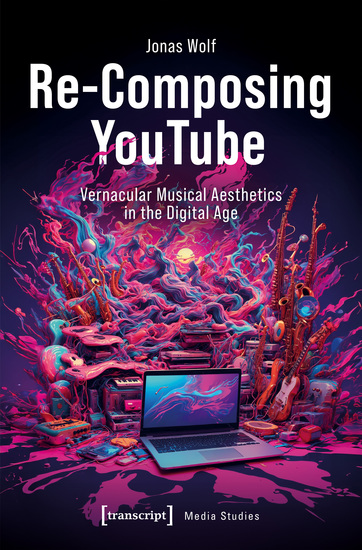
Re-Composing YouTube - Vernacular Musical Aesthetics in the Digital Age - cover

Re-Composing YouTube - Vernacular Musical Aesthetics in the Digital Age

Jonas Wolf

Verlag: transcript Verlag

  • 0
  • 0
  • 0

Beschreibung

YouTube features a wide array of multimodal musical figurations, including fan-made music videos, musical aestheticisations of pre-circulating content, and musical self-performances. Jonas Wolf explores open-ended forms of musical creative relay on YouTube, delving into formal, imitative, affective, and (non-)institutional aspects of networked media remix and (self-)aestheticisation. Beyond creating value for non-musical fields of discourse, this study is directed at filling a gap in a largely ocularcentric domain of study. It provides a concise theory of vernacular composition within our time's total digital archive that accounts for socio-aesthetic phenomena and their relation to systems of knowledge, control, and discourse.
Verfügbar seit: 30.09.2024.
Drucklänge: 402 Seiten.


Weitere Bücher, die Sie mögen werden

  • Western Han Dynasty The: A History of China - cover

    Western Han Dynasty The: A...

    Hui Wang

    • 0
    • 0
    • 0
    The Western Han Dynasty: A History of China, PART THREE takes you on a journey through ambition, betrayal, war, and the struggle for power. From Emperor Yuan’s court to the dynasty’s fall and rebirth under Liu Xiu, this book brings to life the rulers, rebels, and visionaries who shaped one of China’s most fascinating eras. 
    Inside the imperial palace, love and power intertwined. Figures like Zhao Feiyan, a dancer turned empress, and the “Cut-Sleeve Emperor,” whose personal life left a historic mark, rose to prominence. Meanwhile, political schemes brewed. Wang Mang, a seemingly noble reformer, seized the throne, triggering chaos, rebellion, and his own dramatic downfall. 
    Beyond the palace, Han power extended through diplomacy and war. General Chen Tang’s bold campaign proved Han’s far-reaching influence. Meanwhile, Wang Zhaojun, sent to marry a Xiongnu chieftain, sacrificed her status to bring peace beyond the Great Wall. 
    As the empire crumbled, Liu Xiu waited. Patient and strategic, he seized the moment to lead a rebellion that restored the Han Dynasty. His rise marked the climax of this era of transformation. 
    This is more than history—it’s a saga of power, betrayal, sacrifice, and resilience. If you love epic tales of real-life intrigue and legacy, this book will draw you deep into the Western Han's dramatic rise, fall, and rebirth.
    Zum Buch
  • Living Resistance - An Indigenous Vision for Seeking Wholeness Every Day - cover

    Living Resistance - An...

    Kaitlin B. Curtice

    • 0
    • 0
    • 0
    In an era in which "resistance" has become tokenized, popular Indigenous author Kaitlin B. Curtice reclaims it as a basic human calling. Resistance is for every human who longs to see their neighbors' holistic flourishing. We each have a role to play in the world right where we are, and our everyday acts of resistance hold us all together. 
     
    Curtice shows that we can learn to practice embodied ways of belonging and connection to ourselves and one another through everyday practices, such as getting more in touch with our bodies, resting, and remembering our ancestors. She explores four "realms of resistance"--the personal, the communal, the ancestral, and the integral--and shows how these realms overlap and why all are needed for our liberation. Readers will be empowered to seek wholeness in the various spheres of influence they inhabit. Now in paperback. 
     
    "Readers will find abundant wisdom in this accessible guide."--Publishers Weekly
    Zum Buch
  • Pozzing - When HIV is the only way not to die - cover

    Pozzing - When HIV is the only...

    Steve Beeferman

    • 0
    • 0
    • 0
    There is a new virus in town, out to get everyone, well not everyone. Being poz (HIV-positive) gives you an edge. Three brave poz are out to save the world, even if they have to infect every human on the planet.
    Zum Buch
  • The Legends of China and Slavic Lore - Ancient Stories of the East (3 in 1) - cover

    The Legends of China and Slavic...

    Odessa Nightshade

    • 0
    • 0
    • 0
    This bundle delves into the rich mythological traditions of the East, showcasing a fascinating collection of ancient stories from China, Slavic cultures, and the Hindu pantheon. These legends have shaped the spiritual and cultural landscapes of their respective regions, offering timeless wisdom, cosmic tales, and moral lessons that continue to resonate today. 
    The first part of the collection explores The Legends of Ancient China, where gods, dragons, and emperors abound. In Chinese mythology, celestial beings play pivotal roles in shaping the destiny of mankind, and the stories of ancient heroes and supernatural creatures offer insight into the balance between heaven and earth. The enduring tale of the Yellow Emperor, the story of the great flood, and the legendary journey of the Monkey King are just some of the captivating narratives woven into China’s ancient lore. 
    Next, The Mythology of the Slavs introduces a world of spirits, gods, and mystical beings who govern the natural world. From the powerful Perun, god of thunder and war, to the mischievous domovoi, a house spirit, Slavic mythology is filled with both divine and folk elements. These stories emphasize the deep connection between humans and nature, as well as the complex relationships between gods, demons, and ancestors. The Slavic pantheon reveals a culture steeped in rituals, symbolism, and reverence for the earth. 
    Lastly, The Hindu Pantheon takes readers on a journey through one of the world’s oldest and most intricate mythologies. The Hindu gods—each with their unique powers and personalities—shaped the spiritual landscape of India and beyond. From the creation stories involving Brahma to the heroic exploits of Vishnu and Shiva, these tales illustrate cosmic principles, divine intervention, and the eternal battle between good and evil.
    Zum Buch
  • Cold War Boys Overseas - True Tales by Those Who Served with the Royal Air Force Abroad - cover

    Cold War Boys Overseas - True...

    Air Commodore Graham Pitchfork,...

    • 0
    • 0
    • 0
    Until the end of the Cold War in 1990, the RAF had several major bases worldwide—largely in those areas where the service had been based during the inter-war years. In Cold War Boys Overseas, contributors recall their time at these foreign destinations. With almost half of RAF personnel serving abroad in the 1960s situated throughout Germany, the book starts its focus there with tales of monitoring the Soviet threat. The stories then advance to the warmer climates of the Near East and Far East where different challenges awaited those serving there. As the period progressed RAF squadrons saw changes to their equipment with Hunters, Javelins and Canberras being replaced by a new generation of combat aircraft such as the Buccaneer, Harrier, Jaguar, Phantom and Vulcan. Innovation of missile defense and the expansion of the role of helicopters were also critical at this time. How this affected the RAF is told by the aircrew and ground crew who served then. The stories that feature in the book reveal just how serving overseas was a different way of life and the chapters illustrate the many facets of the RAF’s capabilities across the globe. They also highlight a lifestyle that no longer exists in today's RAF. Buckle up and allow the Cold War Boys to take you on a thrilling adventure across the globe.
    Zum Buch
  • Escaping the Gulags: The History of the Most Famous Attempts to Escape the Soviet Union’s Notorious Labor Camps - cover

    Escaping the Gulags: The History...

    Editors Charles River

    • 0
    • 0
    • 0
    One of the most idiosyncratic horrors of Soviet Russia was the Gulag system, an extensive network of forced labor and concentration camps. Part of the rationale behind this system was that it could serve as slave labor in the drive for industrialization, while also serving as a form of punishment. The name Gulag is in fact an acronym, approximating to “Main Administration of Camps” (in Russian: Glavnoe Upravlenie Lagerei) and operated by the Soviet Union’s Ministry of the Interior.[1] The Gulag consisted of internment camps, forced labor camps, psychiatric hospital facilities, and special laboratories, and its prisoners were known as zeks. Such was the closed and secretive nature of the Soviet state that to this day, knowledge of the Gulag system comes mainly from Western studies, firsthand accounts by prisoners such as Aleksandr Solzhenitsyn, and some local studies after the fall of communism. 
    	The most recognisable version of the Gulag, a term that was never pluralized in Russia itself, existed from the 1930s-1950s, a period in which a huge network of camps and prisons was established across the vast Soviet federation. Prisoners were often used as forced labor, made to do physically arduous and soul-destroying tasks. Some workers helped to build large infrastructure projects, and indeed the system was partly rationalized in terms of economics.  
    	By the early 1960s, Gulags were synonymous with various forms of punishments, including house arrest, imprisonment in isolated places, or confinement to a mental hospital where a prisoner would be declared insane or diagnosed with a “political” form of psychosis. In its later years, the Gulags held a particular place in the public’s imagination, both within the USSR and in the outside world. They could mean exile, brutal punishment, or simply being banished to Siberia.
    Zum Buch