Join us on a literary world trip!
Add this book to bookshelf
Grey
Write a new comment Default profile 50px
Grey
Subscribe to read the full book or read the first pages for free!
All characters reduced
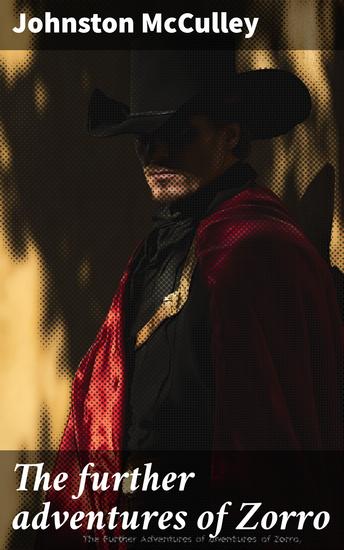
The further adventures of Zorro - cover

The further adventures of Zorro

Johnston McCulley

Publisher: Good Press

  • 0
  • 0
  • 0

Summary

In "The Further Adventures of Zorro," Johnston McCulley continues the legendary tale of the swashbuckling hero, Zorro, masterfully combining action, romance, and poignancy in a series of captivating escapades. Set against the backdrop of 19th-century California, McCulley employs a rich narrative style infused with vivid imagery and pulse-pounding dialogue, showcasing Zorro's clever tricks and moral fortitude as he fights against tyranny. This work serves as both a homage to the original character and a nuanced exploration of social justice, elevating the genre of historical fiction and adventure, reflecting America's evolving identity during a time of political upheaval. Johnston McCulley, a prolific author of adventure fiction, was deeply influenced by the cultural currents of his time, including the rise of the pulp fiction genre. His own fascination with heroism and the underdog is palpable throughout the narrative. Having originally created Zorro in 1919, McCulley's continued engagement with this character reveals his desire to explore deeper themes of empowerment, resistance, and societal change, resonating with the challenges of contemporary life. This captivating tale is highly recommended for readers who relish adventure and seek a deeper understanding of the archetypal hero. McCulley's flair for storytelling not only entertains but also sparks dialogue about justice and identity, making it a timeless addition to any literary collection.
Available since: 03/02/2025.
Print length: 210 pages.

Other books that might interest you

  • Caterpillars - From their pens to your ears genius in every story - cover

    Caterpillars - From their pens...

    E F Benson

    • 0
    • 0
    • 0
    Edward Frederic Benson was born in Berkshire, England on 24th July 1867. 
    Educated at Marlborough and Kings College Cambridge he began his career as a writer at an early age and was published whilst still studying. 
    Benson was also a gifted athlete and represented his country at figure skating. 
    His career was prodigious and widely acknowledged.  Perhaps he is best known for his collection of novels about ‘Mapp & Lucia’ which have proved very popular throughout the decades.   
    Benson was also well regarded as a writer of ghost stories—‘spook stories’ in the then vernacular—as well as biographies.  His ghost and supernatural fiction covered a range of subjects but all were exceptionally well-written, drenched in atmosphere, riven with chills and have stood the test of popularity over the decades as testament to his literary talents.  
    Benson was never married and practised his homosexuality discreetly. 
    E F Benson died on 29th February 1940 at University College Hospital, London of throat cancer.  He was 72.
    Show book
  • Around the Moon - cover

    Around the Moon

    Jules Verne

    • 0
    • 0
    • 0
    In this sequel to From the Earth to the Moon, Barbicane, Ardan, and Nicholl have decided to take a trip around the moon. But first they have to get to the moon from Earth.
    
    Will their trip succeed as they attempt to dodge asteroids and realize that the scientists on Earth have miscalculated their trajectory towards the moon?
    Show book
  • Street The (Unabridged) - cover

    Street The (Unabridged)

    H. P. Lovecraft

    • 0
    • 0
    • 0
    The story traces the history of the titular street in a New England city, presumably Boston, from its first beginnings as "but a path" in colonial times to a quasi-supernatural occurrence in the years immediately following World War I. As the city grows up around the street, it is planted with many trees and built along with "simple, beautiful houses of brick and wood", each with a rose garden. As the Industrial Revolution runs its course, the area degenerates into a run-down and polluted slum, with all of the street's old houses falling into disrepair.
    After World War I and the October Revolution, the area becomes home to a community of Russian immigrants. Among the new residents is the leadership of a "vast band of terrorists," who are plotting the destruction of the United States on Independence Day. When the day arrives, the terrorists gather to do the deed, but before they can get started, all the houses in the street collapse concurrently on top of each other, killing them all. Observers at the scene testify that immediately after the collapse, they experienced visions of the trees and rose gardens that had once been in the street.
    Show book
  • Winifred Holtby - A Short Story Collection - Ardent feminist and activist who wrote many stories before tragically dying young - cover

    Winifred Holtby - A Short Story...

    Winifred Holtby

    • 0
    • 0
    • 0
    Winifred Holtby was born on 23rd June 1898 to a prosperous farming family in the village of Rudston in Yorkshire.  
     
    A governess provided her early education before she went to Queen Margaret's School in Scarborough.  After passing the entrance exam for Somerville College, Oxford in 1917, she decided to join the Women's Army Auxiliary Corps in early 1918.  However, soon after her arrival in France, the War ended. 
     
    She returned to study at Oxford and met fellow student Vera Brittain.  After graduating from Oxford, in 1921, Winifred and Vera moved to London, hoping to establish themselves as authors. 
     
    Her early novels met with only moderate success but as a journalist she was both prolific and increasingly well-known.  Her articles graced more than 20 newspapers and magazines, including the Manchester Guardian newspaper.   
     
    Winifred was a committed feminist, socialist and pacifist.  She gave many lectures for the League of Nations Union.  She was also active in the Independent Labour Party and was a campaigner for the unionisation of black workers in South Africa. 
     
    In 1931 the symptoms of high blood pressure, recurrent headaches and bouts of lassitude brought forth a diagnosis of Bright's disease.  She was given two years to live and now put all her efforts into what was to become her crowning achievement: South Riding.  Released posthumously it received lavish praise and enormous sales.  Her canon of works tackle difficult subjects head on, many in unusual ways, brimming with verve and usually strong female protagonists. 
     
    Winifred Holtby died on 29th September 1935 in London.  She was 37. 
     
    1 - Winifred Holtby - A Short Story Collection - An Introduction 
    2 - The Voice of God by Winifred Holtby 
    3 - Truth is Not Sober by Winifred Holtby 
    4 - The Casualty List by Winifred Holtby 
    5 - The Man Who Hated God by Winifred Holtby 
    6 - Why Herbert Killed His Mother by Winifred Holtby
    Show book
  • The Cask of Amontillado - cover

    The Cask of Amontillado

    Edgar Allan Poe

    • 0
    • 0
    • 0
    Title: The Cask of Amontillado 
    Author: Edgar Allan Poe 
    Narrator: Jonathan Dunne 
    Original Publication: 1846 
    Public Domain: Yes 
    Series Placement: Number 7 in the Timeless Terrors series 
    Description: 
    The Cask of Amontillado by Edgar Allan Poe is a masterful tale of revenge, deception, and macabre horror. First published in 1846 in Godey’s Lady’s Book, it follows Montresor as he lures the unsuspecting Fortunato into the catacombs beneath an Italian city, promising a taste of rare Amontillado wine. 
    What begins as a seemingly friendly encounter descends into a chilling nightmare of entombment and vengeance. Poe crafts a tightly woven narrative filled with irony, tension, and the psychological darkness for which he is renowned. 
    This recording, narrated by Amazon bestselling horror author Jonathan Dunne, brings to life the Gothic atmosphere and sinister undertones of one of Poe’s most unforgettable stories. While the text is in the public domain, this performance is an original work and copyright © 2025 Jonathan Dunne. 
    Listeners should prepare for an unsettling journey into obsession and retribution that echoes long after the story ends.
    Show book
  • The Republic of the Southern Cross - One of the earliest dystopian stories written in 1903 this one of Russian origin about a disease causing madness - cover

    The Republic of the Southern...

    Valery Bryusov

    • 0
    • 0
    • 0
    Valery Yakovlevich Bryusov was born on 13th December 1873 into a merchant's family in Moscow.  
     
    His parents did little to involve themselves with his upbringing and Bryusov seems to have spent long periods immersed in books until studying in two private Moscow gymnasia between 1885 and 1893. 
     
    Whilst a student at Moscow State University he completed translations of the French Symbolists and some of Edgar Allan Poe.  Bryusov, influenced by both the Symbolist and Decadent movements, also began to publish his own poems.  
     
    With the appearance of ‘Tertia Vigilia’ he became acknowledged by other Symbolists as an authority in matters of art and then, in 1904, he became the editor of ‘The Balance’, the influential literary magazine.  
     
    With his poems gradually being seen as outdated he worked harder at prose and two historical novels ‘The Altar of Victory’ (regarding life in Ancient Rome) and ‘The Fiery Angel’ (based in 16th century Germany) brought him much recognition as did a series of science fiction short stories.  Over the decades he also translated authors as diverse as Hugo, Racine, Byron, Verlaine, Goethe and Virgil. 
     
    After the 1917 Revolution Bryusov supported the Bolsheviks and was given a position in the cultural ministry of the new state.  
     
    For his Russian translation of the Armenian folk epic ‘David of Sasun,’ he was designated the People's Poet of Armenia in 1923.   
     
    Valery Yakovlevich Bryusov died on 9th October 1924.  He was 50.
    Show book