Begleiten Sie uns auf eine literarische Weltreise!
Buch zum Bücherregal hinzufügen
Grey
Einen neuen Kommentar schreiben Default profile 50px
Grey
Jetzt das ganze Buch im Abo oder die ersten Seiten gratis lesen!
All characters reduced
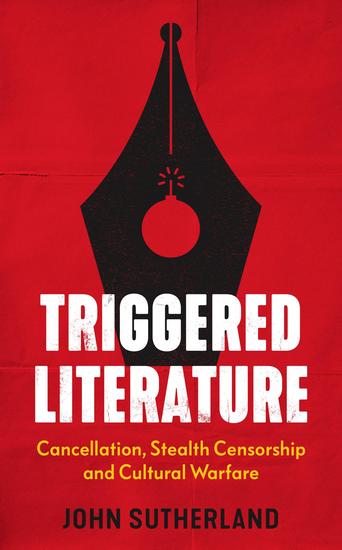
Triggered Literature - Triggered Literature: Cancellation Stealth Censorship and Cultural Warfare - cover

Triggered Literature - Triggered Literature: Cancellation Stealth Censorship and Cultural Warfare

John Sutherland

Verlag: Biteback Publishing

  • 0
  • 0
  • 0

Beschreibung

Amid the flames of the culture wars, politicians have taken up arms over controls on literary culture, spurred on in part by universities 'triggering' canonical texts. Jonathan Swift's 'Battle of the Books' has flared up again. But is 'triggering' utter wokery or responsible pedagogic practice?
Through dozens of case studies of triggered works, from Romeo and Juliet to Gender Queer, John Sutherland explores the recent phenomenon of triggering and its consequences for university English departments and literature itself. He maintains that what is routinely overlooked in the heat of polemic is that triggering is categorically different from traditional institutional (religious, educational, dictatorial) controls on literature. Triggering is in essence an alert. Done responsibly it does not erase or meddle; it stimulates curiosity and thought. It honours the fact that great literature is great because it is, as Franz Kafka says, powerful.
In this characteristically nuanced and calmly objective study, the witty literary critic guides us through the increasingly rocky terrain of triggering. His advice rings clear: literature matters, to us and what we make of our world, and it must be handled with critical care.
Verfügbar seit: 05.10.2023.
Drucklänge: 352 Seiten.

Weitere Bücher, die Sie mögen werden

  • The Stranger Who Was Myself - cover

    The Stranger Who Was Myself

    Barbara Jenkins

    • 0
    • 0
    • 0
    Barbara Jenkins writes about the experiences of a personal and family-centred life in Trinidad with great psychological acuteness, expanding on the personal with a deep awareness of the economic, social and cultural contexts of that experience. She writes about a childhood and youth located in the colonial era and an adult life that began at the very point of Trinidad's independent nationhood, a life begun in poverty in a colonial city going through rapid change. It is about a life that expanded in possibility through an access to an education not usually available to girls from such an economic background. This schooling gave the young Barbara Jenkins the intense experience of being an outsider to Trinidad's hierarchies of race and class. She writes about a life that has gender conflict at its heart, a household where her mother was subject to beatings and misogynist control, but also about strong matriarchal women.
    As for so many Caribbean people, opportunity appeared to exist only via migration, in her case to Wales in the 1960s. But there was a catch in the arrangement that the years in Wales had put to the back of her mind: the legally enforceable promise to the Trinidadian government that in return for their scholarship, she had to return. She did, and has lived the rest of her life to date in Trinidad, an experience that gives her writing an insider/outsider sharpness of perception.
    'From her childhood in colonial Port of Spain, to becoming a migrant student and young mother in Wales and then returning to Trinidad post-Independence, Jenkins tells her own life story with the emotional sensitivity of a natural storyteller, the insight of a philosopher, the scope of a historian and the good humour of a Trini. This beautifully written and moving memoir will feel achingly familiar to anyone who knows what it is like to navigate race, class and girlhood while growing up in the West Indies, anyone who has ever felt like an outsider.' Ayanna Lloyd Banwo, author of When We Were Birds.
    Zum Buch
  • A Short History of Tomb-Raiding - The Epic Hunt for Egypt’s Treasures - cover

    A Short History of Tomb-Raiding...

    Maria Golia

    • 0
    • 0
    • 0
    A spine-tingling exploration of a venture as ancient as the pyramids themselves. 


    To secure a comfortable afterlife, ancient Egyptians built fortress-like tombs and filled them with precious goods, a practice that generated staggering quantities of artifacts over the course of many millennia—and also one that has drawn thieves and tomb-raiders to Egypt since antiquity. Drawing on modern scholarship, reportage, and period sources, this book tracks the history of treasure-seekers in Egypt and the social contexts in which they operated, revealing striking continuities throughout time. Listeners will recognize the foibles of today's politicians and con artists, the perils of materialism, and the cycles of public compliance and dissent in the face of injustice. In describing an age-old pursuit and its timeless motivations, A Short History of Tomb-Raiding shows how much we have in common with our Bronze Age ancestors.
    Zum Buch
  • The Word of Dog - What Our Canine Companions Can Teach Us About Living a Good Life - cover

    The Word of Dog - What Our...

    Mark Rowlands

    • 0
    • 0
    • 0
    A heartwarming philosophical meditation on how to live a fulfilling life—inspired by the inherent happiness of dogs. 


    If you have spent any part of your life with a dog, you may have found certain questions popping, unbidden, into your mind: Is my dog living a fulfilled life? Is my dog a good dog? Does my dog love me? Addressing these questions compels you to confront not just your dog's life but yours as well—to think about what fulfillment, and meaning, in life really is. 


    In The Word of Dog, philosopher Mark Rowlands explores these questions and suggests that in dogs we can see hints—faint, shrouded, but discernible—of what a better way of living might look like. Perhaps none of us can be happy in the way a dog can, but The Word of Dog shows us we could do a lot better than we're doing simply by listening to the unspoken wisdom our dogs reveal to us every day of their happy, uncomplicated lives.
    Zum Buch
  • The Involuntary American - A Scottish Prisoner's Journey to the New World - cover

    The Involuntary American - A...

    Carol Gardner

    • 0
    • 0
    • 0
    In the winter of 1650–51, 150 ragged Scottish prisoners of war arrived at Massachusetts Bay Colony, where they were sold as indentured laborers for twenty to thirty pounds each. Among them was Thomas Doughty, a common foot soldier who had survived the Battle of Dunbar. Doughty was among some 420 Scottish soldiers who were captured during the War of the Three Kingdoms, transported to America, and sold between 1650 and 1651. Their experiences offer a fresh perspective on seventeenth-­century life. 


    The Involuntary American: A Scottish Prisoner's Journey to the New World describes Doughty's life as a soldier, prisoner of war, exile, servant, lumberman, miller, and ultimately free landowner. It follows him and his peers through critical events: the apex of the Little Ice Age, the War of the Three Kingdoms, the colonization of New England, the burgeoning transatlantic trade in servants and slaves, King Philip's and King William's wars, and the Salem witch crisis. 


    The Involuntary American demonstrates how even indi­viduals of humble circumstances were swept into the mael­strom of the First Global Age. It expands our understanding of immigration to the colonies, colonial servitude, the link­ages and tensions between Europe, Massachusetts Bay, and America's northeastern frontier, and of New England socie­ty in the early colonial period.
    Zum Buch
  • A Daughter of the Samurai - cover

    A Daughter of the Samurai

    Etsu Inagaki Sugimoto

    • 0
    • 0
    • 0
    “I came to realize the tragic truth that the Japanese woman – like the plum blossom, modest, gentle, and bearing unjust hardship without complaint – is often little else than a useless sacrifice; while the American woman – self-respecting, untrammelled, changing with quick adaptability to new conditions – carries inspiration to every heart.” 
    In the late 19th century, after Japan was restored to imperial rule, the samurais were no longer the seat of power. As Western ideas and precepts were adopted across the world, the power and wealth the families of samurais had once known was no longer. The families who were impacted by this shift lost wealth and power. 
    Etsu Inagaki Sugimoto was the daughter of one such samurai, and had begun her life on a track to become a Buddhist priestess. But as the family lost their position in society, her path changed, and she was eventually sent to the United States to be in an arranged marriage to an American man. A Daughter of the Samurai is her personal memoir of her life and perspective on the differences between Japanese and American lifestyles, the value of women in each society, and the influence that evolving cultures had on different classes of society. 
    A Daughter of the Samurai is a fascinating read for those wanting to gain a first-hand perspective on the shifting power dynamics through the Meiji Restoration and Edo period in Japan, as well as the treatment of women in both Japan and America.
    Zum Buch
  • A Light in the Tower - A New Reckoning with Mental Health in Higher Education - cover

    A Light in the Tower - A New...

    Katie Rose Guest Pryal

    • 0
    • 0
    • 0
    With evocative storytelling and incisive research, Katie Rose Guest Pryal brings a new eye to the mental health crisis that higher education has faced for decades. Written from the perspective of a bipolar-autistic professor, A Light in the Tower is both a bracing account of the mental health crisis in higher education and a passionate and informed proposal for how to teach with mental health in mind. 


    Pryal contends that higher education's mental health crisis is the result of long-term systemic problems in education that demand nothing short of a revolution. She examines the anxiety that plagues campuses as a result of exploited and overworked contingent faculty and students, the shock events like COVID-19 and campus shootings that traumatize communities, the systemic and institutional burnout that affects higher education at every level, and the market-driven culture of toxic overwork. These are large-scale problems that need large-scale solutions. Addressing the stigma that haunts mental disability on campus, the ableism that hounds our teaching, and the cascade of mental health struggles that far too many faculty and students face, Pryal provides straightforward solutions to these complex challenges.
    Zum Buch