Begleiten Sie uns auf eine literarische Weltreise!
Buch zum Bücherregal hinzufügen
Grey
Einen neuen Kommentar schreiben Default profile 50px
Grey
Jetzt das ganze Buch im Abo oder die ersten Seiten gratis lesen!
All characters reduced
The pronunciation of Greek; accent and quantity A philological inquiry - Unlocking the Mysteries of Greek Pronunciation and Accentuation - cover

The pronunciation of Greek; accent and quantity A philological inquiry - Unlocking the Mysteries of Greek Pronunciation and Accentuation

John Stuart Blackie

Verlag: Good Press

  • 0
  • 0
  • 0

Beschreibung

In "The Pronunciation of Greek; Accent and Quantity: A Philological Inquiry," John Stuart Blackie embarks on a meticulous exploration of ancient Greek phonetics and prosody. The work encompasses a comprehensive analysis of Greek accentuation, vowel quantity, and the intricacies of pronunciation that have influenced the historical and contemporary study of the language. Drawing on his extensive scholarly background, Blackie articulates his arguments with clarity and precision, employing a linguistic style that deftly balances scholarly rigor with accessibility, making his inquiries pertinent to both philologists and classicists alike. John Stuart Blackie (1809-1895) was a Scottish scholar, poet, and professor of Greek whose profound love for classical studies shaped his intellectual pursuits. His discontent with the traditional approaches to Greek pronunciation motivated him to advocate for a more accurate and authentic understanding of the language. Blackie'Äôs commitment to philology and his extensive travels across Greece enriched his insights, enabling him to challenge prevailing norms and advocate for a pronunciation that resonated with the historical realities of ancient speakers. For scholars, students, and enthusiasts of classical languages, Blackie'Äôs inquiry serves as an invaluable resource that not only sheds light on Greek pronunciation but also encourages a deeper appreciation for the linguistic heritage of the Mediterranean world. This work is highly recommended for anyone seeking to enhance their linguistic understanding and connection to classical antiquity.
Verfügbar seit: 10.07.2023.
Drucklänge: 51 Seiten.

Weitere Bücher, die Sie mögen werden

  • The PhD Debate - Is This Path Right for You? - cover

    The PhD Debate - Is This Path...

    Darius Robinson

    • 0
    • 0
    • 0
    Embark on a journey through the labyrinth of higher education with "The PhD Debate: Is This Path Right for You?" This guide serves as a compass, unraveling the rich history of a PhD and exploring personal and professional goals. Delve into financial considerations, uncover funding secrets, and experience the highs and lows of a PhD student's life. Discover the art of selecting a mentor and navigate the post-PhD career landscape. This book isn't just a guide; it's a mirror to your potential and the key to unlocking endless possibilities. Are you ready to step through the door to your future?
    Zum Buch
  • On the Duty of Civil Disobedience - cover

    On the Duty of Civil Disobedience

    Henry David Thoreau

    • 0
    • 0
    • 0
    Motivated by his disgust with the US government, Henry David Thoreau’s seminal philosophical essay enjoins individuals to stand against the ruling forces that seek to erase their free will. It is the duty of a good citizen, he argues, not only to disobey a bad law, but also to protest an unjust government. His message of nonviolence and appeal to value one’s own conscience over political legislation have resonated throughout American and world history. Peppered with the author’s poetry and social commentary, Civil Disobedience has become a manifesto for civil dissidents, revolutionaries, and protestors everywhere. Indeed, originally so unpopular with readers that Thoreau was forced to buy back over half of the books from his publisher, this work has gone on to inspire the likes of Mahatma Gandhi and Martin Luther King Jr.
    Zum Buch
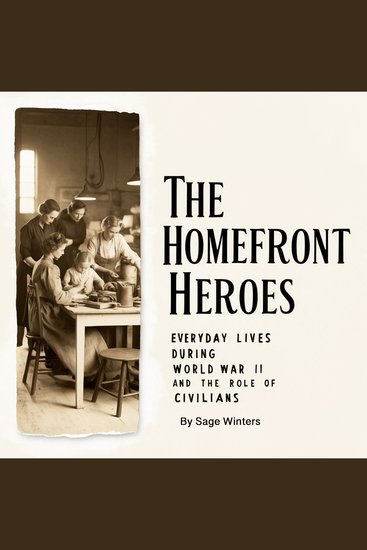
  • The Homefront Heroes - Everyday Lives during World War II and the Role of Civilians - cover

    The Homefront Heroes - Everyday...

    Sage Winters

    • 0
    • 0
    • 0
    The term "homefront" often evokes images of soldiers in trenches or aircraft soaring across the skies, but it is also a powerful representation of the unseen sacrifices and contributions made by civilians during times of war. During World War II, the homefront became an essential element in the overall war effort, with civilians across the world playing critical roles in supporting the troops and maintaining the stability of their countries. The efforts of everyday people—often invisible and uncelebrated—were foundational to both the immediate success of the war and the longer-term impact on society. This chapter delves into the importance of the homefront during WWII, exploring the diverse contributions of civilians, and highlighting how they collectively displayed a resilience that was vital for the war’s outcome. 
      
    World War II was not just fought on foreign battlefields—it was waged in factories, schools, hospitals, and even neighborhoods. The efforts of civilians extended well beyond the provision of material goods. They also contributed by keeping national spirits high through solidarity and patriotism, showing an unyielding dedication to the cause despite the challenges at home. The mobilization of the homefront became a key factor in the Allied victory, and it transformed daily life in ways that would endure long after the war ended. 
      
    Women, for instance, took on roles that had traditionally been reserved for men, stepping into factories, shipyards, and offices, proving their capacity to contribute to industries critical to the war effort. At the same time, families managed with rationing and shortages while simultaneously participating in drives for scrap metal, rubber, and other materials that could be recycled for wartime use. Even children contributed in their own ways, collecting tin cans and engaging in other activities designed to support the war effort.
    Zum Buch
  • 1922: Scenes from a Turbulent Year - Scenes from a Turbulent Year - cover

    1922: Scenes from a Turbulent...

    Nick Rennison

    • 0
    • 0
    • 0
    1922 was a year of great turbulence and upheaval. Its events reverberated throughout the rest of the twentieth century and still affect us today, 100 years later. 
     
    Empires fell. The Ottoman Empire collapsed after more than six centuries. The British Empire had reached its greatest extent but its heyday was over. The Irish Free State was declared and demands for independence in India grew. New nations and new politics came into existence. The Soviet Union was officially created and Mussolini's Italy became the first Fascist state. 
     
    In the USA, Prohibition was at its height. The Hollywood film industry, although rocked by a series of scandals, continued to grow. A new mass medium - radio - was making its presence felt and, in Britain, the BBC was founded. In literature it was the year of peak modernism. Both T. S. Eliot's The Waste Land and James Joyce's Ulysses were first published in full. 
     
    In society, already changed by the trauma of war and pandemic, the morals of the past seemed increasingly outmoded; new ways of behaving were making their appearance. The Roaring Twenties had begun to roar and the Jazz Age had arrived. 
     
    1922 also saw the discovery of Tutankhamun's tomb, the arrest of Mahatma Gandhi, the death of Marcel Proust, the election of a new pope, the release of the first major vampire movie, and the brief imprisonment in Munich of an obscure right-wing demagogue named Adolf Hitler. 
     
    In a sequence of vivid sketches, Nick Rennison conjures up all the drama and diversity of an extraordinary year. 
     
    "Its eclecticism worked brilliantly... tremendous, beguiling." WILLIAM BOYD
    Zum Buch
  • Infinite Reality - Avatars Eternal Life New Worlds and the Dawn of the Virtual Revolution - cover

    Infinite Reality - Avatars...

    Anonym

    • 0
    • 0
    • 0
    “Enough with speculation about our digital future. Infinite Reality is the straight dope on what is and isn’t happening to us right now, from two of the only scientists working on the boundaries between real life and its virtual extensions.” 
    —Douglas Rushkoff, author of Program or Be Programmed 
    Can our brains recognize where ""reality"" ends and ""virtual"" begins? Where will technology lead us in five, fifty, or five hundred years? An unrivaled guide to our digital future that has been cited by the Supreme Court, Infinite Reality is a mind-bending ""journey through the virtual universe"" (Wall Street Journal). Jim Blascovich and Jeremy Bailenson, two pioneering authorities, explore the profound potential of emerging technologies and reveal how our brains behave in digital worlds. 
     
    Along the way, Bailenson and Blascovich examine the timeless philosophical questions of the self and ""reality"" that arise through the digital experience; explain how virtual reality's latest and future forms—including immersive video games and social-networking sites—will soon be seamlessly integrated into our lives; show the many surprising practical applications of virtual reality, from education and medicine to sex and warfare; and probe further-off possibilities like ""total personality downloads"" that would allow your great-great-grandchildren to have a conversation with ""you"" a century or more after your death. 
    Equally fascinating, farsighted, and profound, Infinite Reality is an essential guide to our virtual future, where the experience of being human will be deeply transformed.
    Zum Buch
  • Demographic Dividend - Turning Population Growth into Economic Gold - cover

    Demographic Dividend - Turning...

    Priyank Agrawal

    • 0
    • 0
    • 0
    Demographic Dividend: Turning Population Growth into Economic Gold offers a comprehensive exploration of one of the most pivotal forces shaping the global economy today—demographic change. This insightful and timely book delves into the concept of the demographic dividend, a period of accelerated economic growth driven by shifts in population structure, particularly when the working-age population outnumbers dependents. Through a blend of theory, real-world case studies, and policy analysis, the book reveals how nations can harness their demographic potential to spur sustainable economic development. 
    Drawing on historical examples and contemporary trends, the book uncovers how demographic transitions—such as the shift from youthful to aging populations—can either be a boon or a burden for economies. It explores key drivers of economic success, such as human capital investment, healthcare improvements, and job creation, while also addressing the challenges posed by aging populations, dependency ratios, and unemployment. 
    This book also explores the regional perspectives of Asia, Africa, and Latin America, highlighting diverse strategies for leveraging demographic changes in different contexts. It emphasizes the role of education, healthcare, and economic policies in unlocking the full potential of a growing or transitioning population. With a forward-thinking approach, it concludes with actionable insights and a call to action for policymakers, economists, and citizens to turn demographic challenges into lasting economic opportunities. 
    Whether you are a policymaker, economist, academic, or simply an engaged citizen, Demographic Dividend: Turning Population Growth into Economic Gold provides the essential tools and knowledge to understand and navigate the complexities of demographic transitions and their transformative impact on economic development.
    Zum Buch