Rejoignez-nous pour un voyage dans le monde des livres!
Ajouter ce livre à l'électronique
Grey
Ecrivez un nouveau commentaire Default profile 50px
Grey
Abonnez-vous pour lire le livre complet ou lisez les premières pages gratuitement!
All characters reduced
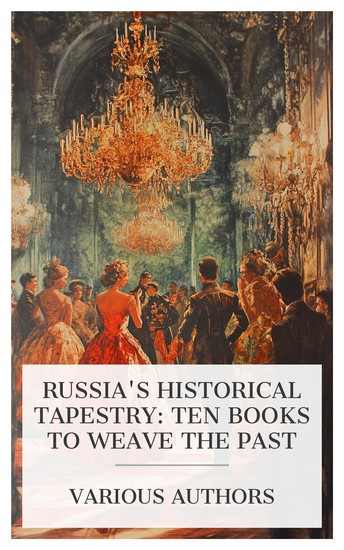
Russia's Historical Tapestry: Ten Books to Weave the Past - The Romance of the Romanoffs One Year at the Russian Court The Red Reign Russia in 1916 etc - cover

Russia's Historical Tapestry: Ten Books to Weave the Past - The Romance of the Romanoffs One Year at the Russian Court The Red Reign Russia in 1916 etc

John S. C. Abbott, Mary Platt Parmele, Leon Trotsky, Joseph McCabe, Stephen Graham, R. Van Bergen, Anton Ivanovich Denikin, Renée Gaudin de Villaine Maud, N. Sokolov, Kellogg Durland

Maison d'édition: e-artnow

  • 0
  • 0
  • 0

Synopsis

Russia's Historical Tapestry: Ten Books to Weave the Past presents a rich exploration of Russian history through the expressive lens of ten diverse authors. This anthology delves deeply into the complexities of Russia's past, offering a multifaceted examination that spans from insightful historical treatises to evocative personal narratives. Each contribution showcases a distinct literary style, reflecting the turbulent and rich history of Russia. Brimming with pivotal moments and lesser-known stories, standout pieces within the collection navigate the complexities of empire and revolution, providing readers with a broad understanding of Russia's societal transformations. The authors brought together in this collection include historians, revolutionaries, and writers, each offering a unique perspective that collectively illuminates the dynamic tapestry of Russian history. From the analytical narratives of Joseph McCabe to the poignant insights of Leon Trotsky, each voice contributes significantly to the themes of the book. Aligning with significant cultural and historical movements, these works capture a vibrant dialogue across time, offering readers rich insights into societal, political, and cultural endeavours that have shaped modern Russia. For readers seeking an encompassing journey through Russia's past, Russia's Historical Tapestry is an indispensable resource. This collection not only serves as an educational tool, enriching understanding through numerous lenses, but it also fosters a dialogue between the varied voices contained within. Immerse yourself in this anthology to engage with Russia's history on a profound level, discovering the interwoven narratives that define its present and past. With its vast range of insights, the compilation promises to be a valuable addition to any reader's exploration of global histories.
Disponible depuis: 04/03/2025.
Longueur d'impression: 2546 pages.

D'autres livres qui pourraient vous intéresser

  • Art Monsters - Unruly Bodies in Feminist Art - cover

    Art Monsters - Unruly Bodies in...

    Lauren Elkin

    • 0
    • 0
    • 0
    Coming across the term "art monster" in Jenny Offill's 2014 novel Dept. of Speculation, Lauren Elkin was intrigued. What kinds of connections might there be between art and monstrosity, and how was it different when the artist in question was a woman? 


    Art Monsters is a landmark feminist intervention in the way we think about women's stories and bodies, calling attention to a radical genealogy of feminist art that not only reacts against patriarchy but redefines its own aesthetic aims. Exploring a rich lineage of visual artists, thinkers, and writers, Elkin examines the ways feminists have confronted the problem of how to tell the truth of their experiences as bodies. Queer bodies, sick bodies, raced bodies, female bodies: What are the languages of the body, and what are the materials we need to transcribe them? Above all, how can we use the notion of the feminist "art monster" to shape how we live our lives? 


    Writing in the tradition of Susan Sontag and Maggie Nelson, Elkin demonstrates her power as a cultural critic in this erudite and engaging book. From Kara Walker's silhouettes to Theresa Hak Kyung Cha's trilingual masterpiece Dictee, Art Monsters daringly weaves links between disparate artists and writers, and shows that their work offers a potent defense of beauty and excess, sentiment and touch, ambiguity and opacity.
    Voir livre
  • A Rare Recording of Israeli Prime Minister Golda Meir - cover

    A Rare Recording of Israeli...

    Golda Meir

    • 0
    • 0
    • 0
    Golda Mabovitch Meir (May 3, 1898 - December 8, 1978) was an Israeli politician who served as the fourth prime minister of Israel from 1969 to 1974. She was Israel's first and only female head of government, the first female head of government in the Middle East, and the fourth elected female head of government or state in the world. Born in Kiev in the Russian Empire to Jewish parents, Meir immigrated as a child with her family to the United States in 1906. She graduated from the Milwaukee State Normal School and found work as a teacher. While in Milwaukee, she embraced the Labor Zionist movement and, in 1921, Meir and her husband emigrated to Mandatory Palestine. She was a signatory of the Israeli Declaration of Independence in 1948, and was elected to the Knesset in 1949. She served as Labor Minister until 1956, when she was appointed Foreign Minister by Prime Minister David Ben-Gurion. A controversial figure in Israel, Meir has been lionized as a founder of the state and described as the "Iron Lady" of Israeli politics, but also widely blamed for the country being caught by surprise during the war of 1973. 
     
    In this 1970 recording, Meir answers questions shortly after a Swissair Flight 330 from Zurich to Hong Kong, with a planned stopover in Tel Aviv, was brought down by a bomb planted by two PLO members soon after takeoff, killing all 47 passengers and crew.
    Voir livre
  • Then I Am Myself the World - What Consciousness Is and How to Expand It - cover

    Then I Am Myself the World -...

    Christof Koch

    • 0
    • 0
    • 0
    The world's leading investigator of consciousness argues that by understanding what consciousness does—cause change in the world—we can understand its origins and its future 


    In Then I Am Myself the World, Christof Koch explores the only thing we directly experience: consciousness. At the book's heart is integrated-information theory, the idea that the essence of consciousness is the ability to exert causal power over itself, to be an agent of change. Koch investigates the physical origins of consciousness in the brain and how this knowledge can be used to measure consciousness in natural and artificial systems. 


    Enabled by such tools, Koch reveals when and where consciousness exists, and uses that knowledge to confront major social and scientific questions: When does a fetus first become self-aware? Can psychedelic and mystical experiences transform lives? What happens to consciousness in near-death experiences? Why will generative AI ultimately be able to do the very thing we can do, yet never feel any of it? And do our experiences reveal a single, objective reality? 


    This is an essential book for anyone who seeks to understand ourselves and the future we are creating.
    Voir livre
  • The Voting Rights Act of 1965 - cover

    The Voting Rights Act of 1965

    Various

    • 0
    • 0
    • 0
    This program is read by an AI-based synthesized voice.
    Voir livre
  • First Guns The: The History and Legacy of the Invention of Firearms - cover

    First Guns The: The History and...

    Editors Charles River

    • 0
    • 0
    • 0
    The Chinese developed what were later dubbed the “Four Great Inventions of China,” and one of those was none other than gunpowder, which was developed no later than the 9th century and was being used for military purposes by the 11th century. Its use slowly spread through South Asia and the Middle East before making it to Europe in the late 13th century.  
    For a time it was a mere curiosity, but its destructive power and military potential would be realized quickly. The first record of a cannon in Europe comes from a manuscript written in 1326, which has an illustration showing an armored man with what looks like a slow match lighting a vase-shaped object. This crude cannon was called a pot de fer in French and vasi in Italian.  
    While medieval engineers developed new types of cannons and explosives capable of destroying walls and castles, others were making the first handguns possible. European sources first mentioned the widespread use of handgonnes, as they were often called, in the late 14th century, precisely the time when gunpowder became cheaper. These were short metal barrels stuck on the end of wooden hafts that could be tucked under the arm, the powder being lit through a touchhole with the free hand. While they were not terribly accurate and had a shorter range and slower rate of fire than longbows or crossbows, they had the advantage of being better able to punch through armor than longbows and crossbows, and they were simple to make and use.  
    By the late 15th century, handgonners had become a major part of the leading armies, and weapons that relied on gunpowder would remain a staple of warfare throughout the 19th century, paying deadly homage to one of history’s most important inventions. Of course, that would also bring about innovative new military strategies, and some of the first people to think outside of the box would be credited with putting together the makings of the first modern armies. 
    Voir livre
  • His Side - Men Speak Out on Dating Marriage and Life in America - cover

    His Side - Men Speak Out on...

    PhD Helen Smith

    • 0
    • 0
    • 0
    Men don't tell you what they really think, but they tell psychologist Helen Smith—and she tells you.James Brown said that it's a man's world. That was then. Today, men are living in a female-centered society that shares and pervades their lives whether they realize it or not. Our modern culture views dating, marriage, and domestic life almost exclusively through women's eyes and voices; men are simply seen as objects that women can order or reject by swiping on a dating app. Men's needs and feelings are left out of the equation, or seen as downright undeserved. From the COVID Karens who scold those without masks to the den mothers who run society and the workplace, men are inundated with messages that the male point of view is unwelcome and unheard.His Side brings previously silenced straight male perspectives to light with in-person interviews by psychologist and men's rights advocate Helen Smith, author of Men on Strike. These interviews are first-person accounts of how young, middle-aged, and older men experience dating apps, marriage, and work while living in a world that no longer values masculine traits and desires. It is a psychological and political look into the mind of the modern male—terrain that is rarely explored in our female-centered society.
    Voir livre