Begleiten Sie uns auf eine literarische Weltreise!
Buch zum Bücherregal hinzufügen
Grey
Einen neuen Kommentar schreiben Default profile 50px
Grey
Jetzt das ganze Buch im Abo oder die ersten Seiten gratis lesen!
All characters reduced
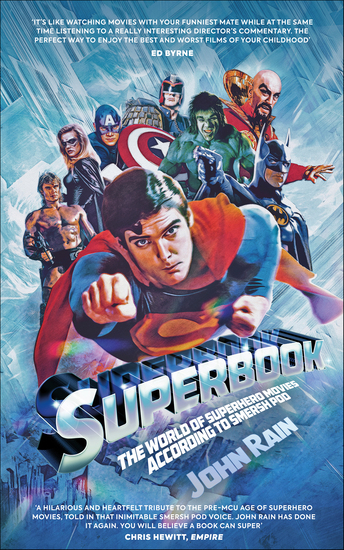
Superbook - The World of Superhero Movies According to Smersh Pod - cover

Superbook - The World of Superhero Movies According to Smersh Pod

John Rain

Verlag: Polaris

  • 0
  • 0
  • 0

Beschreibung

If you mention the word ‘superhero’ these days, everyone and their mum can tell you a potted history of it all, because they’ve sat through numerous phases, extended TV series, and animated side-specials of expansive character-development, culminating in extraordinary final chapters, with the screen literally stacked full of characters battling one another while your eyes bleed with excitement and spectacle.

But before 1997, people would generally only think of a few things: Christopher Reeve smiling as he keeps a watchful eye over Earth’s atmosphere, Michael Keaton running around Gotham while dressed in molded rubber. Nicholas Hammond's Spider-Man being hauled up a wall on a rope, pretending to grip it, while also being a foot away from it. Bill Bixby trying not to get angry, Flash Gordon arriving in another galaxy, that was essentially a soft porn film, Dolph Lundgren mumbling in broken English while Frank Langella hammed behind a mask, and how Michael Crawford dressed like a bird was the closest thing Disney had to a cinematic universe.

Despite starting on a high in 1978, by 1997 there could be no doubt that the genre was dead. Out was the sheen of verisimilitude, and in were Bat-credit-cards, ugly CGI, slashed budgets, rubber nipples and Martin Sheen in a girdle.

So, whatever happened to the heroes? Join John Rain as he walks through every film of note from 1978 to 1997, and examines just what went wrong, and how. Is it a bird? Is it a plane? No, it’s SUPERBOOK.
Verfügbar seit: 09.01.2024.
Drucklänge: 380 Seiten.

Weitere Bücher, die Sie mögen werden

  • Spirits Seers & Séances - Victorian Spiritualism Magic & the Supernatural - cover

    Spirits Seers & Séances -...

    Steele Alexandra Douris

    • 0
    • 0
    • 0
    Spiritualism in the Age of Sherlock Holmes and Edgar Allan Poe 


    A woman wearing a black veil convenes a séance. A magician puts a volunteer into a trance. A fortune-teller leans over a crystal ball. Everyone knows what Victorian mysticism looks like because our modern imagery, language, and practice of magic borrows heavily from the Victorians. But we have little understanding of its spiritual, cultural, and historical foundations. 


    What made the Victorians turn to mediumship, hypnotism, and fortune-telling? What were they afraid of? What were they seeking? 


    This book explores the history of automatic writing, cartomancy, clairvoyance, and more. It reveals how Victorian belief in ghosts, fairies, and nature spirits shaped our celebrations of Halloween and Christmas. With historic examples and hands-on exercises, you will discover how spiritualism in the time of Jack the Ripper, Jane Eyre, "A Christmas Carol," and Dracula left such a profound impact on both the past and present.
    Zum Buch
  • Tour Wars - cover

    Tour Wars

    Carla Luna

    • 0
    • 0
    • 0
    Ten days, two rivals, and a busload of tourists. How bad could it be? 
    For archaeologist Emilia Flores, landing a fellowship to work at the ancient ruins of Pompeii in Italy is a dream come true. The only catch? She’ll be digging alongside her infuriating nemesis, TJ Mayer, who’s been a constant thorn in her side. 
    TJ isn’t about to pass up the Pompeii project. Sure, he’ll be stuck working with Emilia, but he thrives on challenging her. And he hasn’t forgotten that secret kiss they shared at an archaeology conference last winter. 
    Though unearthing Pompeii’s treasures might be a dream, student debt is a nightmare that never takes a vacation. So, when TJ and Emilia are offered a lucrative side job to lead a ten-day tour through southern Italy, they grudgingly agree to tackle it together. 
    Forced to set aside their animosity and work as a team, they forge an unexpected camaraderie. As the sparks between them ignite, their rivalry gives way to passion, making it easy to forget their years of fierce competition. But what happens when the tour ends and the real world steps in? 
    Tour Wars is a rivals-to-lovers, grumpy/sunshine romance featuring a nerdy cinnamon roll hero, a strong-willed Latina heroine, and plenty of hotel hijinks. It can be read as a standalone.
    Zum Buch
  • Left for Dead - Shipwreck Treachery and Survival at the Edge of the World - cover

    Left for Dead - Shipwreck...

    Eric Jay Dolin

    • 0
    • 0
    • 0
    In Left for Dead, Eric Jay Dolin—“one of today’s finest writers about ships and the  
    sea” (American Heritage)—tells the true story of a wild and fateful encounter  
    between an American sealing vessel, a shipwrecked British brig, and a British  
    warship in the Falkland archipelago during the War of 1812. 
    Fraught with misunderstandings and mistrust, the incident left three British sailors  
    and two Americans, including the captain of the sealer, Charles H. Barnard,  
    abandoned in the barren, windswept, and inhospitable Falklands for a year and a  
    half. With deft narrative skill and unequaled knowledge of the very pith of the  
    seafaring life, Dolin describes in vivid and harrowing detail the increasingly  
    desperate existence of the castaways during their eighteen-month ordeal—an alltoo-common fate in the Great Age of Sail. 
    A tale of intriguing complexity, with surprising twists and turns throughout— 
    involving greed, lying, bullying, a hostile takeover, stellar leadership, ingenuity,  
    severe privation, endurance, banishment, the great value of a dog, the birth of a  
    baby, a perilous thousand-mile open-ocean journey in a seventeen-foot boat, an  
    improbable rescue mission, and legal battles over a dubious and disgraceful  
    wartime prize—Left for Dead shows individuals in wartime under great duress  
    acting both nobly and atrociously, and offers a unique perspective on a pivotal era  
    in American maritime history. 
    “An absorbing adventure that explores the dark shadows of instinct and self-preservation, and the hardships and stress that stretch the bonds of humanity.  
    Fascinating reading.”—Stephen R. Bown, author of Island of the Blue Foxes:  
    Disaster and Triumph on the World’s Greatest Scientific Expedition
    Zum Buch
  • Freedom of Speech - Navigating the Balance Between Expression and Responsibility - cover

    Freedom of Speech - Navigating...

    Marcus Klein

    • 0
    • 0
    • 0
    Freedom of speech is a cornerstone of democratic societies, integral to the exercise of individual autonomy and the pursuit of truth. At its core, it is the right to express ideas, opinions, and beliefs without fear of government reprisal or censorship. This principle is enshrined in numerous legal documents, most notably the First Amendment to the U.S. Constitution, which guarantees "the freedom of speech, or of the press," protecting the individual’s right to speak openly in the public sphere. 
      
    The origins of free speech can be traced back to philosophical and political thinkers of the Enlightenment era, who emphasized the importance of reason, individual rights, and personal liberty. Thinkers such as John Locke, Voltaire, and John Stuart Mill argued that the free exchange of ideas was essential for the flourishing of society, allowing for the progress of knowledge, the correction of errors, and the protection of political freedom. These ideas laid the groundwork for the modern understanding of free expression as a fundamental human right. 
      
    However, the right to free speech is not absolute. Throughout history, the boundaries of this freedom have been tested by a wide range of societal, political, and ethical concerns. From the regulation of speech in times of war or national security threats to the ongoing debates over hate speech, defamation, and misinformation, societies have struggled to find a balance between protecting free expression and safeguarding the common good. This tension continues to shape the debate surrounding free speech, particularly in the context of emerging technologies like social media, which have transformed the landscape of communication.
    Zum Buch
  • The Story of Pearl Harbor – The Attack That Changed History - The Events Strategy and Aftermath of December 7 1941 - cover

    The Story of Pearl Harbor – The...

    Max Owen

    • 0
    • 0
    • 0
    On December 7, 1941, the world changed forever. In a surprise attack by the Japanese Imperial Navy, Pearl Harbor was bombed, dragging the United States into World War II. How did this happen? Was it truly unexpected, or were there warnings? 
    This audiobook uncovers the strategic planning, key military figures, and devastating impact of the attack. Learn about the battleships lost, the heroes of that fateful day, and the American response that led to war in the Pacific. 
    The Story of Pearl Harbor – The Attack That Changed History is a must-listen for military history lovers, World War II enthusiasts, and anyone interested in the pivotal moments that shaped the modern world.
    Zum Buch
  • Great American Socialist The: Eugene Debs 1890-1919 - cover

    Great American Socialist The:...

    Eugene Debs

    • 0
    • 0
    • 0
    Six months ago, I had never heard the name Eugene Debs. Today, I believe he is one of the greatest orators in history, ranking alongside Napoleon, Robespierre, Lincoln, and Cicero. More importantly, he was a genuine hero, a man to believe in and follow into the fires of hell. His legacy has been unrightly ignored by the same powers that imprisoned and harassed him over his life. He should be an icon, but is unremembered, for reasons he himself goes into. However, there is one key difference between Debs and these other orators: every one of the others fought for empire, or glory, or democracy – but Debs fought for the working man’s right to a decent existence.A railroad man from 15, he founded then turned against the unions as they became tools of the owners, and won 3% of the presidential vote in 1920 despite being a) the Socialist candidate and b) in prison for sedition. The two major speeches missing from this volume can be found in the prior collection, being “You Railroad Men”, whose content is covered in other speeches herein, and “Statement to the Court”, which is summarised in part 4 of Scott Nearing’s analysis.
    Zum Buch