Begleiten Sie uns auf eine literarische Weltreise!
Buch zum Bücherregal hinzufügen
Grey
Einen neuen Kommentar schreiben Default profile 50px
Grey
Jetzt das ganze Buch im Abo oder die ersten Seiten gratis lesen!
All characters reduced
In Behalf of Rowan and Free Speech - cover

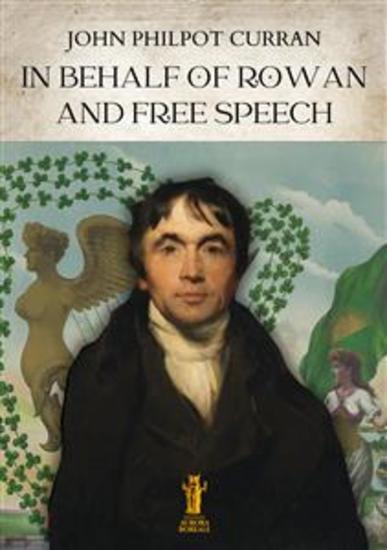
In Behalf of Rowan and Free Speech

John Philpot Curran

Verlag: Edizioni Aurora Boreale

  • 0
  • 0
  • 0

Beschreibung

John Philpot Curran (1750-1817) was an Irish orator, politician, wit, and lawyer renowned for employing his skills in defence of civil and political liberty. He first won popular acclaim in 1780, as the only lawyer in his circuit willing to represent a Catholic priest horsewhipped by an Anglo-Irish lord. In the 1790s he was celebrated as a champion of Catholic emancipation and reform in the Irish Parliament and as defence counsel in court for United Irishmen facing charges of sedition and treason. He was vocal in his opposition to Britain’s incorporation of Ireland in a United Kingdom.
Admitted to the Irish Bar in 1775, Curran entered the Irish Parliament in 1783, and defended prisoners arrested during the Irish Insurrection of 1798.
Curran’s speeches before the judicial bench were widely admired. Lord Byron said, after the death of Curran, «I have heard that man speak more poetry than I have seen written», and, in a letter to Thomas Moore, 1 October 1821, «I feel, as your poor Curran said, before his death, 'a mountain of lead upon my heart, which I believe to be constitutional, and that nothing will remove it but the same remedy'». Karl Marx, recommending to Friedrich Engels the speeches of Curran, described him as the greatest "people's advocate" of the eighteenth century.
The Curran’s oration In Behalf of Rowan and Free Speech, which we propose to our readers today, dates from 1794. Archibald Hamilton Rowan was secretary of the Dublin Society of United Irishmen. In August, 1792, in reply to a proclamation against "the Volunteers of Ireland", Rowan had published an address inviting them to resume their arms. The government having decided to prosecute him, Curran in 1794 was engaged to defend him.
Verfügbar seit: 06.06.2024.

Weitere Bücher, die Sie mögen werden

  • A Rare Recording of Edwin Hubble - cover

    A Rare Recording of Edwin Hubble

    Edwin Hubble

    • 0
    • 0
    • 0
    Edwin Powell Hubble (November 20, 1889 - September 28, 1953), born in Marshfield, MO, was an American astronomer who played a crucial role in establishing the fields of extragalactic astronomy and observational cosmology. Hubble proved that many objects previously thought to be clouds of dust and gas and classified as "nebulae" were actually galaxies beyond the Milky Way. Hubble's name is most widely recognized for the Hubble Space Telescope, which was named in his honor. The following is a 1945 recording of Hubble's lecture at the New York Philharmonic.
    Zum Buch
  • Prophetic Leadership and Visionary Hope - New Essays on the Work of Cornel West - cover

    Prophetic Leadership and...

    Barbara Will

    • 0
    • 0
    • 0
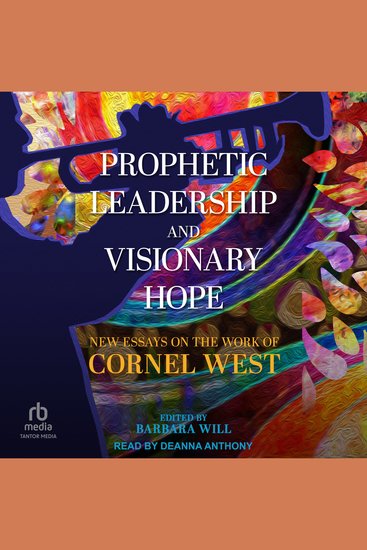
    Thirty years have passed since Cornel West's book Race Matters rose to the top of the bestseller lists in 1993. Yet his book remains as relevant as ever to American culture—even more so, if one considers its influence on contemporary racial justice movements such as Black Lives Matter, prison justice, and the fight for police reform. Prophetic Leadership and Visionary Hope looks back to the original 1993 text and forward into the future of racial understanding and healing in our current century. 


    Prophetic Leadership and Visionary Hope offers new points of entry into the thorny issues that the 1993 text addressed: the challenge of leadership in a culture marked by the legacy of white supremacy; the limited value of liberal affirmative action programs in promoting the affirmation of Black humanity; the dangerous seductions of African American conservatism and the question of Black self-regard; the necessity and difficulty of cross-race solidarity and cross-religious affinity; the need to channel legitimate Black rage over untenable conditions of existence into productive opportunities and viewpoints. With essays that span the topics of history, politics, philosophy, religion, cultural studies, music, and aesthetics, Prophetic Leadership and Visionary Hope is as wide-ranging as the thinker whose ideas it engages, interrogates, and celebrates.
    Zum Buch
  • Lankesh - cover

    Lankesh

    Devdutt Pattanaik

    • 0
    • 0
    • 0
    Lankesh, a book written by Devdutt Pattanaik, is based on the Ramayana and various other scriptures. Through it, he tries to present Ravana’s perspective. Each part of the book offers a unique lesson that helps us conquer the ‘Ravana’ within ourselves and ignite the light of ‘Rama’ in our hearts.
    Zum Buch
  • Thales - Thoughts and Ideas from the First Philosopher - cover

    Thales - Thoughts and Ideas from...

    Hector Davidson

    • 0
    • 0
    • 0
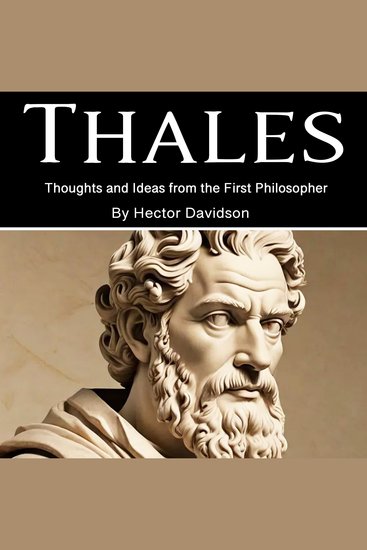
    Thales of Miletus, often hailed as the first philosopher in Western history, was born in the ancient Greek city of Miletus, around 624 BCE. As a figure whose contributions have shaped the course of philosophy, science, and mathematics, Thales stands as a foundational figure in intellectual history. Although much of his life remains shrouded in mystery due to the passage of time, the few details that have survived reveal a thinker whose ideas and insights went beyond the conventional beliefs of his era. 
    Thales is traditionally considered the first to break away from mythological explanations of the world. Prior to Thales, the Greek understanding of nature was largely dominated by myth and religious explanations, where gods and divine forces were invoked to explain the natural phenomena. Thales, however, proposed a radical shift by seeking rational, natural explanations. He is best known for his theory that water is the fundamental substance from which everything originates. This insight marks a profound moment in intellectual history because it moved away from mythological thinking and introduced the idea of a unifying principle underlying all things. 
    In addition to his contributions to philosophy, Thales was also a mathematician and astronomer, and his influence in these fields is considerable. He is credited with being the first to predict a solar eclipse, using his understanding of the stars and celestial movements. His work in geometry is equally important—he is famously known for Thales’ Theorem, which laid the groundwork for the development of geometry. This theorem states that if two points are on a circle, and a line is drawn through them, then the center of that line will always lie on a straight line through the center of the circle. This geometric insight shows his ability to understand and systematize mathematical concepts that were previously unexamined.
    Zum Buch
  • Norse Myths Unveiled - The Gods Giants and Heroes of Scandinavia - cover

    Norse Myths Unveiled - The Gods...

    Julia Blacksmith

    • 0
    • 0
    • 0
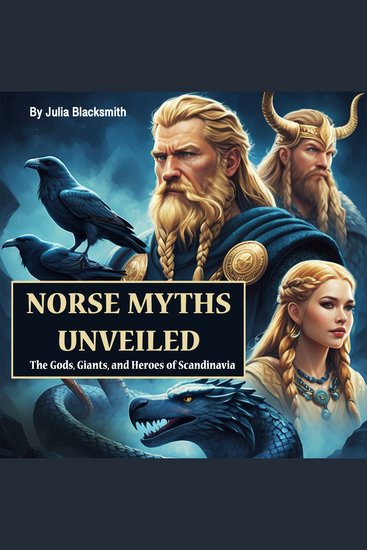
    Norse mythology is a vast and intricate belief system that shaped the spiritual and cultural identity of the Scandinavian people. Rooted in oral traditions and later recorded in texts such as the *Poetic Edda* and *Prose Edda*, these myths offer a glimpse into a world filled with powerful gods, fearsome giants, and legendary heroes. Unlike many other mythologies, Norse myths do not present a perfect and orderly universe but rather one marked by struggle, chaos, and an inevitable end.  
      
    At the heart of Norse cosmology are the Nine Realms, each interconnected through Yggdrasil, the great World Tree. These realms include Asgard, the home of the gods; Midgard, the realm of humans; and Jotunheim, the land of giants, among others. The Norse viewed the universe as a place of constant conflict and transformation, where even the gods were not immune to fate. This belief in destiny was central to their worldview, with figures like the Norns weaving the threads of fate for gods and mortals alike.  
      
    Prophecy played a significant role in Norse mythology, shaping the actions of both gods and mortals. One of the most well-known prophecies is that of Ragnarok, the great battle that would bring about the end of the world. Unlike many other religious traditions that offer eternal salvation, Norse myths emphasize the inevitability of destruction and rebirth. Even Odin, the Allfather, seeks wisdom not to change fate but to prepare for its arrival. 
    Zum Buch
  • France - History People and Significant Places and Events - cover

    France - History People and...

    Kelly Mass

    • 0
    • 0
    • 0
    This is a combo of three different topics, which are the following: 
    Topic 1, Lourdes: You may have heard of Lourdes, a town in France where millions of people go every year, either as a tourist to take pictures or see what the hype is all about, or real believers who think that the town has a sanctity to it and can somehow cure them, help them, or inspire them through divine means. Whatever the reason for the many visitors is, it is undeniably an interesting historical heritage, something worth exploring. 
    Topic 2, the Gauls: This is a book about a people that has often been overlooked. Wallowing in the shadow of the seemingly almighty Romans, and dispersed throughout the ages into other peoples, the Gauls appear as if they had nothing going for them. Quite the opposite is true. The Gauls had a distinct culture, with habits, warfare, and so much more to offer to the intrigued historian and everyday researcher. 
    Throughout the Iron Age and the Roman period, the Gauls were a collection of Celtic tribes from Continental Europe (circa from the fifth century BC to the fifth century advertisement). 
    Topic 3, the Huguenots: An important chapter in history is that in which the Catholic Church was being questioned by the commoners. People were standing up against tyranny and illogical rules. They had had it with hypocrisy and double standards. The abuse in the church wasn’t representing the text in the Bible. Too much corruption had crept into the clergy, or so the narrative went about across the entire European continent. 
    The Huguenots were a spiritual group of French Protestants who complied with the Reformed, or Calvinist, Protestant custom. The expression originates from the name of a Swiss politician, Genevan burgomaster Bezanson Hugues (from about 1491 - 1532) and was commonly used in Europe by the 16th century.
    Zum Buch