Begleiten Sie uns auf eine literarische Weltreise!
Buch zum Bücherregal hinzufügen
Grey
Einen neuen Kommentar schreiben Default profile 50px
Grey
Jetzt das ganze Buch im Abo oder die ersten Seiten gratis lesen!
All characters reduced
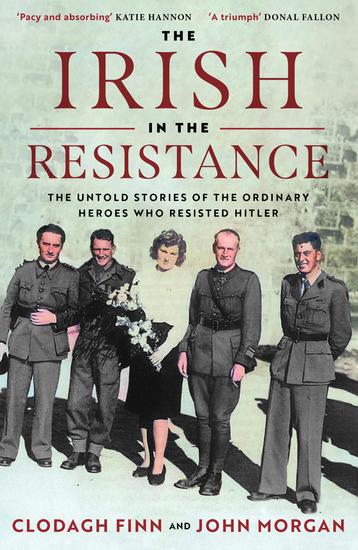
The Irish in the Resistance - The Untold Stories of the Ordinary Heroes Who Resisted Hitler - cover

The Irish in the Resistance - The Untold Stories of the Ordinary Heroes Who Resisted Hitler

John Morgan, Clodagh Finn

Verlag: Gill Books

  • 0
  • 0
  • 0

Beschreibung

'You simply couldn't stand by with your arms folded.'
These were the words of Samuel Beckett who famously returned to France from a holiday in Ireland when World War II broke out. His clandestine work against the Nazi occupation of Europe is well documented, but there were many other ordinary Irish people who joined the underground network.
Some took up arms. Others gathered intelligence, sheltered fugitives, committed acts of sabotage or broke codes. This new history tells the stories of those forgotten Irish men and women.
Discover Captain John Keany from Cork, who parachuted into occupied Italy to help the local Resistance; Margaret Kelly, the Dublin founder of the world-famous Bluebell Girls cabaret troupe in Paris, who hid her Jewish husband; and Catherine Crean, the Irish governess born on Moore Street, Dublin, who was sent to a concentration camp for helping Allied airmen in Belgium.
These, and many more stories, span the course of World War II and remind us of the power of individuals to make a difference.
'An eye-opening account of how ordinary people caught up in extraordinary situations helped to fight the Nazis' David McCullagh
'A truly important and groundbreaking book' Mary Kenny
Verfügbar seit: 29.08.2024.
Drucklänge: 368 Seiten.
Weitere Bücher, die Sie mögen werden

  • Memory - How to Develop Train and Use It - cover

    Memory - How to Develop Train...

    William Walker Atkinson

    • 0
    • 0
    • 0
    An in-depth exploration of the human memory, providing an analysis of how it works and how to improve it. The work is heavily rooted in Atkinson's neurological and psychological research, providing a comprehensive overview of the neural pathways, synaptic networks, and biochemical processes associated with memory formation. He additionally touches on the cognitive strategies that can be utilized to hone one's memory recall capabilities. Read in English, unabridged.
    Zum Buch
  • Lincoln - A Very Short Introduction - cover

    Lincoln - A Very Short Introduction

    Allen C. Guelzo

    • 0
    • 0
    • 0
    Beneath the surface of the apparently untutored and deceptively frank Abraham Lincoln ran private tunnels of self-taught study, a restless philosophical curiosity, and a profound grasp of the fundamentals of democracy. Now, in Lincoln: A Very Short Introduction, the award-winning Lincoln authority Allen C. Guelzo offers a penetrating look into the mind of one of our greatest presidents. 


    Guelzo takes us on a wide-ranging exploration of problems that confronted Lincoln and liberal democracy—equality, opportunity, the rule of law, slavery, freedom, peace, and his legacy. The Lincoln we meet here is an Enlightenment figure who struggled to create a common ground between a people focused on individual rights and a society eager to establish a certain moral, philosophical, and intellectual bedrock. Lincoln insisted that liberal democracy had a higher purpose, which was the realization of a morally right political order. But how to interject that sense of moral order into a system that values personal self-satisfaction—"the pursuit of happiness"—remains a fundamental dilemma even today. 


    Guelzo paints a marvelous portrait of this Lincoln—Lincoln the man of ideas—providing new insights into one of the giants of American history.
    Zum Buch
  • The Brexit Referendum - The UK's EU Departure - cover

    The Brexit Referendum - The UK's...

    Nova Ashford

    • 0
    • 0
    • 0
    The Brexit referendum, which took place on June 23, 2016, marked a pivotal moment in the history of the United Kingdom and its relationship with the European Union. The decision to leave the EU, known as Brexit, came after years of mounting debate and growing division within British society and politics. The referendum was the result of a long-standing debate over the UK’s membership in the European Union, with political, economic, and cultural tensions playing a central role in shaping the outcome. 
    The road to Brexit began long before the referendum vote. The United Kingdom joined the European Economic Community (EEC) in 1973, a precursor to the European Union, and since then, the nation’s relationship with the organization has been fraught with disagreement. Euroscepticism, or skepticism about the benefits of EU membership, had been steadily rising, particularly among certain political groups and sections of the public. Critics of the EU argued that membership undermined national sovereignty and that the UK was bound by regulations and policies that did not align with its interests. This sentiment was exacerbated by issues such as immigration, trade regulations, and the financial burden of contributing to the EU budget. 
    In the years leading up to the referendum, the political landscape of the UK began to shift. The rise of UKIP (the United Kingdom Independence Party), led by Nigel Farage, brought the issue of EU membership into sharper focus. UKIP’s success in the 2014 European Parliament elections, where it emerged as the largest UK party, put pressure on the Conservative Party to address the growing concerns over the EU. Prime Minister David Cameron, seeking to quell dissent within his own party and avoid a potential electoral challenge from UKIP, promised a referendum on EU membership in 2013. This pledge set the stage for the referendum that would ultimately decide the UK’s fate within the EU.
    Zum Buch
  • Uthram Thirunal Thirumanassukondum Kathakali yogavum - cover

    Uthram Thirunal...

    Kottarathil Sankunni

    • 0
    • 0
    • 0
    Aithihyamala is a collection of century-old stories from Kerala that cover a vast spectrum of life, famous persons and events. It is a collection of legends numbering over a hundred, about magicians and yakshis, feudal rulers and conceited poets, kalari or Kalaripayattu experts, practitioners of Ayurveda and courtiers; elephants and their mahouts, tantric experts.
    Zum Buch
  • Parliamentary America - The Least Radical Means of Radically Repairing Our Broken Democracy - cover

    Parliamentary America - The...

    Maxwell L. Stearns

    • 0
    • 0
    • 0
    Americans face increasingly stark choices each presidential election and a growing sense that our government can't solve the nation's most urgent challenges.  Our eighteenth-century system is ill-suited to our twenty-first-century world. Information-age technology has undermined our capacity to face common problems together and turned our democracy upside down, with gerrymanders letting representatives choose voters rather than voters choosing them. In Parliamentary America, Maxwell L. Stearns argues that the solution to these complex problems is a parliamentary democracy. 


    Stearns considers such leading alternatives as ranked choice voting, the national popular vote, and congressional term limits, showing why these can't solve our constitutional crisis. Instead, three amendments—expanding the House of Representatives, having House party coalitions choose the president, and letting the House end a failing presidency based on no confidence—will produce a robust multiparty democracy. 


    Stearns takes listeners on a world tour—England, France, Germany, Israel, Taiwan, Brazil, and Venezuela—showing what works in government, what doesn't, and how to make the best features our own. Genuine party competition and governing coalitions, commonplace across the globe, may seem like a fantasy in the United States. But we can make them a reality.
    Zum Buch
  • The Tech Coup - How to Save Democracy from Silicon Valley - cover

    The Tech Coup - How to Save...

    Marietje Schaake

    • 0
    • 0
    • 0
    Under the cover of "innovation," technology companies have successfully resisted regulation and have even begun to seize power from governments themselves. Facial recognition firms track citizens for police surveillance. Cryptocurrency has wiped out the savings of millions and threatens the stability of the global financial system. Spyware companies sell intelligence tools to anyone who can afford them. This new reality—where unregulated technology has become a forceful instrument for autocrats worldwide—is terrible news for democracies and citizens. 


    In The Tech Coup, Marietje Schaake explains how technology companies crept into nearly every corner of our lives and our governments. She takes us beyond the headlines to high-stakes meetings with human rights defenders, business leaders, computer scientists, and politicians to show how technologies have gone from being heralded as utopian to undermining the pillars of our democracies. To reverse this existential power imbalance, Schaake outlines solutions to empower elected officials and citizens alike. Democratic leaders can—and must—resist the influence of corporate lobbying and reinvent themselves as dynamic, flexible guardians of our digital world. Schaake offers a frightening look at our modern tech-obsessed world—and a clear-eyed view of how democracies can build a better future before it is too late.
    Zum Buch