Rejoignez-nous pour un voyage dans le monde des livres!
Ajouter ce livre à l'électronique
Grey
Ecrivez un nouveau commentaire Default profile 50px
Grey
Abonnez-vous pour lire le livre complet ou lisez les premières pages gratuitement!
All characters reduced
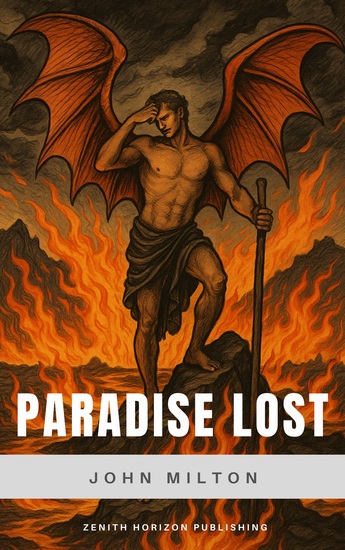
Paradise Lost - John Milton's Epic Poem of Heaven Hell and Humanity - cover

Paradise Lost - John Milton's Epic Poem of Heaven Hell and Humanity

John Milton, Zenith Horizon Publishing

Maison d'édition: Zenith Horizon Publishing

  • 0
  • 0
  • 0

Synopsis

The fall of Lucifer. The fall of man. The rise of eternal questions.

Paradise Lost is one of the greatest epic poems in the English language. In soaring blank verse, John Milton recounts the biblical story of the rebellion in Heaven, Satan's descent, and the tragic temptation of Adam and Eve. Combining theological vision with poetic brilliance, this timeless work explores free will, pride, justice, and redemption.

📖 Milton's masterpiece has inspired readers, artists, and thinkers for over 350 years.

🕊️ This edition includes:

The full, unabridged 1667 and 1674 versions (where applicable)

Striking illustrations capturing celestial and infernal imagery

Kindle-optimized formatting for a rich digital reading experience

📚 Essential for lovers of poetry, classical literature, and spiritual philosophy.

Enter a world of angels, demons, and divine destiny.
Get your illustrated edition now.
Disponible depuis: 13/06/2025.
Longueur d'impression: 286 pages.

D'autres livres qui pourraient vous intéresser

  • The Poetry of Elinor Wylie - One of the first American female celebrities Wylie was surrounded by media and controversy her whole life yet managed to write amazing poetry too - cover

    The Poetry of Elinor Wylie - One...

    Elinor Wylie

    • 0
    • 0
    • 0
    Elinor Morton Hoyt was born on 7th September, 1885 in Somerville, New Jersey and from age 12 grew up in Washington D C where her father served as assistant attorney general and later solicitor general.  Her early education together with her renowned beauty suggests she was being trained for life as a debutante but her life quickly found another route as she became absorbed in the world of books. 
     
    An early marriage following her graduation ended when, after being pursued by Horace Wylie, 17 years her senior and a married Washington lawyer with three children, she eloped to England with him.  His wife would not divorce him and the subsequent scandal was widely publicised further fueled by the suicide in 1912 of her abandoned husband. 
     
    With Wylie's encouragement she published in 1912, ‘Incidental Number’, assembled from poems of the previous decade. 
     
    Despite a child from her first marriage Elinor subsequently endured miscarriages, a stillbirth and a premature child who lived for only one week.  When Wylie’s deserted wife agreed to a divorce, the couple returned to the United States and married but they were already drawing apart. 
     
    In 1921, Elinor’s ‘Nets to Catch the Wind’, was published. It was an immediate success and a prize-winner.  In New York’s literary circles she found her next husband who acted as her agent – the poer William Rose Benét, brother of the famed Stephen. They married in 1923 and that same year ‘Black Armor’, was published. The New York Times said "There is not a misplaced word or cadence in it."  She also published her first of four novels, ‘Jennifer Lom’, to excellent reviews. 
     
    She worked for a time as the poetry editor of Vanity Fair, an editor of Literary Guild, and a contributing editor of The New Republic.  Her third book of poetry, ‘Trivial Breath’ arrived in 1928 as did the failure of her marriage with Benét.  
     
    She moved again to England and fell in love with a friend’s husband, to whom she wrote, and later published a series of 19 sonnets; ‘Angels and Earthly Creatures’. 
     
    Elinor Wylie suffered high blood pressure all her adult life and this eventually led to her death at Benet’s New York apartment on 16th December, 1928 where she suffered a stroke. She was 43. 
     
    1 - The Poetry of Elinor Wylie - An Introduction 
    2 - Wild Peaches by Elinor Wylie 
    3 - Escape by Elinor Wylie 
    4 - Ophelia by Elinor Wylie 
    5 - The Puritan's Ballad by Elinor Wylie 
    6 - Velvet Shoes by Elinor Wylie 
    7 - Parting Gift by Elinor Wylie 
    8 - Little Elegy by Elinor Wylie 
    9 - Love Song by Elinor Wylie 
    10 - Quarrel by Elinor Wylie 
    11 - Valentine by Elinor Wylie 
    12 - Les Lauriers Sont Coupee by Elinor Wylie 
    13 - Sunset on the Spire by Elinor Wylie 
    14 - Phases of the Moon by Elinor Wylie 
    15 - Full Moon by Elinor Wylie 
    16 - Nadir by Elinor Wylie 
    17 - Address to My Soul by Elinor Wylie 
    18 - The Child on the Curbstone by Elinor Wylie 
    19 - The Eagle and the Mole by Elinor Wylie 
    20 - The Falcon by Elinor Wylie 
    21 - A Proud Lady by Elinor Wylie 
    22 - Preference by Elinor Wylie 
    23 - Nancy by Elinor Wylie 
    24 - The Lion and the Lamb by Elinor Wylie 
    25 - Beauty by Elinor Wylie 
    26 - The Tortoise in Eternity by Elinor Wylie 
    27 - The Fairy Goldsmith by Elinor Wylie 
    28 - Innocent Landscape by Elinor Wylie 
    29 - A Madman's Song by Elinor Wylie 
    30 - Poor Earth by Elinor Wylie 
    31 - The Church Bell by Elinor Wylie 
    32 - Cold Blooded Creatures by Elinor Wylie 
    33 - Let No Charitable Hope by Elinor Wylie 
    34 - Little Joke by  Elinor Wylie 
    35 - Pretty Words by Elinor Wylie 
    36 - Incantation by Elinor Wylie 
    37 - Fire and Sle
    Voir livre
  • George Bernard Shaw: CANDIDA - cover

    George Bernard Shaw: CANDIDA

    George Bernard Shaw

    • 0
    • 0
    • 0
    Morell is a Christian Socialist, popular in the Church of England, but Candida is responsible for much of his success. Candida returns home briefly from a trip to London with Eugene Marchbanks, a young poet who wants to rescue her from what he presumes to be her dull family life. Marchbanks is in love with Candida and believes she deserves something more than just complacency from her husband. He considers her divine, and his love eternal. In his view, it is quite improper and humiliating for Candida to have to attend to petty household chores. Morell believes Candida needs his care and protection, but the truth is quite the contrary. Ultimately, Candida must choose between the two gentlemen. She reasserts her preference for the "weaker of the two" who, after a momentary uncertainty, turns out to be her husband Morell. Note that the pronunciation of Candida is how Shaw himself preferred it be pronounced.
    Voir livre
  • Milk Snake - Poems - cover

    Milk Snake - Poems

    Toby Buckley

    • 0
    • 0
    • 0
    In Milk Snake, Toby Buckley invites us to look at the world from a slightly different angle, where small things become unsettling if you look closely enough. The poet explores queerness, displacement and trauma through clear-voiced, deceptively gentle poems about fishermen, maggots and bees.
    bleary
    from sleep and warm
    water and no glasses
    i spot an uncertain comma
    sliding
    he drags his tail up my
    shower wall cumbersome
    and not unmaggotesque and i
    can see
    his guts
    or maybe it's
    his dinner
    
    - from 'companion'
    Voir livre
  • The Poetry of Lord Byron - Legendary poet who is regarded as the first modern style celebrity - cover

    The Poetry of Lord Byron -...

    Lord Byron

    • 0
    • 0
    • 0
    George Gordon Byron, 6th Baron Byron, but more commonly known as just Byron was a leading English poet in the Romantic Movement along with Keats and Shelley. 
    Byron was born on January 22nd, 1788.  He was a great traveller across Europe, spending many years in Italy and much time in Greece.  With his aristocratic indulgences, flamboyant style along with his debts, and a string of lovers he was the constant talk of society.  
    In 1823 he joined the Greeks in their war of Independence against the Ottoman Empire, both helping to fund and advise on the war’s conduct.  
    It was an extraordinary adventure, even by his own standards. But, for us, it is his poetry for which he is mainly remembered even though it is difficult to see where he had time to write his works of immense beauty. But write them he did.  
    He died on April 19th 1824 after having contracted a cold which, on the advice of his doctors, was treated with blood-letting.  This cause complications and a violent fever set in.  Byron died like his fellow romantics, tragically young and on some foreign field. 
     This volume comes to you from Portable Poetry, a specialized imprint from Deadtree Publishing.  Our range is large and growing and covers single poets, themes, and many compilations.
    Voir livre
  • Diary of an Old Soul - Annotated Edition - cover

    Diary of an Old Soul - Annotated...

    George MacDonald

    • 0
    • 0
    • 0
    "Be thou the well by which I lie and rest;
    
    Be thou my tree of life, my garden ground;
    
    Be thou my home, my fire, my chamber blest,
    
    My book of wisdom, loved of all the best;
    
    Oh, be my friend, each day still newer found,
    
    As the eternal days and nights go round!
    
    Nay, nay—thou art my God, in whom all loves are bound!"
    In 1880, the prolific author George MacDonald self-published a long poem in book form as a gift for his friends. He called it, in full, A Book of Strife in the Form of the Diary of an Old Soul. It contained a new seven-line stanza for each day of the calendar year, written as prayers expressing MacDonald's longings, struggles, and joys in everyday life.
    The Diary was originally printed with a blank page facing every page of poetry so that readers could supplement MacDonald's diary with their own. This feature in particular, along with the spiritual wisdom and literary artistry of the text itself, was beloved by C. S. Lewis, who gave a copy of the book to his future wife, Joy Davidman, as a Christmas gift in 1952.
    Now in this deluxe edition, MacDonald's classic devotional resource is again available with the blank pages he envisioned alongside the complete text. With a new introduction and explanatory notes by historian Timothy Larsen, the beloved writer's prayers find new life for enthusiasts and first-time readers alike.
    
    - Complete text of MacDonald's classic work—one poem for each day of the year
    - Thoughtful layout with a blank page for journaling opposite each poem
    - Introduction and annotations by historian Timothy Larsen
    - Deluxe features including cloth binding and bookmark ribbon
    Voir livre
  • Chattering at School: Nature poems for children - cover

    Chattering at School: Nature...

    Edward Forde Hickey

    • 0
    • 0
    • 0
    "Chattering at School" is a series of animal poems that invites the reader to learn and marvel at all the wonders of the natural world. The poems include fun narratives on the surface, while containing learning and teaching moments as the poems unfold. The book has lovely illustrations and is full of moral lessons.The introduction to "Chattering at School:  Nature poems for children" explains that these poems were written by a schoolboy aged 11 to 18 (1951-58) during his annual summer holiday visits to his grandmother on her small farm in Ireland. She had been his carer and guardian from the time of the German Blitz of London where he was born, and lived with her until the war ended in 1945. He then returned to his unknown parents, who had been unable to visit him in Ireland from the UK during the war.Over 60 years later, the author of these poems - Edward Forde Hickey - discovered them (his own schoolboy attempts at writing poetry) lying in the attic and felt they were worth recording publicly.
    Voir livre