Begleiten Sie uns auf eine literarische Weltreise!
Buch zum Bücherregal hinzufügen
Grey
Einen neuen Kommentar schreiben Default profile 50px
Grey
Jetzt das ganze Buch im Abo oder die ersten Seiten gratis lesen!
All characters reduced
History of the Kentucky Derby 1875-1921 - cover

History of the Kentucky Derby 1875-1921

John Lawrence O'Connor

Verlag: DigiCat

  • 0
  • 0
  • 0

Beschreibung

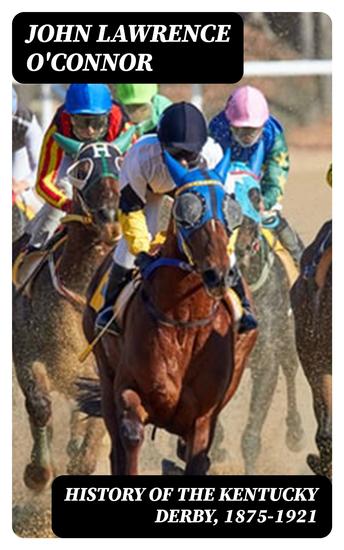
In "History of the Kentucky Derby, 1875-1921", John Lawrence O'Connor provides a meticulous account of the origins and evolution of one of America's most celebrated horse races. The narrative is woven with rich historical anecdotes, vibrant descriptions, and an analytical lens that captures the race's cultural significance. O'Connor employs a chronological approach to explore not only the derby's emergence but also the social and economic factors that influenced it, enriched by vivid illustrations and period photographs that enhance the reader's understanding of the era. This work stands as a significant contribution to both sports history and American cultural studies, reflecting on how the derby shaped and was shaped by its time. O'Connor, an esteemed historian and equestrian enthusiast, brings a profound understanding of both the sporting world and its impact on American society. His deep-seated passion for equestrian culture is evident in his comprehensive research and engaging prose. Drawing from a wealth of archival material, O'Connor's scholarly expertise ensures the text is both informative and captivating, appealing to both academics and casual readers alike. This book is a must-read for anyone fascinated by American history, sports culture, or the intricate interplay of social dynamics in the context of major events. "History of the Kentucky Derby, 1875-1921" not only chronicles the race itself but also encapsulates a pivotal chapter in America's narrative, making it an essential addition to historical and sports literature.
Verfügbar seit: 16.09.2022.
Drucklänge: 106 Seiten.

Weitere Bücher, die Sie mögen werden

  • Tides of Fortune - The Rise and Decline of Great Militaries - cover

    Tides of Fortune - The Rise and...

    Zack Cooper

    • 0
    • 0
    • 0
    An ambitious look at how the twentieth century's great powers devised their military strategies and what their implications mean for military competition between the United States and China 


    How will the United States and China evolve militarily in the years ahead? Many experts believe the answer to this question is largely unknowable. But Zack Cooper argues that the American and Chinese militaries are following a well-trodden path. For centuries, the world's most powerful militaries have adhered to a remarkably consistent pattern of behavior, determined largely by their leaders' perceptions of relative power shifts. By uncovering these trends, this book places the evolving military competition between the United States and China in historical context. 


    Drawing on a decade of research and on his experience at the White House and the Pentagon, Cooper outlines a novel explanation for how militaries change as they rise and decline. Tides of Fortune examines the paths of six great powers of the twentieth century, tracking how national leaders adjusted their defense objectives, strategies, and investments in response to perceived shifts in relative power. All these militaries followed a common pattern, and their experiences shed new light on both China's recent military modernization and America's potential responses.
    Zum Buch
  • The Wisdom of the Ancients - cover

    The Wisdom of the Ancients

    Francis Bacon

    • 0
    • 0
    • 0
    Bacon published this interesting little work in 1609. It contains thirty-one fables abounding with a union of deep thought and poetic beauty. In most fables he explains the common but erroneous supposition that knowledge and the conformity of the will, knowing and acting, are convertible terms.
    Zum Buch
  • Island Hopping across the Pacific Theater in World War II: The History of America’s Victorious Leapfrogging Strategy against Imperial Japan - cover

    Island Hopping across the...

    Editors Charles River

    • 0
    • 0
    • 0
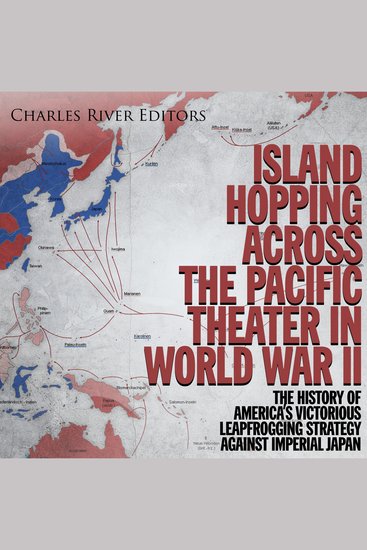
    The waters of the Pacific Ocean – stretching deep blue under the tropical sun, or scourged by typhoons – provided World War II's most far-flung battlefield. Two of the world's premier mid 20th century maritime powers, the United States of American and the Empire of Japan, grappled for supremacy across that vast expanse. 
    By the time the Battle of Midway was over in June 1942, the defeat was so devastating for Japan that it was actually kept secret from all but the highest echelons of the Japanese government. Along with the loss of hundreds of aircraft and over 3,000 men killed, the four Japanese aircraft carriers lost, when compared to America’s one lost carrier, was critical considering America’s huge shipbuilding superiority.  
    By the spring of 1943, American military planners had begun to create a plan to dislodge Japan from east and southeast Asia. To do so, parts of the Philippines were considered main strategic points in the potential Allied attack in the Pacific. The end goal of the Allied plan was an invasion of the Japanese home islands, in which heavy aerial bombardment would precede a ground assault. In order for this to occur, Allied forces would have to occupy areas surrounding Japan, with China adding to Luzon (the largest island in the Philippines) and Formosa (a large island off the coast of China) to create a triangle from which they could launch their bombers. 
    The Allied advance across the Pacific was based on this 1943 plan, with General MacArthur and his forces moving to the north through New Guinea, then Morotai Island, and then to Mindanao, which was the southernmost major island in the Philippines chain. At the same time, Admiral Chester Nimitz sent his fleet through the central Pacific, where they engaged Japanese forces at the Gilbert, Marshall, Marianas and Palau Islands en route to Mindanao.
    Zum Buch
  • Western Allies’ Procurement of Nazi Germany’s Technology The: The History of British and American Operations to Capture Nazi Scientists and Equipment - cover

    Western Allies’ Procurement of...

    Editors Charles River

    • 0
    • 0
    • 0
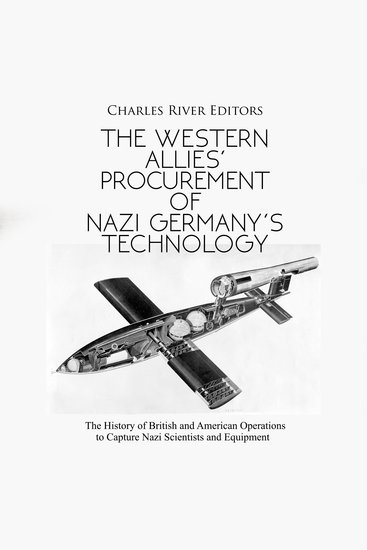
    After the last shots of World War II were fired and the process of rebuilding Germany and Europe began, the Western Allies and the Soviet Union each tried to obtain the services of the Third Reich's leading scientists, especially those involved in rocketry, missile technology, and aerospace research. Naturally, this was a delicate affair due to the fact many of the German scientists were not only active Nazis but had helped the Nazi war machine terrorize the world. At the same time, by the late war period, the Anglo-American Allies formed a clear picture of the Soviet state. Though forced to ally with the USSR's dictator, Josef Stalin, the West came to understand Communist Russia represented yet another hungry totalitarian power, and thus a very real threat to an independent Europe. British Prime Minister Winston Churchill realized the menacing character of the Soviets from the Katyn Forest Massacre of Polish army officers, if not before, while the Americans only gradually shed a naïve assumption of continued Russian friendliness after the war. 
    The result was the American-led “Operation Paperclip” on the Western side, which resulted in German scientists putting their expertise at the disposal of the U.S. and other NATO members. Operation Paperclip aimed not only to obtain the benefits of German scientific advances for the United States but also to deny them to the potentially hostile Soviets. 
    The Western approach, however self-interested, typically met with voluntary compliance on the German scientists' parts. In contrast, the Soviet answer to Paperclip, Operation Osoaviakhim, used the implied threat of imprisonment, torture, and death, the characteristic tools of Stalinist Russia, to coerce assistance from German scientists and engineers following the war. These men yielded rich dividends to the Soviet state in terms of achieving at least temporary technical parity with the USSR's western rivals.
    Zum Buch
  • African Americans in the Revolutionary War - cover

    African Americans in the...

    Lt. Col. (Ret.) Michael Lee Lanning

    • 0
    • 0
    • 0
    At first, neither George Washington nor the Continental Congress approved of enlisting African Americans in the new army. Nevertheless, Black men—both slave and free—filled the ranks and served in all of the early battles. Black sailors also saw action in every major naval battle of the Revolution, including members of John Paul Jones's crew aboard the Bonhomme Richard. At least thirteen Black Americans served in the newly formed US Marine Corps during the war. 


    Bravery among African Americans was commonplace, as recognized by their commanders and state governments, and their bravery is recorded here in the stories of citizen Crispus Attucks at the Boston Massacre; militiaman Price Esterbrook at Lexington Green; soldier Salem Poor at Bunker Hill; and marine John Martin aboard the brig Reprisal. 


    As interest in colonial history enjoys renewed popularity due to works like Hamilton, and the issues of prejudice and discrimination remain at the forefront of our times, African Americans in the Revolutionary War offers an invaluable perspective on a crucial topic that touches the lives of Americans of every color and background.
    Zum Buch
  • History of Marathas EP04 - Valourous acts at Panhala and Godkhind - cover

    History of Marathas EP04 -...

    Vikrant Pande

    • 0
    • 0
    • 0
    Shiva the barber was unperturbed. 'There is no point in showing your anger. Raje is gone. Flown away! I got a chance to wear his clothes and pretend to be him for an hour. What else do I need. This is my reward.'
    'Haramzaade!' Siddi shouted again and plunged his sword into Shiva's chest. Shiva's face contorted with pain and he stumbled back. He steadied himself for a bit, holding a pillar inside the tent. He could not afford to show his back to the enemy. Even when he was acting like Shivaji he had to be one!
    He said, raising his hand to his forehead as he said, 'Raje, ha maaza shevat cha muzra.' It was his last salute to Raje. Shiva collapsed the next moment, dead.
    
    When Shivaji has men like him, how could he not live up to their expectations
    Zum Buch