¡Acompáñanos a viajar por el mundo de los libros!
Añadir este libro a la estantería
Grey
Escribe un nuevo comentario Default profile 50px
Grey
Suscríbete para leer el libro completo o lee las primeras páginas gratis.
All characters reduced
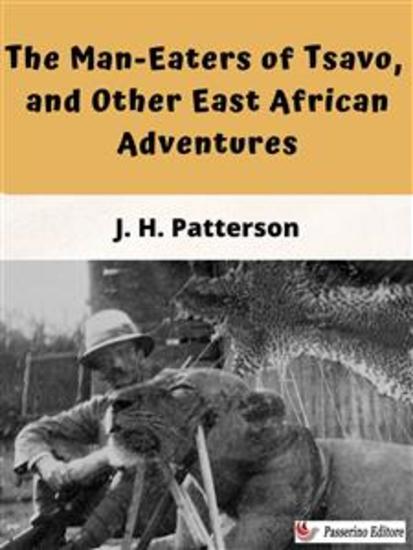
The Man-eaters of Tsavo - cover

The Man-eaters of Tsavo

John Henry Patterson

Editorial: Passerino

  • 0
  • 0
  • 0

Sinopsis

The Man-eaters of Tsavo is a semi-autobiographical book written by Anglo-Irish military officer and hunter John Henry Patterson. Published in 1907, it recounts his experiences in East Africa while supervising the construction of a railroad bridge over the Tsavo river in Kenya, in 1898. It is titled after a pair of man-eating lions that terrorized the undertaking for nine-months, until at last their reign of terror was put to an end by Patterson. His recounting of this incident projected him to fame, and it remains the subject of debate to this day. It has also been the basis of numerous films, the best known being The Ghost and the Darkness (1996), starring Val Kilmer and Michael Douglas.

Lieutenant-Colonel John Henry Patterson (10 November 1867 – 18 June 1947) was an Anglo-Irish military officer, hunter and author best known for his book The Man-eaters of Tsavo (1907), which details Patterson's experiences during the construction of a railway bridge over the Tsavo River in the East Africa Protectorate from 1898 to 1899. The book went on to inspire three films: Bwana Devil (1952), Killers of Kilimanjaro (1959) and The Ghost and the Darkness (1996). During World War I, Patterson served as the commander of the British Army's Jewish Legion, which has been described as the first precursor to the Israel Defense Forces.
Disponible desde: 16/09/2023.

Otros libros que te pueden interesar

  • Lieutenant General James Longstreet - Innovative Military Strategist: The Most Misunderstood Civil War General - cover

    Lieutenant General James...

    F. Gregory Toretta

    • 0
    • 0
    • 0
    Lieutenant-General James Longstreet, commander of the First Corps of the Army of Northern Virginia, was a brilliant tactician and strategist. Prior to the Civil War there were many technological developments, of which the rifled musket and cannon, rail transport, and the telegraph were a few. Longstreet adapted to these technological changes and the disparity between the belligerents making recommendations on how the war should be fought. Unfortunately, his advice was not heeded and given the weight it deserved. In contrast to many other southern generals, Longstreet advocated for defensive warfare, using entrenchments and trying to maneuver the enemy to assault his position, conserving manpower, resources, and supplies. 


    Longstreet was a pragmatic and methodical general and had his suggestions been utilized there would have been a better outcome for the South. Many historians and biographers have misunderstood Longstreet and his motives, not focusing on the total picture. This work offers a fresh and unique perspective on Lieutenant-General James Longstreet and the Civil War. This narrative takes a new viewpoint of the Civil War and the generals who tailored their designs to pursue the war, analyzes Longstreet's views of the generals and the tactics and strategy they employed, and examines why Longstreet proposed and urged a new type of warfare.
    Ver libro
  • Resurrection Lily - The BRCA Gene Hereditary Cancer & Lifesaving Whispers from the Grandmother I Never Knew - cover

    Resurrection Lily - The BRCA...

    Amy Byer Shainman

    • 0
    • 0
    • 0
    Resurrection Lily shares a story of inheritance and intuition, of what can surface in the body and the spirit when linked by DNA. As Amy Byer Shainman discovers she has inherited a BRCA gene mutation that puts her at high risk of developing certain cancers, she struggles to come to terms with preventively removing her breasts when she does not have a breast cancer diagnosis. Through her experience making decisions about her health, Amy becomes invigorated with purpose and establishes herself as a leading advocate for those with BRCA and other hereditary cancer syndromes, tirelessly working to educate others facing the same daunting reality. 
    Painting a timely and moving portrait of what it feels like to carry a BRCA gene mutation, Resurrection Lily provides firsthand insight into the patient experience. Weaved throughout Amy's open and vulnerable story is the expertise of her doctors, education from top medical experts in cancer genetics, and whispered lifesaving guidance from her grandmother Lillian.
    Ver libro
  • A Dialogue Among Clever People - From their pens to your ears genius in every story - cover

    A Dialogue Among Clever People -...

    Leo Tolstoy

    • 0
    • 0
    • 0
    Leo Tolstoy was born in 1828 in the Russian province of Tula to a wealthy noble family. As a child, he had private tutors but he showed little interest in any formal education. When he went to the University of Kazan in 1843 to study oriental languages and law, he left without completing his courses.  Life now was relaxed and idle but with some writing also taking place.  Gambling debts forced an abrupt change of path and he joined the army to fight in the Crimean War.  He was commended for his bravery and promoted but was appalled at the brutality and loss of life.  He recorded these and other earlier experiences in his diaries which formed the basis of several of his works. 
    In 1852 ‘Childhood’ was published to immediate success and was followed by ‘Boyhood’ and ‘Youth’. 
    His experience in the army and the horrors he witnessed resulted in ‘The Cossacks’ in 1862 and the trilogy ‘Sevastopol Tales’. After the war he travelled around Europe, visiting London and Paris and meeting such luminaries as Victor Hugo and Charles Darwin.  
    It was now that Tolstoy began his masterpiece, ‘War and Peace’. Published in 1869 it was an epic work that changed literature. He quickly followed this with ‘Anna Karenina’.  
    These successes made Tolstoy rich and helped him accomplish many of his dreams but also brought problems as he grappled with his faith and the lot of the oppressed poor. These revolutionary views became so popular that the authorities now kept him under surveillance.  
    He led a life of asceticism and vegetarianism and put his socialist ideals into practice by establishing numerous schools for the poor and food programmes. He also believed in giving away his wealth, which caused much discord with his wife.  
    His writing continued to bring forth classics such as ‘The Death of Ivan Ilyich’ and many brilliant and incisive short stories such as ‘How Much Land Does A Man Need’.  
    In 1901 Tolstoy was excommunicated from the Church and controversially deselected for the Nobel Prize for Literature. 
    Whilst undertaking a pilgrimage by train in October 1910 with his daughter Aleksandra he caught pneumonia in the nearby town of Astapovo.  Leo Tolstoy died on November 9th, 1910, he was 82.
    Ver libro
  • Notorious - Life with no parole for a crime I did not commit - cover

    Notorious - Life with no parole...

    Raphael Rowe

    • 0
    • 0
    • 0
    Some would call this an autobiography. Others would say it’s a hell of a story. I call it my life. Living it had become the norm, but choosing to write about it wasn’t easy. It’s one thing to react to whatever life throws at you, and another to reflect on it. I’ve been sentenced to life imprisonment, and confined to a prison within a prison, for a crime I did not commit. Being outspoken and relentless in fighting for justice had become my only choice, and as it turns out, my redemption.  My personal life, on the other hand, I have chosen to keep private. Until now.  
     
    For the first time ever, this book will walk you through my improbable personal journey with brutal honesty. The good, the bad and the ugly. My story, combined with an exceptional journey to the forefront of investigative journalism remains unparalleled.  As the host of the critically-acclaimed Netflix series ‘inside the World’s Toughest Prisons,’ I continue to do what no-one else has ever done before.  
     
    I am Raphael Rowe and my career was born as a result of spending 12 years in prison for crimes I did not commit. 
     
    All this has inspired me to try to make positive changes in prison systems throughout the world. I believe passionately that we can make such changes, and this is why I have set up the Raphael Rowe Foundation. Please join us @  https://raphaelrowefoundation.org/about-me/
    Ver libro
  • Barber Life - The Shop Hopper - cover

    Barber Life - The Shop Hopper

    Tyron Trotter

    • 0
    • 0
    • 0
    This book describes the author's journey as a barber and offers inspiration and insight to aspiring barbers and entrepreneurs. The story begins with him not being able to get a haircut to him later becoming a licensed barber. This is also a story of self-reflection and forewarning of what others who desire a successful business may encounter. The author gives a glimpse of the possible future for barber and barbershop owners while answering questions he was frequently asked: "Why do shops fail? How did barbering change him and why didn't he stay in one place?"
    Ver libro
  • "Get Beethoven!" - cover

    "Get Beethoven!"

    Paul Cassidy

    • 0
    • 0
    • 0
    A comic book character is born, the youngest of sixteen, into a war torn country. Facing extreme brutality at school and on the streets, not to mention the oppression of the Catholic Church, he finds music. Armed with a violin and a burning passion, he escapes the madness and sets off to pursue his dreams.
    "Get Beethoven!" is the inspirational story of Paul Cassidy's life. Overcoming adversity in his younger years, Paul recounts tragedy, joy, horror and humour. Informative and entertaining, the book charts his journey up to joining the Brodsky Quartet in 1982.
    Ver libro