Begleiten Sie uns auf eine literarische Weltreise!
Buch zum Bücherregal hinzufügen
Grey
Einen neuen Kommentar schreiben Default profile 50px
Grey
Jetzt das ganze Buch im Abo oder die ersten Seiten gratis lesen!
All characters reduced
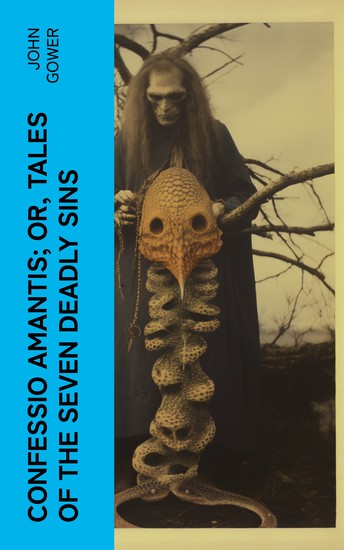
Confessio Amantis; Or Tales of the Seven Deadly Sins - cover

Confessio Amantis; Or Tales of the Seven Deadly Sins

John Gower

Verlag: e-artnow

  • 0
  • 0
  • 0

Beschreibung

Confessio Amantis or The Lover's Confession is a 33,000-line Middle-English poem by John Gower. The plot is based on the confession made by an aging lover to the chaplain of Venus. This confession works as a frame story for a collection of shorter narrative poems. As it is mentioned in the prologue, the work was composed on the commission of Richard II.
Verfügbar seit: 27.11.2023.
Drucklänge: 518 Seiten.

Weitere Bücher, die Sie mögen werden

  • Sirius the Star of the Maltese Temples - cover

    Sirius the Star of the Maltese...

    Lenie Reedijk

    • 0
    • 0
    • 0
    Sirius, the Star of the Maltese Temples invites the reader to look at the megalithic temples of Malta in an entirely new way. The discovery of the temples’ orientation to Sirius explains with mathematical precision the slight shift in the direction of their axes, caused by the movement of the stars called the Precession of the Equinoxes. The resultant astronomical dating of the temples to the Mesolithic, the period immediately after the last Ice Age, is far older than mainstream archaeology maintains and is on a par with other megalithic sites elsewhere, including Göbekli Tepe in Turkey. These findings turn on its head our conception of the accomplishments of ancient people. Instead of being just primitive cave-dwellers, they were primeval astronomers, whose interest in the sky has left us a legacy we never dreamt existed. 
    From the Foreword by Giovanni Bonello: “This is a disturbing book. The author defines its contents as controversial and its conclusions as surprising. I judge it to be far, but far, more than that. It is disruptive of accepted wisdom and unsettles all we believe we knew of the origin of man in Malta, of the sequences of early civilization and the histories of prehistory – not in Malta alone, but throughout the whole of Europe. I started reading it in awe, at first with a deliberate effort at disbelief. By the time I was approaching the climax of the exposition, I ended as mesmerized as I was perplexed.” 
    (Giovanni Bonello is a human rights lawyer and judge who served at the European Court of Human Rights for 12 years)
    Zum Buch
  • The Experiencer - Idealistic emergence God science and you - unified An idealistic theory of the world and a story about awakening - cover

    The Experiencer - Idealistic...

    Tom W. Ottmar

    • 0
    • 0
    • 0
    The author firmly believes that the philosophical standpoint of idealism provides the correct understanding of the world. Nothing material exists; all are conceptions in a single, universal consciousness. 
    Is it possible? Is it likely? 
    This book shows that it is, in fact, the most likely explanation of all. In a mental world, it is easy to connect the natural sciences with humanistic fields such as psychology, language, music, sociology, ethics, religion – and everything else. 
    Common laws govern them all. Poetry and weather can be explained by the fundamental mechanisms of emergence and complexity dynamics. Economy, trees, gossip, elementary particles and cosmological events all follow the same laws in their development. 
    What, then, is a human being? What are life and death? What is time? You get specific answers. 
    The author says that he has ”known” things all his life, but it took many years before the knowledge entirely broke through. The first part of the book is about this awakening. You get to know precisely how it happened and what is required for it to occur. 
    The book’s second part presents a complete theory of the world. It is idealistic (Plato, Descartes), i.e. based on the fact that thought and consciousness are fundamental, while all the material things we see around us are mental conceptions which are also experienced as qualia; something tangible, felt, material, physical. 
    This is a book like no other, and it not only sets the mind spinning but presents what may well be an accurate description of the universe in which we live. 
    At the same time, it goes deep into being human; what it is in essence, and also why we experience life’s pain, fear, longing, etc. – and how we can live more in harmony with our authentic self, which is something quite different from what most people think.
    Zum Buch
  • The Road - cover

    The Road

    Christopher Hadley

    • 0
    • 0
    • 0
    A TIMES BOOK OF THE YEAR 
    ‘An absolute joy to read and an early contender for every list of History Books of the Year’ Sunday Telegraph 
    ‘On nearly every page a random passage takes one’s breath away’ The Times 
    Have you ever heard the march of legions on a lonely country road?  
    For two thousand years, the roads the Romans built have determined the flow of ideas and folktales, where battles were fought and where pilgrims trod. Almost everyone in Britain lives close to a Roman road, if only we knew where to look. 
    In the beginning was Watling Street, the first road scored on the land when the invading Romans arrived on a cold and alien Kentish shore in 43 CE. Campaign roads rolled out to all points of the compass, forcing their way inland and as the Britons fell back, the roads pursued them relentlessly, carrying troops, supplies and military despatches. In the years of fighting that followed, as the legions pushed onwards across what is now England, into Wales and north into Scotland in search of booty, mineral wealth, land and tribute, they left behind a vast road network, linking marching camps and forts, changing the landscape, etching the story of the Roman advance into the face of the land, channelling our lives today. 
    Christopher Hadley, acclaimed author of Hollow Places, takes us on a lyrical journey into this past, retracing and searching for an elusive Roman road that sprang from one of the busiest road hubs in Roman Britain. His passage is not always easy. Time and nature have erased many clues; bridges rotted and whole woods grew across the route. Carters found an easier ford downstream, and people broke up its milestones to mend new paths. Year after year the heavy clay swallowed whole lengths of it; the once mighty road became a bridleway, an overgrown hollow-way, a parched mark in the soil. 
    Hadley leads us on a hunt to discover, in Hilaire Belloc’s phrase, ‘all that has arisen along the way’. Gathering traces of archaeology, history and landscape from poems, church walls, hag stones and cropmarks, oxlips, killing places, hauntings and immortals, and things buried too deep for archaeology, The Road is a mesmerising journey into two thousand years of history only now giving up its secrets. 
    In his latest work, The Road, Christopher Hadley delves into the historical and social aspects of Roman roads, enriching them with elements of mythology and folklore. His unique approach to historiography breathes new life into our understanding of past civilizations and their impact on our current geography. 
    For fans of Matthew Green (Shadowlands), Robert Macfarlane (Mountains of the Mind), Amy Jeffs (Storyland), Andrew Ziminski (Church Going), and Eleanor Parker (Winters in the World). 
    HarperCollins 2023
    Zum Buch
  • Environmental Justice - A Very Short Introduction - cover

    Environmental Justice - A Very...

    Pamela Hill

    • 0
    • 0
    • 0
    Environmental justice recognizes that environmental benefits and burdens should be distributed fairly, and that the people making policy decisions should incorporate the views of those most often harmed: people of color, Indigenous populations, low-income communities, and those who are underserved and disenfranchised for other reasons such as age, gender, or disability. It encompasses not only traditional environmental issues like clean air and clean water, but also social issues such as employment, nutrition, and access to health care. Although environmental justice is a relatively recent concept, it has become a focus of governmental environmental policy, UN actions, and the activities of many nongovernmental environmental organizations. Its development tracks our growing understanding of racism and wealth disparity in the United States and elsewhere, and of our understanding of inequality between the Global North and the Global South. In the era of climate change, climate justice is a particular focus.Environmental Justice: A Very Short Introduction defines the concept, identifies specific environmental justice populations, examines root causes, including racism, capitalism, and colonialism, and traces the history of the environmental justice movement and governmental responses to it. It concludes with suggestions for achieving this elusive goal.
    Zum Buch
  • Lesbians - Where are we now? - cover

    Lesbians - Where are we now?

    Julie Bindel

    • 0
    • 0
    • 0
    'Bracing, nourishing and wonderfully pro-woman'Victoria Smith, author of Hags
    'A big-hearted, infuriating, clever and highly entertaining read, just like the woman who wrote it' Kathleen Stock, author of Material Girls
    'Personal, passionate memoir-cum-cultural commentary' New Statesman
    'Excellent ... Discursive and engaging' Susanna Rustin, author of Sexed: A History of British Feminism
    What does it mean to be a lesbian now? Has the quest for lesbian liberation stalled, and if so, why?
    Part-memoir, part frontline reportage and part cultural commentary, Julie Bindel examines what defines lesbian culture, love, friendship and happiness today. She distinguishes the particular challenges facing lesbians from the very different experiences of gay men, and asks: why do lesbians so often seem to face particular hostility? Comparing past attitudes to today, she argues that lesbians continue to suffer from bigotry and discrimination because sexism and enforced gendered roles are still left unchallenged. She explores why many of the biggest assaults on lesbian freedom and wellbeing around the world now come, not just from conservatives, but also from so-called progressives, who are often antagonistic to lesbians organising and socialising autonomously.
    Rooted in her own remarkable story, this personal and passionate book is both an investigation into the obstacles to lesbian flourishing, and a testament to the particular delights of being a lesbian.
    Zum Buch
  • A Rare Recording of Otto Frank Father of Anne Frank - cover

    A Rare Recording of Otto Frank...

    Otto Frank

    • 0
    • 0
    • 0
    Otto Heinrich Frank (May 12, 1889 - August 19, 1980) was a German businessman, and the father of Anne Frank. He edited and published the first edition of her diary in 1947 (subsequently known in English as The Diary of a Young Girl) and advised on its later theatrical and cinematic adaptations. In the 1950s and the 1960s, he established European charities in his daughter's name and founded the trust which preserved his family's wartime hiding place, the Anne Frank House, in Amsterdam. The following first two audio clips are in English; the third is in Dutch.
    Zum Buch