Begleiten Sie uns auf eine literarische Weltreise!
Buch zum Bücherregal hinzufügen
Grey
Einen neuen Kommentar schreiben Default profile 50px
Grey
Jetzt das ganze Buch im Abo oder die ersten Seiten gratis lesen!
All characters reduced
Edinburgh Old Town - Journeys and Evocations - cover

Edinburgh Old Town - Journeys and Evocations

John Fee

Verlag: Luath Press

  • 0
  • 0
  • 0

Beschreibung

John Fee was a true storytelling artist, painting verbal pictures, setting off on digressions that turned out not to be digressions, moving effortlessly into a song or poem. He has uncovered little-known aspects of the Royal Mile along with long-forgotten characters who spring back to life through the storyteller's art.


Following on from the acclaimed Arthur's Seat and Calton Hill volumes, this third instalment in the Journeys and Evocations series focuses on the extensive history and folklore surrounding Edinburgh's atmospheric Old Town. Take a vivid trip with John Fee through Edinburgh's Old Town as you've never seen it before, with this wonderful blend of prose, poetry, photography and incredible stories from another era of one of Edinburgh's most renowned districts.


Two of the city's leading storytellers have sifted through the centuries to compile the remarkable guide to Edinburgh's famous landmark.EDINBURGH EVENING NEWS on Arthur's Seat: Journeys and Evocations

A fascinating spotlight on the Hill's unique position in centuries of Edinburgh life. EDINBURGH EVENING NEWS on Calton Hill: Journeys and Evocations
Verfügbar seit: 19.08.2024.
Drucklänge: 128 Seiten.

Weitere Bücher, die Sie mögen werden

  • Don't Scare Yourself to Death - 8 Practical Ways to Overcome Anxiety and Get More Creative - cover

    Don't Scare Yourself to Death -...

    Kim O'Leary

    • 0
    • 0
    • 0
    Break free from worry and stress to build a progressive and creative life. 
    You can do this. You don't have to rely on medications to overcome anxiety. 
    You can get there with simple changes to your mental attitude and lifestyle that won't cost you a thing. 
    This book is partly an autobiographical account of Kim's journey of life lessons learned in the Music industry and how a holistic lifestyle brought her health back. It also describes some practical solutions for fearless creativity. 
    Do you wish that your activities were more creative? 
    You were born creative. Find out ways to tap into your own talents. 
    Do you think you are not good enough or strong enough to change for the better? 
    We are stronger than we think. We just need practical methods to get there. 
    This book looks at the topics of self-esteem, food and addictions, finding your passion and discovering your sense of purpose. It also offers sleep advice, achievable exercise ideas and affordable diet tips.
    Zum Buch
  • Limitless Mind - Learn Lead and Live Without Barriers - cover

    Limitless Mind - Learn Lead and...

    Anonym

    • 0
    • 0
    • 0
    In this revolutionary book, a professor of education at Stanford University and acclaimed math educator who has spent decades studying the impact of beliefs and bias on education, reveals the six keys to unlocking learning potential, based on the latest scientific findings. 
    From the moment we enter school as children, we are made to feel as if our brains are fixed entities, capable of learning certain things and not others, influenced exclusively by genetics. This notion follows us into adulthood, where we tend to simply accept these established beliefs about our skillsets (i.e. that we don’t have “a math brain” or that we aren’t “the creative type”). These damaging—and as new science has revealed, false—assumptions have influenced all of us at some time, affecting our confidence and willingness to try new things and limiting our choices, and, ultimately, our futures.  
    Stanford University professor, bestselling author, and acclaimed educator Jo Boaler has spent decades studying the impact of beliefs and bias on education. In Limitless Mind, she explodes these myths and reveals the six keys to unlocking our boundless learning potential. Her research proves that those who achieve at the highest levels do not do so because of a genetic inclination toward any one skill but because of the keys that she reveals in the book. Our brains are not “fixed,” but entirely capable of change, growth, adaptability, and rewiring. Want to be fluent in mathematics? Learn a foreign language? Play the guitar? Write a book? The truth is not only that anyone at any age can learn anything, but the act of learning itself fundamentally changes who we are, and as Boaler argues so elegantly in the pages of this book, what we go on to achieve.
    Zum Buch
  • Elixir for Excellence - Systematic Approach to Excel in Studies - cover

    Elixir for Excellence -...

    Robin Mathew

    • 0
    • 0
    • 0
    Importance of the Book 
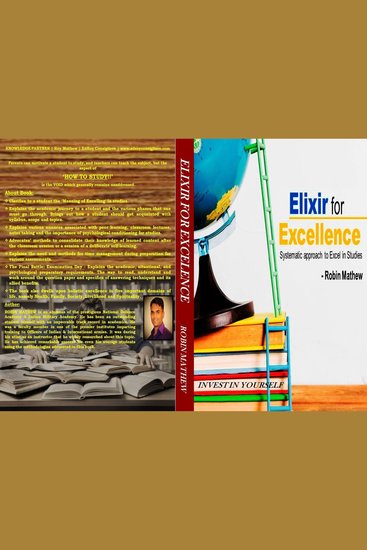
    1.        Education has become a determining factor for everyone to scale up the ladder of success. Therefore everyone has an inherent desire to do well or rather excel in studies. Students involved with studies as well as their parents, teachers and other well-wishers will want a student to excel in studies. However, only a few students excel in studies, whereas the majority perform average or even poor. Elders and peers can motivate a student and the teachers can teach the subject content. Still, the mechanics of "How to study" is the gap that most students cannot bridge. The students who understand the mechanics of how to study are the ones who constantly excel in their studies. This book will bring out the finer details about the mechanics of "How to Study". The systematic method to excel in studies advocated in this book will cover all the aspects right from the beginning when the student gets to know that he is affected for a course until the final day of the final examinations. 
     Who should buy this book? 
     2.        This book will be immensely valuable for students with a basic developed understanding capability, i.e. the age group starting twelve years of age. It will serve well even the students enrolling for professional courses or even competitive examinations. The parents of young students who want their kids to excel in studies will also be hugely benefitted from this book. Apart from them, the teachers at various academic institutions would also find this book insightful and quite helpful in training their students in the art of systematic learning methodologies.  
     
    Zum Buch
  • Leading Maths - The essential guide for new and aspiring maths leaders - cover

    Leading Maths - The essential...

    Peter Mattock

    • 0
    • 0
    • 0
    Leading maths at any school is a unique challenge and comes with pressures not experienced in many other subject areas. The relatively abstract nature of the subject content, combined with the contrasting societal and parental attitudes to mathematics, can complicate communication and stifle progress. Most pupils and parents will recognise the importance of maths but many feel it's perfectly acceptable to be "no good" at it. Leading maths in schools is about managing these contradictions and getting the very best out of every teacher and pupil.
    Offering a fresh perspective and practical strategies for maths teachers and leaders at any level, Leading Mathsexplores how to make the most of a maths leadership role and manage the daily pressures and demands that come with it. Backed up by specific examples from fifteen years of experience leading maths, Peter Mattock goes on to examine the more long-term, strategic view of maths leadership, including how leaders can work with their teams to develop high quality mathematics teaching and learning for all pupils.
    The book covers day-to-day issues that arise when leading maths, in particular results and accountability, as well as difficult situations more generally. It offers useful takeaways at the end of each chapter, with a summary of key points and advice from the chapter. Leading Maths explores how to manage an inspection, developing improvement plans and the appraisal process, before touching on taking maths leadership beyond one specific school and into system leadership.
    In addition to Peter's insight, Leading Maths also contains contributions from other experienced maths practitioners, including Becky Lawrence, Jemma Sherwood, Rhiannon Rainbow and Dave Tushingham. Becky examines some of the specific approaches to leading primary maths, whilst Jemma does the same from her perspective as a maths lead across a large multi-academy trust. Rhiannon and Dave then go on to discuss how to manage significant change from their experience of adapting curriculum and CPD during the COVID pandemic - including the beginnings of their (now famous) book club.
    An essential guide for current, new, or aspiring maths leaders.
     
    Zum Buch
  • The Venlo Sting - MI6's Deadly Fiasco - cover

    The Venlo Sting - MI6's Deadly...

    Norman Ridley

    • 0
    • 0
    • 0
    "I would recommend the book to intelligence practitioners, scholars, and other persons interested in World War II intelligence history." —Michael Nady, American Intelligence JournalOn 9 November 1939, two unsuspecting British agents of the Special Intelligence Services walked into a trap set by German Spymaster Reinhard Heydrich. Believing that they were meeting a dissident German general for talks about helping German military opposition to bring down Hitler and end the war, they were instead taken captive in the Dutch village of Venlo and whisked away to Germany for interrogation by the Gestapo. The incident was a huge embarrassment for the Dutch government and provided the Germans with significant intelligence about SIS operations throughout Europe.  The incident itself was an intelligence catastrophe but it also acts as a prism through which a number of other important narrative strands pass. Fundamental to the subterfuge perpetrated at Venlo were unsubstantiated but insistent rumours of high-ranking German generals plotting to overthrow the Nazi regime from within. After the humiliation suffered when Hitler tore up the Munich Agreement, British Prime Minister Neville Chamberlain was anxious to see just how much truth there was in these stories; keen to rehabilitate his reputation through one last effort to find a peaceful rapprochement with Germany.  When Franz Fischer, a small-time petty crook and agent provocateur, persuaded British SIS operatives in the Netherlands that he could act as a go-between for the British government with disaffected German generals, the German Security chief Reinhard Heydrich stepped in and quietly took control of the operation. Heydrich’s boss, head of the Gestapo Heinrich Himmler, was anxious to explore the possibility of peace negotiations with Britain and saw an opportunity to exploit the situation for his personal benefit.  On the day before a crucial meeting of conspirators and British agents on the Dutch-German border, a bomb exploded in the Bürgerbräukeller in Munich in the exact spot where Hitler had stood to deliver a speech only minutes earlier. The perpetrator was quickly arrested, and Hitler demanded that Himmler find evidence to show that the two events were intimately connected—the British agents were snatched hours later.  While the world was coming to terms with the fearsome power of German military might the British intelligence capability in northern Europe was consigned to the dustbin in the sleepy Dutch town of Venlo. This first full account of the Venlo incident explores the wider context of this German intelligence coup, and its consequences.
    Zum Buch
  • Agency and Cognitive Development - cover

    Agency and Cognitive Development

    Michael Tomasello

    • 0
    • 0
    • 0
    Children of different ages live in different worlds. This is partly due to learning: as children learn more and more about the world they experience it in different ways. But learning cannot be the whole story or else children could learn anything at any age—which they cannot. 


    Michael Tomasello argues that children of different ages live and learn in different worlds because their capacities to cognitively represent and operate on their experience change in significant ways over the first years of life. These capacities change because they are elements in a maturing cognitive architecture evolved for agentive decision making and action, including in shared agencies in which individuals must mentally coordinate with others. The developmental proposal is that from birth infants are goal-directed agents who cognitively represent and learn about actualities; at 9-12 months toddlers become intentional (and joint) agents who also imaginatively and perspectively represent and learn about possibilities; and at 3-4 years children become metacognitive (and collective) agents who also metacognitively represent and learn about objective/normative necessities. These developing agentive architectures—originally evolved in humans' evolutionary ancestors for particular types of decision making and action—help to explain why children learn what they do when they do.
    Zum Buch